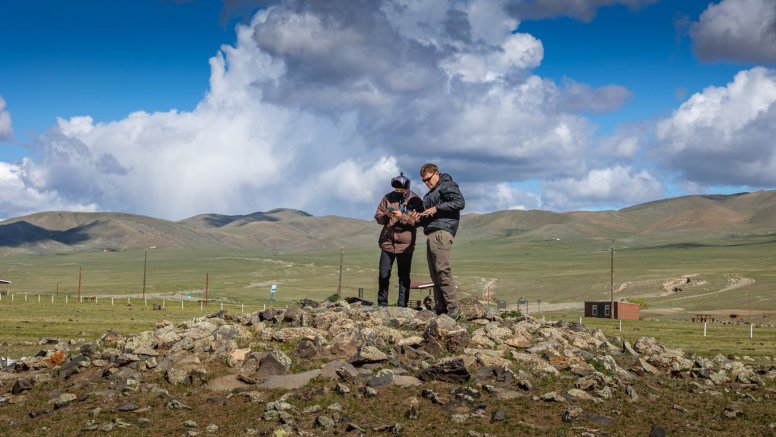
For decades, Mongolian archaeology has focused much of its efforts on the study of large funerary monuments. However, very little is still known about the places where the communities lived that built these monuments and developed one of the most characteristic ways of life in Eurasia: nomadic pastoralism.
Answering these questions is the objective of the NOMADBONES project, led by the Institute of Natural Products and Agrobiology (IPNA-CSIC). Its first archaeological campaign, carried out in the province of Bulgan, in central Mongolia, has allowed the excavation of two Bronze Age settlements, the documentation of 220 new archaeological records, the recording of nearly 150 rock art panels, and the obtaining of two paleoenvironmental archives that will allow the reconstruction of the evolution of the landscape and pastoralism over the last 3,000 years.
Natalia Égüez, a researcher at IPNA-CSIC and director of the project, points out that NOMADBONES aims to "understand what the spaces where these communities lived were like, how they organized their camps, how they managed their animals, and how they responded to the environmental changes that the steppe experienced during the Bronze Age."
The settlements, a key piece
One of the main objectives of the expedition was to locate and study domestic settlements, a type of site exceptionally scarce in Mongolia compared to large funerary complexes.
The first phase of the campaign consisted of a systematic archaeological survey of approximately 3.4 square kilometers, carried out through ground surveys and centimeter-precision differential GPS. As a result, the team documented 220 new archaeological records, including stone monuments, funerary structures, and surface material concentrations, significantly expanding the knowledge of a region until now very little studied.
This new data will allow for a more precise reconstruction of the distribution of settlements, ritual areas, and occupation patterns of the territory by pastoral communities during the Bronze Age.
During the campaign, nearly 150 rock art panels were also recorded. Furthermore, for the first time, the project incorporated a drone equipped with a thermal camera, a technology that facilitated the detection of archaeological structures and terrain variations difficult to identify through conventional observation.
Exceptionally preserved remains
Excavations carried out in two of the settlements made it possible to recover abundant archaeological remains in an extraordinary state of preservation, including hearths, pottery, lithic industry, faunal remains, several complete horse skulls, and coprolites (fossilized or dried animal excrement).
This set of materials will allow for the investigation of livestock practices, animal feeding, and environmental conditions through high-resolution biomolecular and geoarchaeological analyses.
Reconstructing three millennia of environmental changes
The expedition carried out two paleolacustrine soundings in ancient lakes in the region. The sediments preserved in these natural archives record thousands of years of environmental changes and will allow for the reconstruction of the evolution of vegetation, climate, and hydrological conditions in the Mongolian steppe.
In parallel, the team collected numerous samples of archaeological and environmental sediments that will be analyzed in collaborating laboratories. The analyses will combine biomolecular, geochemical, and geoarchaeological techniques to reconstruct the relationships between human communities, their animals, and the environment.
International science
In addition to research staff from IPNA-CSIC, the project brings together specialists from the Mongolian Academy of Sciences, Western Kentucky University (WKU), the University of Oulu, the University of La Laguna and the Milà i Fontanals Institution for Research in Humanities (IMF-CSIC). The expedition also had the collaboration of the geologist David Martín Freire (IGME-CSIC), a specialist in stone heritage, who is participating in the geological study of rock art and in the analysis of the alteration and conservation processes of these sites.
The fieldwork was carried out in coordination with the Mongolian Pastoralist Archaeologies Project, led by WKU, and also served as an international school. Students of six nationalities participated in the excavations and surveys, where they received training in advanced methodologies in archaeology, geoarchaeology, and digital documentation.
The materials and samples obtained during this first campaign will constitute the basis of the archaeological, biomolecular, and paleoenvironmental analyses that the team will develop in the coming years. Their results will contribute to understanding how the first pastoral societies of Mongolia evolved and how they adapted their subsistence strategies to the environmental transformations of the Eurasian steppe.
The NOMADBONES project. Bronze Age nomads and bones: unveiling human-environmental dynamics and pastoral strategies in the Bronze Age in Mongolia is financed by the Ministry of Science, Innovation and Universities, the State Research Agency and the European Social Fund Plus (ESF+). The 2026 archaeological campaign also had the support of the Palarq Foundation, whose backing has contributed to the development of the fieldwork.
Add La Voz de Lanzarote as a preferred Google source.
Stay informed with the latest current news.