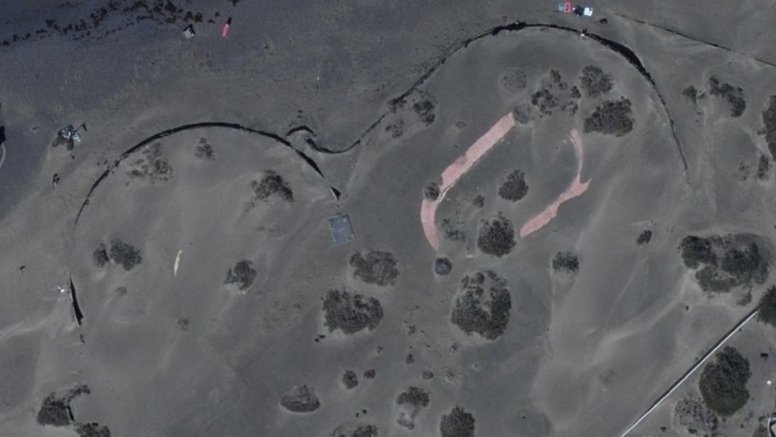
Crumbling blocks and sidewalks built on a vulnerable space like the Famara dunes can still be seen on a walk through the El Papelillo area, also known as El Perejil.
The Directorate General of the Coast and the Sea, dependent on the Ministry for Ecological Transition, has notified the Cabildo of Lanzarote that it will demolish and remove "all artificial elements" from an abandoned development located on public maritime-terrestrial domain land in Famara.
Sixty years ago, an unprecedented urban development project was planned on the Famara beach in Lanzarote. It was the sixties, the tourist model had begun to be promoted in Lanzarote, and a Canarian developer launched the Playa de Famara development, which aimed to be the largest tourist project ever undertaken on the island and one of the largest in the Canary Islands. This private initiative sought to build around a thousand chalets on the dunes and next to one of Lanzarote's most special natural areas.
In 1968, work had already begun to build the central avenue, which aimed to bring vehicle traffic to this area. Some crumbling walls and even some paths can be seen in the area. According to the press of the time, this development planned to occupy around 538,000 square meters and included, in addition to the chalets, a hotel, six large residences, fourteen apartment buildings, and services.
The following year, in 1969, construction work on the Norwegian bungalows in Famara, a foreign investment project, had also begun, and two other tourist projects, Laderas de la Playa de Famara and Caleta de Famara, were on the table.
Finally, the Playa de Famara tourist development was not fully executed, and in the eighties, already in democracy, movements began to declare this area a protected natural space. In addition, Lanzarote's Insular Territorial Planning Plan declassified this land, changing it from developable land to non-developable rustic land.
Despite the property owner's attempts to overturn this decision, the Superior Court of Justice of the Canary Islands upheld the PIOT and ordered Canarias to compensate the property owner for the reclassified land.
Sixty years after road construction work began, last November, in the same communication where Costas reported on the removal of the El Golfo staircase, the General Directorate informed the Cabildo of Lanzarote that it would remove the constructions that are abandoned and deteriorated within the lands under its jurisdiction in Famara.
This abandoned construction has not only affected the natural flow of the dunes, but has also caused animal species to fall into the sewers.
Costas states that this construction "hinders the normal development" of the natural dune area and contributes to its degradation. In the aforementioned intervention, it pointed out that "all artificial elements would be removed, restoring the land to its natural state".
Add La Voz de Lanzarote as a preferred Google source.
Stay informed with the latest current news.