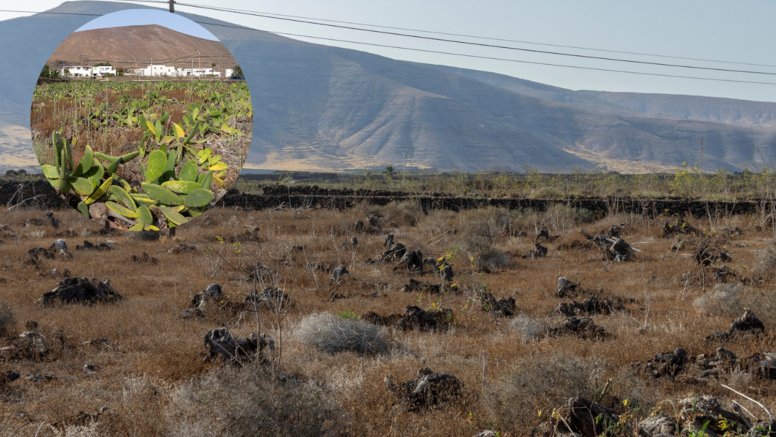
Since the prickly pear cactus arrived in Lanzarote around 1835, this cactus quickly became one of the island's economic drivers thanks to the natural dye extracted from cochineal, an insect that feeds on this species but does not harm it. However, the arrival of the Mexican cochineal plague (Dactylopius opuntiae) in 2019 in the Canary Islands has caused havoc in the prickly pear fields of Mala and Guatiza, where the landscape is inconceivable without this characteristic cactus.
Such is the severity of this plague that currently 95% of the prickly pear fields in this area of Lanzarote have disappeared. As explained by Juan Cazorla, a biologist and member of the Milana Cultural, Social, Heritage, and Agricultural Association, "for years the cultivation of the prickly pear cactus had already been very neglected, and this bad cochineal appeared, which absorbs all the nutrients from the prickly pear cactus, potentially transferring some bacteria, which ends up rotting the plant."
It was around 2019 and 2020 when the Mexican cochineal arrived in this region of Lanzarote and the first insects were seen. The arrival of the pandemic and the previous abandonment of the fields led to this plague spreading uncontrollably through Guatiza and Mala, as well as other areas of the island.
The Milana Association is observing the behavior of some prickly pear cacti that are trying to resist this plague "to see if we can obtain a more resistant variety from them." In fact, the Indian prickly pear (Opuntia ficus-indica), whose fruits are highly sought after for jams, liqueurs, or as fresh fruit, is resistant to the Mexican cochineal. "We have observed that if you place the cochineal next to it, it does not infect it, perhaps because its pads are harder or have fewer nutrients that benefit the cochineal," points out the biologist.
Thus, in the search for other varieties of prickly pear cacti, different conditions are being taken into account such as soil, location, or leaf structure to try to reproduce this cactus. However, the prickly pear fields of Mala and Guatiza are dying due to the presence of this plague, which has led to the near disappearance of this cactus in the north of the island.
Only 5% of prickly pear fields survive
According to Cazorla, only 5% of the prickly pear fields that existed in Mala and Guatiza remain. "There are some colleagues who are trying to maintain some prickly pear plants and are practically on top of them every week with different treatments to control the cochineal, but out of the 200 hectares we had, now not even one hectare is left because we have lost practically everything," he reveals. And it is that almost all of these hectares were dedicated to the production of traditional cochineal.
Regarding the treatments used to combat this pest, they include diatomaceous earth (natural powder formed by fossilized remains of microalgae), ash, sulfur, or potassium soap, which "eliminates some of the cochineal." Despite this, none of the treatments are one hundred percent effective against the Mexican cochineal, because unlike the good cochineal, it has a lot of hair covering it, which repels water and does not allow it to penetrate the insect.
"What I always recommend is that you have to be on top of it, at least once a week, either with high-pressure water or by cleaning the pads with a brush wherever they appear," indicates Juan Cazorla, who emphasizes that currently the prickly pear plants should be "better cared for because before we had them there and they grew as they pleased, but now they must be well pruned and clean."
Furthermore, this cleaning should not only be done on their pads, but also on the ground, as the Mexican cochineal takes refuge in the remains of the prickly pear plants "which can last for months and months."
Recovering the landscape
Because the prickly pear plants are on private land, "an action would have to be taken with the objective of recovering the landscape," says the expert, who indicates that "the solution from the Cabildo of Lanzarote and the town councils would have to be with the commitment that this landscape would continue to be maintained afterwards because we cannot have crews every month for years because it involves public money."
Furthermore, Cazorla emphasizes that it is impossible to ensure a good future for the commonly called good cochineal, the one used as a natural dye. "We cannot guarantee that the cochineal will sell well, nor the fruit. It is a bit complicated because it would be each one on their own trying to find a remedy," he says.
This critical situation is causing other more profitable or pest-free crops to displace the prickly pear cactus, such as the vine or aloe vera. "One could start changing to the Indian prickly pear to also obtain the fruits, but unfortunately, the landscape of Mala and Guatiza is practically all lost," laments the expert.
Looking ahead and to a possible recovery of this characteristic landscape of this area, Cazorla points out that "we would have to leave years without cultivating the prickly pear for the cochineal to disappear as well, and then see how we recover the traditional cochineal."
For its part, at the Experimental Agricultural Farm of the Cabildo de Lanzarote, tests are being carried out with different varieties of prickly pear cacti to check how the cochineal behaves in each of them. "They are cultivated on the farm and they are testing different types of treatments," he explains.
About 40,000 kilos of dried cochineal stored
The disappearance of the prickly pear cacti is seriously endangering the production of traditional cochineal. However, currently there is a large quantity of this product stored that "has not been sold as much."
"The accumulated dried cochineal that we have in the region of Mala and Guatiza is estimated between 30,000 and 40,000 kilos, but it has not been sold to large industries due to the high price we have here, although it is being sold to a buyer from Gran Canaria in small quantities," he declares.
Because of this, less and less cochineal is being stored, but for workshops and craft activities, there is "quite a bit" left. Furthermore, it should be remembered that it is a very concentrated dye that, with very little quantity, goes a long way. On a small scale, the biologist explains, "it would last for years."
Add La Voz de Lanzarote as a preferred Google source.
Stay informed with the latest current news.