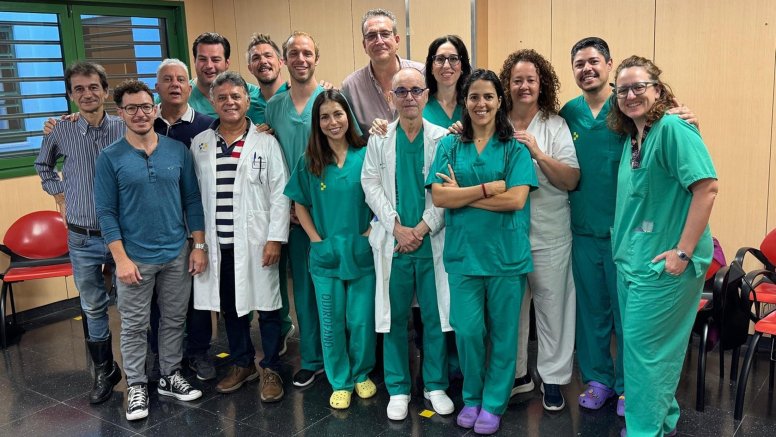
A total of 165 patients have undergone robotic surgery in the first year since the surgical robot at the Doctor José Molina Orosa University Hospital, a center affiliated with the Ministry of Health of the Government of the Canary Islands, was launched. The Lanzarote hospital thus strengthens a technology that began in September 2025 under the leadership of the General Surgery and Digestive System service and to which the Urology service has been added after the accreditation of its specialists in May of this year.
The arrival of the surgical robot represented a technological leap for the Molina Orosa and opened the door to new high-precision surgical procedures in Lanzarote. In these first twelve months, the team has progressively incorporated interventions and consolidated a way of working that combines the experience of professionals with the possibilities offered by robotic surgery.
For the head of the Surgery service at Molina Orosa, Juan de Diego, this first year of operation allows for a "very positive" assessment of the incorporation of the Davinci Robot. "Having exceeded 150 interventions in twelve months shows that the team has successfully integrated robotic surgery into the hospital's surgical activity. It is a technology that provides greater precision in interventions with a minimally invasive approach, which leads to a reduction in complications and faster patient recovery."
The latest advance in this regard has been the incorporation of the Urology service, whose specialists have performed more than 20 robotic interventions since May, mainly radical prostatectomies in patients with localized prostate cancer. A procedure in which the advantages of robotic surgery are especially relevant due to the precision and maneuverability, allowing work on very delicate anatomical structures.
The head of the Urology service, Javier Rábade Rey, highlights that "the entry of Urology represents an important step because it expands the possibilities of the program and allows us to apply this technology to especially complex procedures. In the case of prostate cancer surgery, because it favors better preservation of tissues related to urinary continence and sexual function, which are determining factors for functional recovery and patient quality of life."
A growing surgical activity that adds new techniques
The consolidation of robotic surgery coincides with the growth experienced in the overall surgical activity of Molina Orosa. During the first half of this year, 6,432 interventions were performed, compared to 5,805 registered in the same period of 2023, representing an increase of 10.8%.
The increase in activity is accompanied by the incorporation of new techniques and procedures in different specialties, as part of a modernization process of the center's surgical activity.
The Surgery service currently has 15 specialists, two more than in 2023. The nursing team has also been expanded with six professionals and currently has 40 nurses and 14 auxiliary nursing care technicians.
The growth is also reflected in different specialties. General and Digestive Surgery went from 1,242 interventions in the first half of 2023 to 1,399 in the same period of 2026; Urology increased from 410 to 515 interventions, while Ophthalmology went from 1,124 to 1,638. Otorhinolaryngology, Gynecology, Obstetrics, Angiology and Vascular Surgery, and the Pain unit also registered increases.
It should be noted that during 2025 the hospital reached 13,047 surgical interventions, a historic figure that reflects the volume of activity in the operating rooms of Molina Orosa and the evolution of surgical services that continuously incorporate less invasive techniques and advanced technologies.
A year of evolution in robotic surgery
The program began on September 24, 2025, when professionals from General and Digestive System Surgery performed the first interventions. The launch of the program was possible thanks to the previous work of the surgical teams and a process of training and adaptation to a technology that requires high specialization.
The system allows the surgeon to control instruments installed on robotic arms from a console, with a three-dimensional and magnified view of the surgical field. The digital processing of movements also allows filtering physiological tremor and performing highly precise movements.
The manager of the Lanzarote Health Services, Pablo Eguia, assures that the incorporation of the Da Vinci surgical robot, with an investment of 1.7 million euros, allows progress in the application of robotic surgery to other specialties and expands the portfolio of procedures. It also responds to the center's modernization and technological updating process, which allows Lanzarote patients to access these advanced interventions without needing to travel off the island.
Add La Voz de Lanzarote as a preferred Google source.
Stay informed with the latest current news.