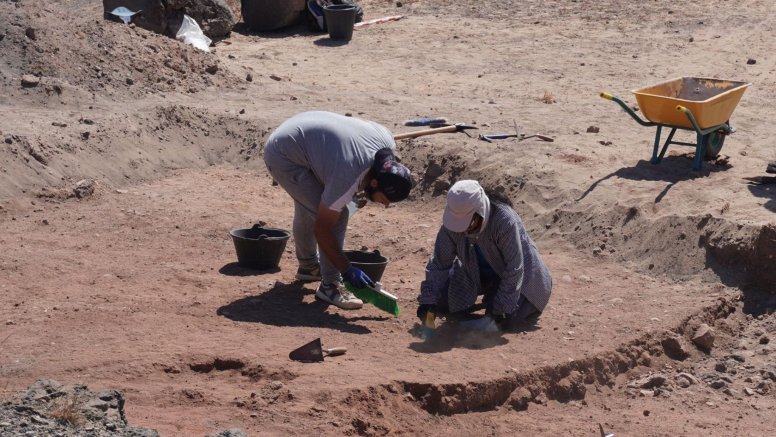
After a month of fieldwork at the San Marcial de Rubicón site (Yaiza), the multidisciplinary team of the ‘Rubicón Project’ has completed the seventh archaeological excavation campaign. Interventions in three different areas of the site have allowed the location of three new hydraulic structures in the ravine, a lime kiln, and pavements linked to the urban organization of this first European settlement in the Canary Islands during the 15th century.
As part of the cooperation agreement between the Government of the Canary Islands, the Yaiza City Council, the University of Las Palmas de Gran Canaria (ULPGC), and the University of La Laguna (ULL), this year's campaign has focused on redefining the enclave and not reopening previously intervened areas to expand the search for new hidden spaces, according to anomalies detected in recent ground-penetrating radar geophysical studies.
The Director General of Culture and Cultural Heritage, Miguel Ángel Clavijo; and the Councilor for Heritage of the Yaiza City Council, Silvia Santana, among other members of the Government of the Canary Islands and the municipal corporation, visited the archaeological site along with María del Cristo González, Esther Chávez, Nona Perera, Luis Alejandro García, and Miguel Ángel Hervás, as co-directors of the research, to learn firsthand about the latest developments of the ‘Rubicón Project’.
Clavijo highlighted the richness of this enclave, stating that “in San Marcial del Rubicón, we are fortunate to have written sources and, at the same time, an extraordinary excavation project that has already reached its seventh campaign.” In this way, “it allows us to rigorously certify what the historical chronicles relate and, on the other hand, it helps us to discover and understand the spaces that these communities occupied to live and prosper in a particularly complex environment, marked by water scarcity,” he anticipates.
“As always, San Marcial del Rubicón never ceases to surprise us,” assures Santana. The new findings have been possible thanks to close institutional cooperation and, moreover, this year, “the research team requested support with heavy machinery to facilitate the work, and the city council managed it quickly,” explains the councilor. Now, with the machinery already operating on the ground to clear the area, “we are confident that this campaign will once again yield great results,” she emphasizes.
New Findings
One of the main focuses of this intervention has been centered on the Barranco de Los Pozos. As archaeologist Chávez points out, "our objective has been to locate a series of hydraulic structures that, through oral sources, written sources, press news, and administrative documentation, specify the existence of more wells in this area." In this regard, "two new wells and a third structure that is also related to the use of water" have been found, she clarifies.
Likewise, "by expanding the intervention area, a lime storehouse linked to one of the first lime kilns on the island, which was excavated in previous campaigns, has also been located, allowing us to learn more about the daily life of this settlement," explains Chávez.
Furthermore, the third area intervened during this campaign has been "a kind of square that could provide access to the church," maintains the ULL professor, "where a series of cuts in the basalt geological level of the area and rammed earth pavements linked to the use made of this space have appeared."
During the excavations in these different areas, a large number of materials of diverse typology have been recovered, among which stand out human and animal bone remains, malacofauna, ceramic remains, and metal pieces such as coins or clothing pins, among other elements.
After the completion of the fieldwork of this seventh campaign, the 'Rubicón Project' continues with laboratory work. Over the next few weeks, the recovered remains will be transferred to the Canarian public universities for their corresponding study. These scientific analyses will be fundamental to more precisely determine the scope of the located structures and continue to deepen the knowledge of the place where the conquest of the Canary Islands began.
Add La Voz de Lanzarote as a preferred Google source.
Stay informed with the latest current news.