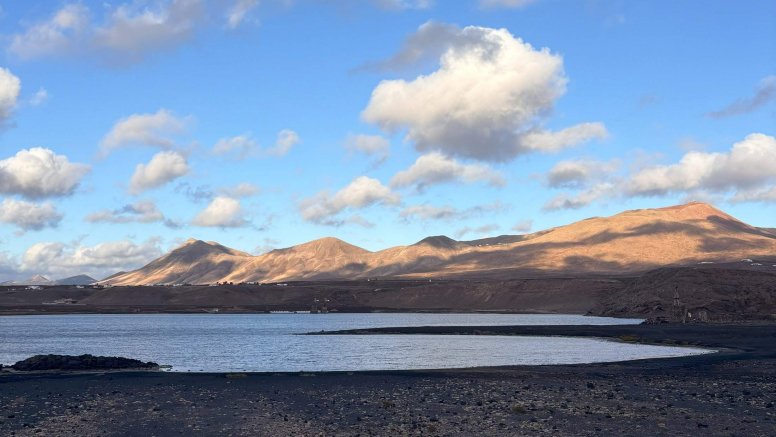
Lanzarote has an extraordinary biodiversity throughout its orography. Specifically, 3,700 endemic species of terrestrial fauna and flora and 816 marine species have been identified. One of the natural spaces that harbors much of this biodiversity is the Janubio lagoon, an ecosystem declared a protected natural space and considered a site of scientific interest by the Government of the Canary Islands.
The lagoon was created as a result of the volcanic eruptions that led to a natural separation between the sea and the lagoon itself, but which allows water to filter underground. The lagoon has a circumference of approximately 1,000 meters and an average depth of three meters.
In addition, this space is a key place for the nesting and laying of a wide variety of aquatic birds, so it is within the network of special protection areas for birds (SPA).
Seventy species of migratory birds
This distinction is due to the 70 species of migratory birds that pass through the place, either to nest, rest or feed. The proximity to Africa and the geographical location of Lanzarote means that birds migrate from Europe and Asia to the African continent. It also concentrates a great variety of microorganisms.
This refuge attracts biologists and ornithologists, either to observe or investigate the different species that we can find, with the beginning of spring and the end of summer being the best times for sighting. Among the birds are flamingos, as La Voz published, ruddy turnstones, sandpipers, plovers, the Eurasian skylark or the common stilt. The latter uses the lagoon as a home for nesting.
"The greatest importance of the lagoon is due to the variety of bird species, many of them spend the whole year in that area, but many others winter in Lanzarote and spend those months in the Salinas de Janubio," explains biologist Alberto Ucero. Some of these birds are protected, as they have protection categories as they are vulnerable and in danger of extinction.
To protect the area from the passage of tourists and locals, part of the lagoon is surrounded by a rope, although according to Ucero, "the right part of the lagoon where many birds nest has no delimitation, so you see tourists and residents who access where these species are or go with dogs that enter the same pond and the birds fly away." This includes some informative posters about the importance of the place.
However, the biologist emphasizes the need to "include more signage that acts as a deterrent, such as no entry, so as not to disturb the birds."
Other places of environmental importance
Apart from the Janubio lagoon, in Lanzarote there are several other areas that are important for the island's fauna and flora. Two of them are the La Santa lagoon and the coastal area of the Islote del Francés area.
In the case of La Santa, "it is an area where water accumulates and pools are created, where there are shorebirds and a very important area of flora," says the biologist. Here the marshes are created with species such as the glasswort (Arthrocnemum macrostachyum), the perennial glasswort (Sarcocornia perennis) or the common shrubby seablite (Tetraena fontanesii).
On the other hand, the salt flats represent an ideal refuge for birds, so the abandoned salt flats of the Famara cliff are, in the same way as the previous places, a place of special interest and protection.
In addition, the Timanfaya National Park and the Famara cliff are also two important areas with regard to biodiversity, both in fauna and flora. In the case of the cliff, we can find several flora endemisms exclusive to Lanzarote. According to Alberto Ucero, "the coastal area of Timanfaya is a very important area for seabirds, as they are nesting areas and birds of prey such as ravens, which are in danger of extinction, inhabit it."
"Activities such as rallies degrade the habitat of protected species"
These spaces are often threatened by human action. The geographical characteristics of Lanzarote mean that the island has a limit, which forces residents and visitors to coexist respectfully with ecosystems, some of them very sensitive. The Isla de los Volcanes Rally is one of the activities that raises the most blisters, as it is held around the Jable de Soo and La Santa-Soo-Tinajo section.
This area is inhabited by steppe birds, species in danger of extinction, and corresponds to a natural habitat of community interest with a population of star onion, a species of flora. Due to this, from 2022 it was eliminated as a result of a report issued by the Department of Ecological Transition of the Government, although in this 2025 it was held again.
In this sense, the expert states that "carrying out a rally where there are protected species such as the houbara bustard or the stone curlew leads to the degradation of the habitat, not only by the passage of cars, but by the large attendance of public that have this type of activities and that many times the location of people or vehicles is not controlled, nor the waste they generate."
Here comes into play the lack of awareness generated by this type of activities. "We have to see the image that is given to the youngest and in general to society, of how the green light is given to this activity in a Biosphere Reserve, especially in an area where there are species in danger of extinction, it is something unethical," he criticizes.
However, the biologist does not advocate prohibiting the celebration of this rally, but to carry it out on asphalt where it does not affect the landscapes and the sensitive and unique species of Lanzarote.
Add La Voz de Lanzarote as a preferred Google source.
Stay informed with the latest current news.