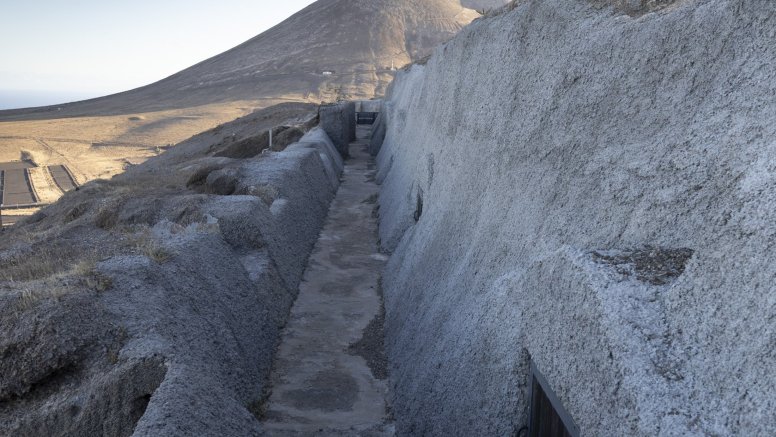
The inhabitants of Lanzarote have always been forced to find a way, however impossible, to find drinking water on the island. This led to devising systems to collect and store the water from the little rain that falls in order to survive in a land marked by drought. For this reason, cisterns, galleries, or maretas became the perfect allies for the people of Lanzarote. One of these infrastructures that is currently out of use are the maretas de Guatisea, located on the mountain of the same name, in the municipality of San Bartolomé.
It is an engineering work that was created to supply water to the town of San Bartolomé. The water was stored in six large tanks, six meters wide and five meters high, and then distributed to the town through a pipe that ran from the mountain itself to the Plaza de León y Castillo in San Bartolomé, explains Margarita Machín, author of the book Depósitos de Guatisea and a resident of the town.
In addition, the structure is also made up of two strainers and a kind of channel that borders the skirt of the mountain on the south side, which facilitated the collection of water when it rained. After falling into this channel, the water flowed through them and ended up in the six tanks.
The water, Machín recalls, was only available in the town square on specific days of the week. On the day the water was enabled, the square came to an unusual life. "Many people went with glass carboys to transport the water on their heads and there was a tremendous hustle and bustle," she recalls.
The Lanzarote native recounts how her mother sent her every week to send letters to her sisters who lived in Venezuela at the post office. "I always saw a huge line of people in the square, where the cistern was," she says.
Construction
In 1927, the lack of water led the authorities of the time to build the maretas de Guatisea, a project promoted by councilman Estanislao Salazar. "The runoff on the mountain led to this place being chosen for its construction and they made a kind of furrows or channels," explains Machín.
Some time later, construction began, but it was not finished. With the project paralyzed, the future reservoirs were used for several years as a military powder keg during the Spanish Civil War. Years later, in 1949, construction resumed with four reservoirs already excavated and a fifth that was built in 1958. At that time, the Cabildo of Lanzarote began the procedures to draft a project and build the canal, the drains, and the outlets.
Thus, in 1961, the creation of the sixth reservoir began, but construction was once again paralyzed due to lack of money and was reactivated in 1963. Finally, Lanzarote completed the construction of this infrastructure in March 1964.
However, the authorities of the time did not count on a major problem: the porosity of the mountainside. "The stone was porous because it is not a compact stone, but like sand, and when they realized it, they had no water at all," points out Margarita Machín.
After encountering this serious filtration problem, the island authorities took action waterproofing the surface of the canal and the six reservoirs with lime and cement.
Abandonment after the arrival of the desalination plant
With the arrival of the first desalination plant in Lanzarote in 1964, the first in Europe, the maretas of Guatisea began to be used less and less, as the possibility of having running water made this hydraulic work inefficient.
As the years passed and the supply network from the Arrecife plant was expanded, the use of the maretas declined and they were completely abandoned.
However, the Cabildo of Lanzarote has tried to recover them on several occasions, as in 2013. On that occasion, the canals and outlets were cleaned, but not their reservoirs, which are full of earth and debris.
For its part, in 2018 the island Cabildo boarded up the entrances to the six reservoirs for safety and to prevent possible accidents to people and animals.
Add La Voz de Lanzarote as a preferred Google source.
Stay informed with the latest current news.