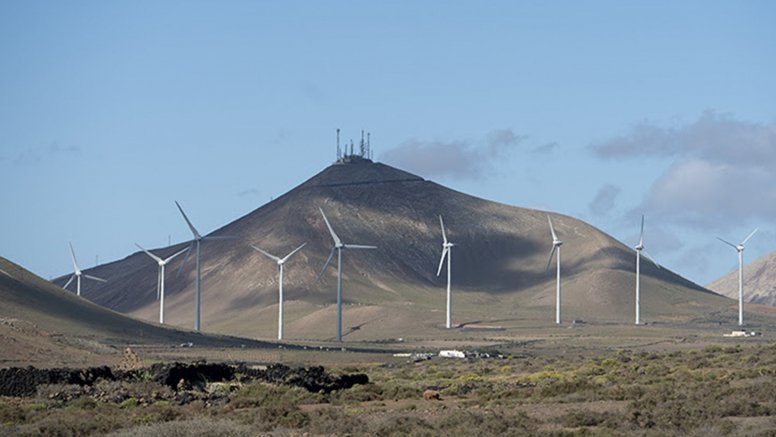
The César Manrique Foundation (FCM) will host on Thursday, June 25, at 7:30 p.m., the presentation of the report titled *Diagnosis of the potential impact of comprehensive wind development in the Canary Islands and, in particular, on the island of Lanzarote*, commissioned by the institution in 2025 —to be developed between March 2025 and June 2026—. The research has been directed by Rosa María Regueiro, associate professor in the Department of Applied Economics at the USC (Bioeconomy Group), whose team has included Torcuato Teixeira, lawyer and specialist in Fisheries Economics by the USC, and Damiano Volpi, environmental technician. The event will take place in the José Saramago hall (La Plazuela, Arrecife). Admission is free until full capacity is reached.
The FCM recognizes and supports the global context of energy transition promoted by the European Union, as well as international commitments to combat climate change and advance towards a decarbonized energy model. However, it considers it necessary to open a critical reflection on the way this transition is being planned and implemented, especially in island territories, characterized by special environmental, territorial, and socioeconomic fragility. In the opinion of the FCM, the accelerated implementation of renewable energy infrastructures cannot be approached solely from technical or climatic criteria.
It is essential to also incorporate principles of territorial justice, ecological sustainability, democratic participation, social models of energy ownership, and protection of traditional economic activities that are part of the local productive fabric, such as artisanal fishing and agriculture. Likewise, the preservation of landscapes, as well as natural, cultural, and heritage values that constitute an essential element of the community's identity, economy, and well-being, must be guaranteed.
The preparation of this report has involved an extensive process of island social dialogue and participation, in recognition of citizens' right to actively intervene in decision-making that affects their territory. The extensive document to be presented analyzes the specific energy characteristics of the Canary Islands and examines the socioeconomic impact associated with wind development in Lanzarote.
Likewise, it studies the delimitation of Renewable Energy Acceleration Zones (ZAR) and their relationship with agricultural land. In this context, the report warns that an insufficiently planned expansion of wind farms could compromise the useful agricultural surface available, generate conflicts in land uses, and cause substantial transformations in the island's traditional landscape, with repercussions on its natural, cultural, and productive heritage.
The study also pays special attention to the implementation of offshore wind energy and its impact on fishing and Lanzarote's coastal visual environment. In addition to reflecting on the "no model of wind development" on the island, it proposes an exhaustive review of the legal and political framework that regulates the implementation of offshore wind farms, analyzing the main directives and regulations of the European Union linked to energy transition and environmental protection. Based on this consideration, the drafting team develops one of the central legal axes of the report: the precautionary principle, whose application is crucial in situations characterized by the existence of significant scientific uncertainties about the possible environmental damage of certain actions.
The study, which will be presented next Thursday, June 25, focusing on the socioeconomic, energy, territorial impacts, and the EU regulatory framework, will be completed next year by the FCM with a complementary report on the environmental impact of the development of wind and photovoltaic energy, with particular attention to the territory of Lanzarote.
Rosa María Regueiro Ferreira is a tenured professor of Applied Economics at the University of Santiago de Compostela and coordinator of the Economics Degree studies. She is a specialist in renewable energy economics. She has focused her research on the socioeconomic and energy impacts of renewable development, especially wind energy. She has been the principal investigator in various energy-related projects, both in European calls and in direct advisory contracts with public administration and other entities. She is a member of the board of directors of the Spanish Association of Critical Economy, where she is responsible for financial management.
Torcuato Teixeira Valoria is a lawyer specializing in Fishing and Maritime Law (Santiago de Compostela), with nearly thirty years of practice. He is the legal advisor to the National Federation of Fishermen's Guilds and technical-legal advisor to OPASTURIAS (OPP 90), spokesperson for the Platform in Defense of Fishing and Marine Ecosystems, and representative of the sector in the Xunta's Offshore Wind Observatory and in the Ministry for Ecological Transition and Demographic Challenge's Offshore Wind Table. He is the author of a manual on fishermen's rights and duties (FREMSS, 2018) and a lecturer in postgraduate programs at USC and the Universidade da Coruña (UDC), and is the son of fishermen.
Damiano Volpi holds a degree in Environmental Sciences from the University of Granada. He has worked on territorial planning, socioeconomic issues, history, and philosophy of society and territories. He is an advocate for the right to citizen participation in territorial political decision-making and for landscape as heritage.
Add La Voz de Lanzarote as a preferred Google source.
Stay informed with the latest current news.