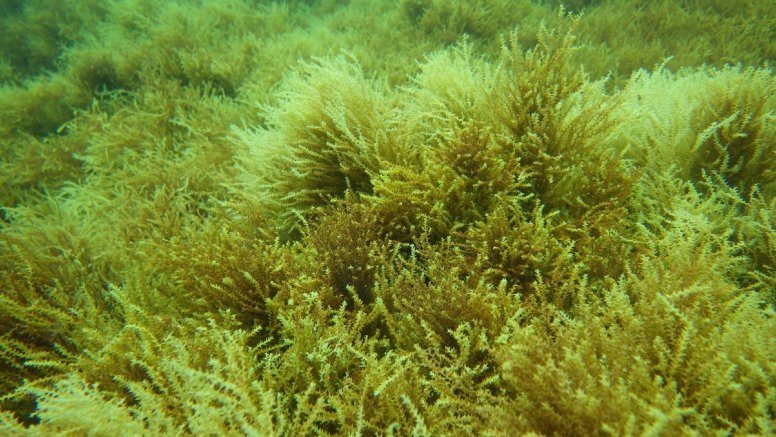
The diversity of macroalgae in the Canary Islands varies between islands and over time, according to a study by the University Institute ECOAQUA, of the University of Las Palmas de Gran Canaria (ULPGC). The study brings together 64,391 records of 573 species of macroalgae from seven Canary Islands, the university reports in a statement.
The work analyzes the differences between islands and the changes observed over approximately three decades and relates patterns to the environmental heterogeneity of the archipelago.
The research integrates historical species records at the scale of the Canary archipelago and combines them with oceanographic data obtained through Copernicus Marine Service, the marine component of the European Earth observation program, managed by Mercator Ocean International and funded by the European Union.
With this information, it analyzes the spatial and temporal patterns of macroalgae diversity in the Canary Islands, evaluating their relationships with environmental conditions and determining whether these associations vary between the eastern and western regions of the archipelago.
Overall, the study, titled ‘Spatial and temporal patterns of macroalgae diversity in an environmentally heterogeneous oceanic archipelago’, seeks to understand how the archipelago's environmental heterogeneity and long-term oceanographic variability relate to the spatial and temporal organization of macroalgae communities.
The research, carried out by Eros Fernando Geppi, as principal investigator, and by Rodrigo Riera, both from the BIOCON group of ECOAQUA, as well as by Daniel González-Aragón, from the Catholic University of the Most Holy Conception of Chile, shows that macroalgae communities are not homogeneous on the seven main islands of the Canary Islands.
These species perform essential functions in coastal ecosystems, where they create habitats and sustain food webs.
Fuerteventura, Lanzarote, and Gran Canaria show more similar compositions among themselves, while La Gomera and El Hierro present more differentiated communities.
La Gomera and El Hierro also show lower values of recorded richness, while Tenerife and La Palma occupy the top positions, followed by Gran Canaria, Fuerteventura, and Lanzarote.
These differences reflect both environmental heterogeneity and unequal sampling intensity among islands.
Based on the results of this study, the eastern islands are more influenced by cold, nutrient-rich waters, while the western islands exhibit warmer, oligotrophic waters.
The study also indicates that richness increased during the 2000s and decreased in subsequent decades, especially on several western islands.
During the analyzed period, changes were observed in sea surface temperature, surface CO₂ conditions, nutrient availability, and water column stratification.
The study identified associations between diversity and distinct environmental variables, such as temperature, currents, oxygen, nutrients, productivity, and surface CO₂ conditions. These relationships were not linear and varied according to the spatial scale analyzed.
Macroalgae are fundamental components of coastal ecosystems because they create habitats, sustain trophic interactions, and contribute to ecosystem services such as fisheries production and coastal protection.
Likewise, the research jointly analyzes local diversity, compositional differences among islands, and regional diversity.
The models offered a better fit when the eastern and western regions of the archipelago were analyzed separately than when a single model was applied to the entire archipelago.
This differentiation between the eastern and western islands is of particular importance for management.
Environmental conditions, temporal trends, and the relationships between biodiversity and the environment are not identical throughout the archipelago.
For this reason, monitoring and conservation measures should consider the oceanographic context of each island and avoid treating the Canary Islands as a homogeneous environmental unit.
In conclusion, this study shows that the diversity and composition of macroalgae in the Canary Islands are structured by persistent environmental differences among islands and by long-term oceanographic variations.
The results are compatible with a gradual reorganization of communities, especially on the western islands. However, the observational nature of the records prevents demonstrating a direct causal relationship between environmental changes and biodiversity variations.
Add La Voz de Lanzarote as a preferred Google source.
Stay informed with the latest current news.