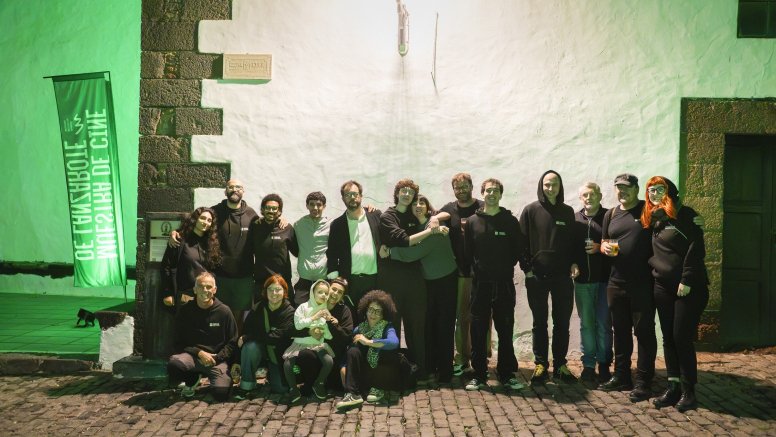
A tenique is, according to the Canarian Academy of Language, each of the three stones with which a rustic hearth is made, which serve to support a toaster, a pot, or any other container. This word was the one chosen by Rafael Martínez, Marco Arrocha, and Javier Fuentes to name Tenique Cultural, an association that since 2018 brings culture closer to all Lanzaroteans with different activities and festivals such as the Lanzarote Film Showcase, La Destiladera, or La Pantalla Chinija.
The founding of Tenique Cultural arose to integrate the Lanzarote Film Showcase and begin a new era for this event. "It had been founded in 2011 by Rafael Martínez and Marco Arrocha along with Víctor Moreno and it had been a rigorous, but very small project, and when I arrived they themselves said it would be interesting to set up a new association and take up the legacy of that Film Showcase and integrate it into a new era," explains Javier Fuentes, president of Tenique Cultural, to La Voz.
The non-profit association was born with three fundamental commitments: to defend civil society and associativism as an important way of defending democracy and civic structures; to generate and provide high-quality culture for the people who live in Lanzarote with projects made by and for the people of the island; and finally, to convey to the world an image that this island can be and is more than just sun and beach.
"It is a place where people think, have the capacity to create top-level cultural projects and where we do not only work solely and exclusively for the tourism sector," points out Fuentes. Tenique Cultural, according to its president, is important "to put on the map an image of Lanzarote that has been very important for a long time and that comes from the heritage of Jesús del Carmen Soto or César Manrique, who understood that the island is a place of great beauty and popular cultural history that makes the island different," he continues.
"Very tough" beginnings
The beginnings of the Lanzarote Film Showcase, highlights its president, for many years the people who were part of the team did it for free and even put money out of their own pockets to move the project forward. "This is the defense of associativism and civil society so that things exist because we understand that democratic freedom lies in the fact that not everything is in business or administrative structures," indicates Javier Fuentes.
"We started developing projects that we thought could be useful, such as the recovery of old films and in recent years La Pantalla Chinija to help the 'chinijos' (children) to watch more sensible, serene, and calm cinema, but the beginnings were very tough," he assures. Fuentes, after going to the cinema with his daughter, realized that the films dedicated to the little ones "are tremendously aggressive and full of shouting."
Furthermore, he acknowledges that he hadn't understood the film. "I asked my daughter what the film was about and my daughter, who was three years old, didn't either, so one day abroad I took her to a very serene and quiet film cycle, and she was very focused throughout the film, so when we left I thought that this had to be given to the 'chinijos' of Lanzarote," he recalls.
In this regard, he emphasizes the complexity of keeping an association like Tenique Cultural alive. "Nowadays it seems that Tenique is a structure, but it is always on the edge because associations are always in a very complicated situation, no matter how much they have grown, because sometimes their structure and their sense of freedom within logic or the relationship with administrations in a given context are not fully understood," explains its president.
In these beginnings, the number of attendees was much lower than the current one. "I think that in the town halls there are culture departments that have really bet in a quite significant way on culture in recent years and when that happens, people start to get into the habit because culture is not something you deliver overnight and people will arrive as if it were something spectacular," he says.
The Summer Traveling Cinema, one of its successes
One of the activities that the population of Lanzarote most eagerly awaits during the year is the Summer Traveling Cinema, a proposal that travels the island during the summer months and that "recovers the experience of the old open-air summer cinemas, when watching a film also meant sharing with family, friends, and neighbors."
Its success with an average of 200 people per session, according to Fuentes, is due to the fact that "it is not a typical summer cinema". "It always has a ten-minute introduction that allows people to watch the film in a different way, even if it is a very popular film, with a more critical and analytical gaze," he points out.
The objective of the Summer Traveling Cinema is to go beyond merely consuming a film, but rather it seeks for people to reflect. Therefore, at the end of the screening there is always a debate "which fifty percent of the people usually stay for, something that gives it a character between leisure and culture that has made it very popular to the point that it has grown towards Fuerteventura".
The Lanzarote Film Showcase, its main attraction
The Lanzarote Film Showcase is one of the most anticipated cultural events of the year on the island and has just been chosen for the second consecutive year as the best large-format festival in all of the Canary Islands and is, moreover, one of the three best-rated festivals by Promotour out of two hundred of all types in the islands.
"For us it is very important because they are grants with juries that have no connection whatsoever with us and that is how public sector funding should always be," he indicates.
Around thirty people come to work so that The Film Showcase grows more and more, an evolution that is very noticeable. "Its evolution is wonderful and it is impressive to see that a project made on a tiny island has been able to form from here a festival that is among the best funded by the Ministry of Culture," states Javier Fuentes.
Recovery of old films
The recovery of old films is one of the tasks that Tenique Cultural carries out to rescue the history of Lanzarote and prevent it from being lost in oblivion. A job that, as Fuentes reveals, is "very arduous and difficult".
"It requires a lot of collaboration and a lot of contact with families because sometimes they do not want to give their private material, and it is work that is not seen because when you see the digitized film, it seems to have arrived like that out of nowhere, but you have to do a lot of work to build trust with people," he says.
In addition to the human aspect, the technical part is one of the most important. This process is handled by one of the foremost experts in Spain in the recovery of Super-8 material and family films, Salvador Vivancos.
Thanks to the work of Tenique Cultural and Salvador Vivancos, around 400 films have been digitized, from screenings of old carnivals, salt flats, salt carpets to popular festivals or communions. "There are also more common things like a house in which nothing happens, but the way people dressed, how they moved or cooked already has its anthropological interest," he argues.
Add La Voz de Lanzarote as a preferred Google source.
Stay informed with the latest current news.