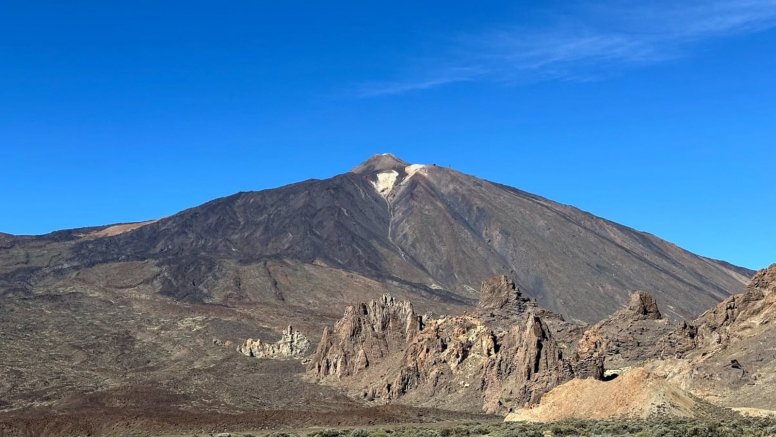
The National Geographic Institute (IGN) has detected an intensification of seismovolcanic activity under the island of Tenerife, with about 1,600 earthquakes automatically registered since July 22, although it has stressed that this episode does not increase the danger of an eruption in the short or medium term.
The agency explains that the seismic activity that began on the afternoon of July 22 continued throughout Thursday and intensified from 6:00 PM (Canary time), when low-frequency signals recorded by the stations closest to the active area increased.
The earthquakes are located in the western area of Las Cañadas del Teide, at depths between 10 and 15 kilometers, where this type of activity has been usual in recent months.
During Thursday, the IGN manually located 191 earthquakes and this Friday, up to the time of preparing the report, another 122, with a maximum magnitude of 1.6 mbLg.
The IGN details that automatic processing has detected around 1,600 earthquakes since July 22, of which about 600 correspond to this Friday.
Likewise, the agency points out that the swarm of repetitive events that began on the night of July 22 ended around 3:00 PM on Thursday.
Subsequently, at 11:30 PM, a new family of low-magnitude repetitive events began, which lasted throughout the early morning and intensified between 3:00 AM and 6:00 AM this Friday.
At the time of writing the report, the events had slightly decreased in magnitude and were more spaced out.
During this episode, volcano-tectonic, hybrid, and low-frequency (LP) earthquakes have been recorded.
According to the IGN, the presence of LP and hybrid events is compatible with the circulation of fluids at depth, although by itself it does not imply an acceleration of the volcanic process.
The National Geographic Institute has maintained continuous monitoring of this intensification and has informed the competent Civil Protection agencies of its evolution.
The agency adds that this is similar activity to that recorded during the months of February, March, and June of this year and emphasizes that it does not represent an increase in the danger of eruption in the short or medium term in Tenerife.
The IGN recalls that it has a network of more than a hundred stations, equipment, and sampling points on the island to monitor seismic activity, ground deformation, and geochemical parameters in real time that may indicate changes in the volcanic system.
Add La Voz de Lanzarote as a preferred Google source.
Stay informed with the latest current news.