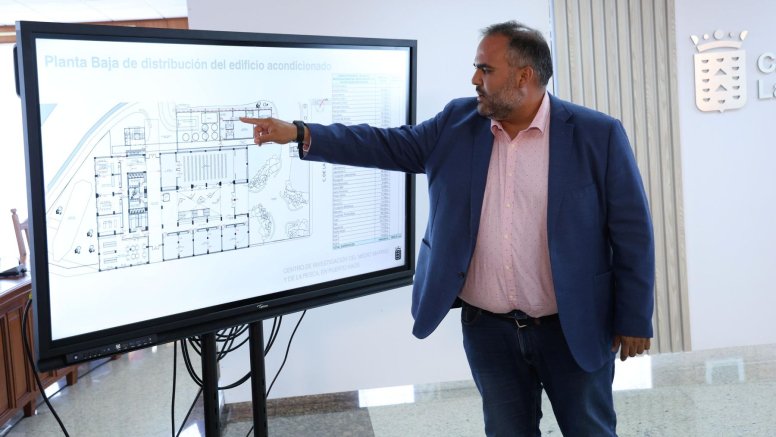
The Cabildo of Lanzarote and the Chamber of Commerce of Lanzarote and La Graciosa have presented this Monday, June 22, the preliminary draft of the future Center for Marine and Fishing Research, in an event that took place in the Plenary Hall of the Institution.
The presentation comes after a key administrative milestone, such as the recent publication in the Official State Gazette (BOE) of the start of the project competition procedure for the concession of port space. Said publication opened a one-month period for the submission of concurrent applications, according to port regulations, safeguarding and consolidating the administrative development of the infrastructure.
During his speech, the president of the Cabildo of Lanzarote, Oswaldo Betancort, celebrated this progress and highlighted that "the future scientific center is the result of rigorous strategic planning, as its preliminary draft clearly shows, and of public-private collaboration". Betancort emphasized that "it is an unusual project that goes beyond the fishing sector and prioritizes scientific and research purposes, while encompassing other areas such as innovation, education, and traditions, and protecting heritage and culture". Thus, he emphasized that this combination of factors will allow this knowledge to be put at the service of our artisanal fishermen and also of the citizens, transforming the Puerto Naos area into a leading hub of economic activity linked to the sea and sustainability".
For his part, the Minister of Fisheries, Samuel Martín, explained that "the application to the Port Authority is the indispensable legal mechanism to intervene comprehensively in a key building that has been abandoned for decades, and therefore this new step represents a great milestone". Martín highlighted that "the facilities have a marked practical character, as they include a marine hospital and operating room for cetaceans that we do not currently have, and will also feature a library, a fishing museum, and even an observatory on the top floor for the enjoyment of the citizens". He insisted that, "despite this process of scientific modernization, the Cabildo will protect the historical value of the building".
Meanwhile, the president of the Chamber of Commerce of Lanzarote and La Graciosa, José Valle, emphasized the positive socioeconomic impact that this infrastructure will have on the capital and the entire island, reiterating “the contribution of added value for scientific and research purposes, as the project plays a fundamental role in urban regeneration and economic transformation of the entire port area of Arrecife”. Valle added that “this new construction will turn the entire area into a training hub with innovations such as the degree in Nautical Science, very important content in innovation and a direction to follow”.
Center for innovation and knowledge
The technical project promoted by the island institution details a request for occupation of a public domain area covering 3,028 square meters of coastal land, integrating the current facilities which total 3,758 square meters of built area.
The Frigorsa building consists of a large north-facing warehouse, a clear perimeter courtyard, and a single-story block divided into technical rooms. Although the exterior structure maintains a solid appearance, the Cabildo will undertake a complete architectural rehabilitation to correct past unfinished interventions, ensuring the physical stability and functionality of the future laboratories.
The new scientific center will be located in the port area of Puerto Naos, in Arrecife. The institutional objective of this joint strategy is to transform Puerto Naos into a cutting-edge space directly linked to the blue economy, training, and scientific knowledge applied to the fishing sector.
Finally, the island councilor for Fisheries of the Cabildo of Lanzarote, Samuel Martín, highlighted the significance of this infrastructure, stating that “the center will directly connect science with fishing activity and environmental conservation, providing indispensable value to our primary sector”.