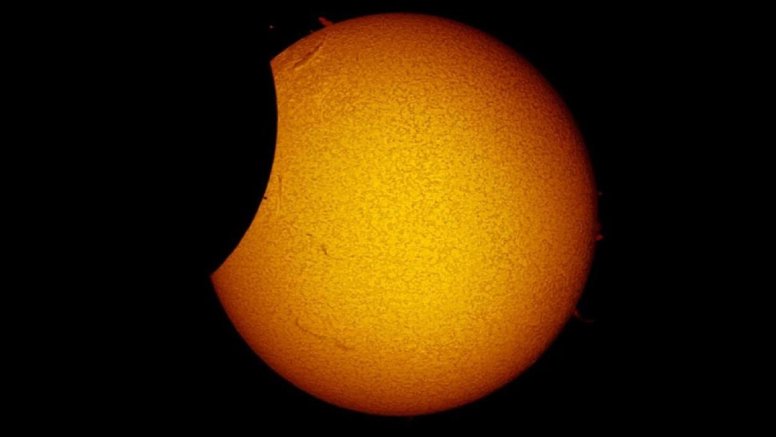
The Ministry of Health of the Government of the Canary Islands, through the Canary Health Service (SCS), recalls the main recommendations to prevent possible health risks that may arise during a solar eclipse observation event like the one that will take place this August 12.
One of the main risks during a solar eclipse is irreversible retinal damage caused by looking directly at the sun without adequate protection, even when the sun is partially obscured. To view it safely, only special eclipse glasses that comply with the relevant safety standard should be used.
Always use approved special glasses
Normal sunglasses, even very dark ones, do not provide enough protection to look directly at the Sun. It is also not safe to use X-rays; CDs or DVDs, smoked glass, homemade filters, 3D cinema glasses, or uncertified dark lenses.
Therefore, it is recalled that safety does not depend on the darkness of the material, but on it being certified. Before buying eclipse glasses, check that they include:
- CE marking: this is mandatory for this type of product and indicates that the manufacturer declares compliance with applicable European regulations.
- Reference to standard EN ISO 12312 - 2:2015 (or ISO 12312 - 2:2015): it is recommended that the product refers to this standard, which establishes the requirements applicable to glasses for direct solar observation.
- Manufacturer/importer details: they must be clearly identified. Instructions and warnings for use: the product must explain how to use it safely.
- Filter in good condition: it must not have scratches, breaks, bubbles, clear areas, or visible defects.
How to use glasses during the eclipse
Specialists recall how glasses should be used correctly during the solar eclipse sighting in five simple steps:
1. Put on the glasses before looking at the sun and do not take them off while observing it.
2. During the partial phases of the eclipse, before and after totality, always keep them on.
3. Supervise children and the elderly especially to prevent them from looking at the sun without protection.
4. Do not use damaged, scratched, bent, or old glasses if you cannot verify that they are in good condition and comply with regulations.
5. Do not look at the sun with cameras, binoculars, or telescopes. These devices require specific solar filters.
Add La Voz de Lanzarote as a preferred Google source.
Stay informed with the latest current news.