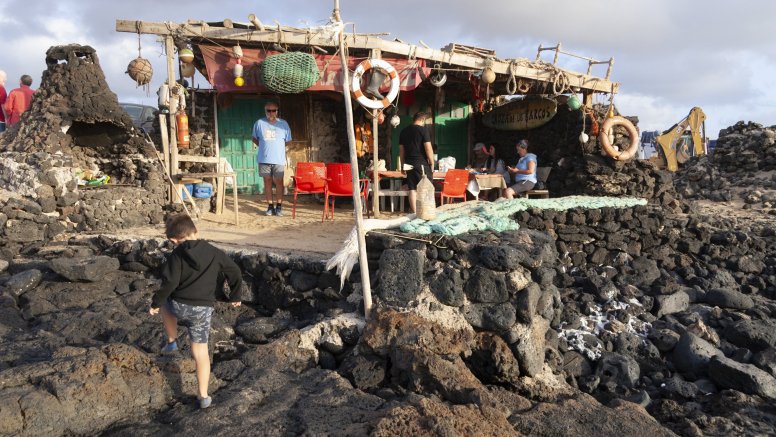
The Pueblo Maho cultural organization has shown itself this Tuesday morning against the demolition of several huts in Mala and Charco del Palo. It has thus pointed out that these constructions near the sea have served as support for the island's families for the use of marine resources. Pueblo Maho has responded in this way to the action of Costas, which has ended with the collapse of two huts in Haría and the temporary suspension of the demolition of another two.
In this way, it recalls that before the island's population "was expelled from the coast to make way for tourist infrastructure, the coastline was dotted with huts where families spent part of the summer, stocking up on food to diversify and supplement their diet."
The use of the sea, part of Lanzarote's Intangible Heritage
"These were stays that, in addition to the economic purpose, were also recreational, leisure, collaborative, and family-oriented," it adds. "The coast was filled with life, with families who met again and strengthened their social ties, while experiencing an atmosphere of care, of exchanging teachings, knowledge, stories, or games that fostered bonds," highlights the collective. These summer changes are part of the worldview about life and date back to indigenous times, forming part of the own knowledge integrated into Lanzarote's Intangible Heritage.
Pueblo Maho has highlighted that the administrative measures adopted have been diminishing the possibilities of this enjoyment. It exemplifies that camping was no longer allowed in El Cable or Caletón Blanco, the Wall of Shame was erected in La Tiñosa so that those who came - and continue to arrive in increasing numbers - would not know our way of life or our needs.
"Once the coast was occupied, they moved inland and now they are settling in the most populated towns, saturating the roads, the garbage dumps, the cement parks, or the buses," it highlights.
The collapse of huts in front of Papagayo Arena
In this regard, it states that "a swarm of laws" determine that the coastal sea and its beaches belong to the national domain; from 1866 with the Water Law, followed by the Port Law of 1880, the Coastal Law of 1969, the Constitution of 1978 or the Coastal Law of 1988 with its 2013 reform, they affect this particular detail of the ownership of the strip, clarifying when ownership is lost and passes to concession with the right to occupation, among many other details, the same ones that correspond to as many hotel buildings, such as the Papagayo Arenas, which today calls itself Sandos Papagayo Beach Resort.
The huts on the coast of Mala and Órzola do not impede passage by land or access to the sea, nor were they built on a public road or a promenade that accessed the sea. "The huts do not have a null and void license since 2007, nor do they exceed the height and buildability limits allowed when the families built each one of them," he questions. "All these illegalities that do not affect the huts, do concern the aforementioned hotel," he adds.
The Directorate General of Coasts approved the new maritime-terrestrial boundary in the Partial Plan of Las Coloradas, by which almost the entire structure of this hotel is affected, and the Superior Court of Justice of the Canary Islands (TSJC) and various other orders have ordered its demolition, but the demolition has not been carried out.
To these differences between the huts and the hotel, three more are added:
1. While the Cabildo does not protect the heritage values that traditional island huts treasure, it grants the former Papagayo Arenas provisional tourist authorization to guarantee its permanence and not demolish it like the huts.
2. While Coasts demolishes the huts, the hotel was authorized to open two new alternative pedestrian accesses to the coast, against the State Coasts.
3. The hotel is a cement and concrete behemoth wallpapered with petroleum derivatives; the huts are made of stone and defined by the Royal Spanish Academy of the Language as "poor dwelling [...] covered with branches or straw, normally used by shepherds or people from the countryside." The Academy also excludes seafarers.
The example of La Mareta
Likewise, the La Mareta house-palace, with almost 2,000 square meters built and not many kilometers away where machines attacked the memory of the sea, partially occupies non-developable state land, although they did not forget to endow it with a special legal nature.
In this regard, Pueblo Maho denounces an "administrative asymmetry": "While Costas uses shovels and guards to erase the huts from the island in which families made use of marine resources; and the Cabildo of Lanzarote does not safeguard the elements that have articulated double life, the one that adds and supplements the food adapted to the island palate, the illegal ex Papagayo Arenas is guaranteed to continue invoicing".
To conclude, the association Pueblo Maho denounces the difference in treatment that Costas and the Insular Cabildo dispense to the huts on the coast of Mala - who receive demolition orders and to other hotel centers, such as the Gran Meliá Salinas or the multitude of terraces, gardens or collective swimming pools that occupy a strip of Public Domain and continue invoicing. "The lack of protection of the heritage associated with the sea guarantees historical impoverishment and thins out the heritage memory until its total loss," it concludes.
Add La Voz de Lanzarote as a preferred Google source.
Stay informed with the latest current news.