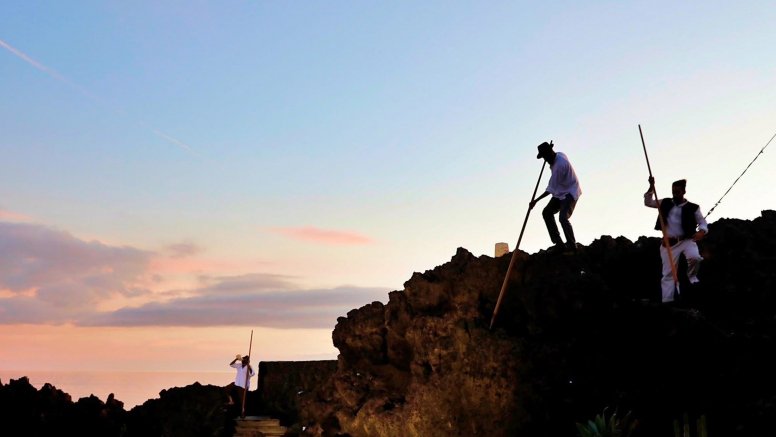
The dissemination, knowledge, and conservation of the cultural and historical heritage of Lanzarote and La Graciosa are the challenges faced by the Pueblo Maho Cultural Association. Born in 2016 and with more than forty members, this year it celebrates a decade full of activities and initiatives to remind Lanzarote society where it comes from and with the need to teach the foreign population the uniqueness and richness of the cultural legacy inherited from the Canarian aborigines.
In an interview with La Voz, Orlando Hernández, president of Pueblo Maho, states that what led to the creation of this association was "the lack of knowledge about our aboriginal history". For her part, Nona Perera, archaeologist, doctor in Prehistory and member of Pueblo Maho, emphasizes that "on the one hand, Lanzarote is an island where many archaeological investigations are carried out, but on the other hand, it is an island where there are few places where the knowledge that is being acquired is disseminated despite there being a great demand".
"Lanzarote was an island that was characterized by launching the network of Art, Culture and Tourism Centers, before any other island, but it has no offerings about our own history and all the efforts made by a government go in one direction, but we would like it to also go in another and that there is a place of memory where all the advances can be known that are happening in archaeology," Perera continues.
All activities carried out by Pueblo Maho are related to the dissemination of the island's heritage, such as book presentations, talks with experts, walks with schoolchildren, workshops or exhibitions of the shepherd's leap, the conch shell blowing, or the whistle language. These activities are disseminated beforehand on their social networks such as Facebook or Instagram, where they inform how to register and all the information.
Lanzarote, the only Canarian island that lacks an archaeological museum
One of the spaces that would promote the dissemination and conservation of Lanzarote's cultural and historical heritage is an archaeological museum, but the island lacks one. Currently, one of the objectives pursued by the Historical Heritage Area of the island Cabildo is that Zonzamas becomes a great museum where anyone who wishes can visit it, learn about aboriginal history, and understand how they lived. However, an exact date for when this promise will become a reality is not yet known.
"We do not have a place where people can enjoy and visit the things that are being discovered in Rubicón, Zonzamas or in the rest of the sites that are being carried out so that they find that feeling because when they tell you something, it is not the same to see it in a photo as to do it in person," points out Orlando Hernández.
Inculcate patrimonial values from childhood
The Pueblo Maho Cultural Association very often works with students from Lanzarote schools in a tireless effort to educate in the heritage field, an action that the youngest receive with open arms. "The response from the kids is brutal, they love it because these are things they have never seen, like the conch, and we explain its history and how it is used," says Hernández. Likewise, he states that the little ones "love our culture, but they are not taught it."
For this, Pueblo Maho not only works with schoolchildren, but also does so with the teaching staff. "There is a level of ignorance among teachers; the normal thing is that they don't even know that the islands were conquered nor that an aboriginal population existed," he/she points out.
Furthermore, Nona Perera emphasizes that the dissemination of heritage not only involves people rooted in Lanzarote, but also a group of population that arrived on the island in recent decades and who remain on the sidelines of these cultural offerings. "They are people who are not very stimulated or it could also be that we have not known how to approach them so that they benefit from the knowledge that exists on the island and for us to learn from theirs," she indicates.
In recent years, social media has accentuated how a part of the Canary Islands population feels rejection towards the Amazigh culture, the Berber culture of North Africa that characterized the Canary aboriginals. "The new generations feel rejection, but it's generally due to ignorance because when you explain it to them, they are delighted," he says. "Geographically the islands are African, now they are trying to sell us that the Canary Islands are Europe, but no, we are not even in Europe... we belong to Spain which is in Europe, but we are not," he continues.
However, during the different activities they have encountered "with very few people who say they are not African".
The protection as key tool
According to Pueblo Maho, the protection of archaeological sites is one of the greatest tools that Lanzarote must implement. "Many people go and with social media it has gotten out of control, in fact, we have found many damaged sites although we assume it is due to ignorance," they point out. And it is that in these cases, citizen collaboration is of great help on occasions when we can see someone attacking a site. In these cases, "drawing attention is the best and, if required, the competent authorities should be called".
For her part, Perera states that not only does the population attack the sites due to "ignorance or malice," but that "those who most attack heritage are the administrations because they are the ones who act the most and, also in the weakness we find in the execution of projects". One of these projects is the Renewable Acceleration Zone (ZAR) which, in the archaeologist's opinion, "the only thing the Government has done is facilitate the imposition by removing environmental impacts and softening what is necessary to do prior to the occupation of a territory".
During its first ten years of life, from Pueblo Maho they look back and highlight the knowledge acquired by the speakers and the walks, but also the enormous network of friends that has formed during this path that has only just begun.
Add La Voz de Lanzarote as a preferred Google source.
Stay informed with the latest current news.