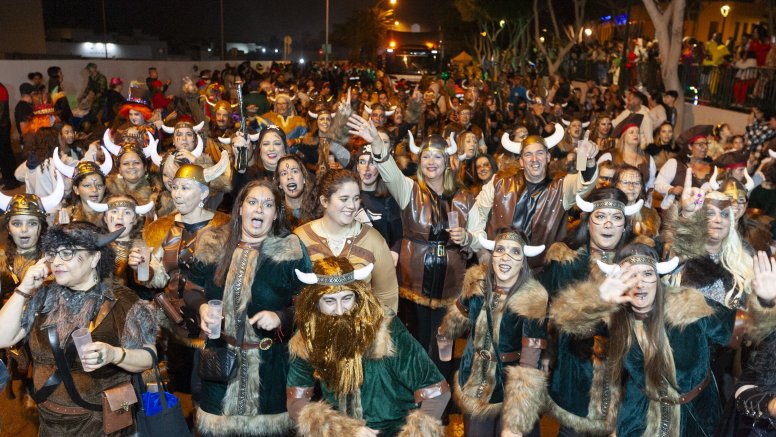
Humor acted as an outlet in the Canary Islands during the Dictatorship with the murgas and figures such as Pepe Monagas, Beuster, Felo Monzón and Eduardo Millares, a tradition that continued in the Transition with Juan Luis Calero and Manolo Vieira, long past the era when the Law on Vagrants and Scoundrels was applied to several island humorists. In the case of Lanzarote, it was the only Canary Island where carnivals continued to be celebrated under the name of "Winter Festivals", which managed to evade the censorship of the time.
Knowing how humor survived in these periods, what type it was, and how it was used as a form of protest has led historian Ricardo Rizo to investigate its function during the Dictatorship and the Transition, which he discusses in an interview with EFE.
This research, under the direction of Professor Domingo Garí, has been presented by Rizo for his final degree project in History at the University of La Laguna, and for it, he has analyzed the murgas during the Franco era, graphic and radio humor, rural humor through Pepe Monagas, and urban humor through Manolo Vieira.
Thus, he explains, in the Canary Islands, Carnival defied the conduct imposed by the Church, and the members of the first murgas – those of El Flaco or El Chucho – belonged to the humblest classes, such as port workers, coal miners, and laborers.
The scarce media of the time did not refer to the murga performances, "thus avoiding that they find out in Madrid," and their criticism, wit, and irony turned the murgas "into defenders of the people," adds the historian.
A mere mockery
As the term murga was not well-regarded following the prohibition of carnivals, several of these groups opted to call themselves "afilarmónica" (a type of musical group), a name change that was nothing more than a mere mockery, and the first was integrated by the members of the veteran murga Los Bigotudos, who became known as Afilarmónica NiFú-NiFá in 1954.
The lyrics had to circumvent the censorship of the authorities, and as it was not easy to write them, they resorted to the help of humorists such as Luisa Machado, popularly known as "Seña Pepa," Arturo Navarro Grau, better known as "Cho Venancio," and "Cho Pacheco," brought to life by Julio Pacheco, among others.
An example of those lyrics in which Arturo Navarro participated is the following: "Antonio told me that the councilors are useless... that they should leave the squares and get lost."
In Las Palmas de Gran Canaria, one must go back to 1976 for the formation of the Afilarmónica Los Nietos de Kika, with its own style in its lyrics, fine and respectful humor, and themes such as Spain's entry into NATO, transsexuality, and the traditional "rivalry" with Tenerife.
The repression of humor
Ricardo Rizo adds that the island's graphic humorists also did not escape repression or prison, as happened in the early years of the Civil War to prominent painters and cartoonists as distinguished as Pedro de Guezala and Paco Martínez.
The start of World War II also caused difficulties for another of the great Canary humorists, Harry Gordon Beuster (1931-2010), son of German immigrants in Tenerife and with internationally recognized work for his geometric style.
The only newspapers authorized to publish cartoons were Falange and El Día, although later La Provincia also received permission, and among this group of island humorists, Felo Monzón stands out, who, along with Ortiz Rosales and Policarpo Niebla, clandestinely founded the newspaper Fyffes in the concentration camp, in which they published their cartoons.
In 1944, the "First Exhibition of Canary Humorists" was held in Las Palmas de Gran Canaria, which brought together the works of a new generation of artists who trained near Las Canteras beach.
Among these young people was Eduardo Millares, a graphic humorist influenced by Felo Monzón but with his own style, with very clean humor without apparent vindictive positions and capable of awakening sympathy towards the Canary identity with his character of "the magician".
The magician is equivalent to the character of the bumpkin who appeared in cartoons nationally, but Millares changed this connotation, giving this character the peculiarity of representing the people and the Canary identity.
The figure of the woman also occupies an important role in graphic humor, but this time more disadvantaged, with a sexual or economic connotation, with the role of the prostitute or the one causing the husband's economic losses.
Other themes that the cartoonists of the time alluded to were directly related to the Army and the Church, with cartoons of great anticlerical content and, from the 1960s onwards, the character of the tourist appeared.
Pepe Monagas
One of the great exponents of a rural, costumbrista humor that is responsible for highlighting the aspects of deep Canarias, was the writer and playwright Pancho Guerra, author of Pepe Monagas, the magician who possessed popular wisdom and knowledge of his territory that made the reader identify with him, creating, perhaps unintentionally, a symbol of Canarian identity.
It is also important to highlight radio humor and its usefulness in the Canary Islands not only as entertainment, but as a tool to give value to the Canarian accent, which was possible thanks to characters like Cho Pacheco, Seña Pepa, and Cho Juan, played by Arturo Navarro, Genoveva del Castillo, and Juan Rolo, respectively, and who also contributed to valuing Canarian idiosyncrasy.
These radio references of costumbrista humor become hallmarks of Canarian identity and a way to release tensions, through humor, for a large part of the population, as explained to Ricardo Rizo a "successor" in this type of humor, Juan Luis Calero, creator of the popular "la señora" and her catchphrases like "my husband has turned out well, within what it can be and thank God".
Canarias also had a pioneer in the comic monologue, Manolo Vieira, who began his professional career in the midst of the transition, recounting everyday life from his native neighborhood of La Isleta, and who confessed that his character Alexis was him as a child.
Humor served as entertainment and an escape valve during the Dictatorship and the Transition, but it must also be valued that "making people laugh is an art," concludes Ricardo Rizo, who is collecting data to expand the research and be able to publish it in the future.
Add La Voz de Lanzarote as a preferred Google source.
Stay informed with the latest current news.