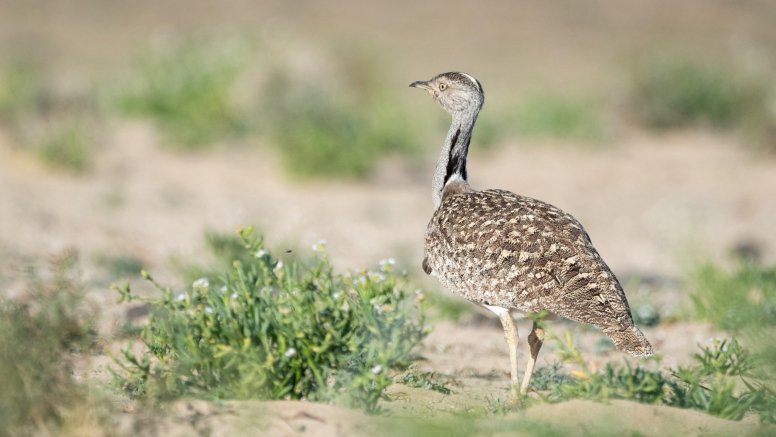
For a long time, Lanzarote's landscape was less valued than that of other Canary Islands due to the lack of trees and lush forests. Its kilometers of sand and volcanic flows went unnoticed compared to the Canary pines and laurisilva of other islands. However, what was once a cause for shame is now an open secret: the island's desert landscape shelters some of its greatest treasures, the animal and plant species that exist only here.
A blanket of sand up to five kilometers wide runs from north to south of Lanzarote, from the town of Caleta de Famara to Playa Honda (San Bartolomé) and Arrecife. This is El Jable, an extensive sandy area that hides Canarian endemic species, meaning species that cannot be found anywhere else on the planet.
"El Jable de Lanzarote is a special desert habitat because the sands that compose it are of biological origin, pieces of shells and marine organisms and not derived from volcanic rocks," explains the Canarian biologist and botany expert Atteneri Rivero to La Voz, who reveals that the relationship of plants with this space makes them "botanical jewels." At the same time, these desert spaces usually host a group of birds "very adapted to extreme environments, where it rains little and there is high insolation," explains ornithologist and travel and nature photographer, Juanjo Ramos.
"Culturally, we have always been told that the richest environments are forest environments, while arid or desert places are poor and have no life," argues ornithologist Juanjo Ramos, who points out that just by stopping to look, it is easy to see life emerging and making its way in these spaces. "What we have here is unique in the world," emphasizes the botanical biologist.
In addition to its environmental richness, this space is part of the Canarian and Lanzaroteño identity, so much so that it is impossible not to remember the search for papacría (Terfezia canariensis) under the sand (an activity now massified), or farmers cultivating sweet potato or watermelon on the sand, an oasis of dry farming.
The winged jewels that survive in the desert
The bird species that inhabit El Jable in Lanzarote usually have colors similar to their surroundings as a survival tool to avoid being perceived by predators. The avifauna of the jable usually "walks a lot on the ground, flies little, and has camouflaged plumage, adapted to the environment in which it lives," indicates Ramos.
One of the "jewels" in the crown of El Jable is the Canarian hubara (chlamydotis undulata fuertaventurae), a subspecies of bustard endemic to the eastern islands of Lanzarote, Fuerteventura, and La Graciosa. This native species of the archipelago is critically endangered, according to the International Union for Conservation of Nature (IUCN).
Doctor cum laude in Biology Alberto Ucero defined Lanzarote as "the bastion" of this subspecies in his thesis, as the island concentrates 80% of the archipelago's specimens. Specifically, the also researcher of the Spanish National Research Council (CSIC) points out in an interview that El Jable is the area with the highest density of Canarian hubaras in all of the Canary Islands and, therefore, in the world.
The striking courtship of the Canarian hubara
One of the most striking elements of this species, which has between 400 and 450 specimens in Lanzarote and between twelve and sixteen in La Graciosa, is its courtship. With the onset of the first rains in late autumn and early winter, the male begins with "his display of movements" and positions "the white feathers on his chest to attract the attention of the females," explains Ucero.
Each year, the female hubaras go to the same place, chosen by the male, to mate. "They are faithful to that place until the male dies or disappears," adds the CSIC researcher. After mating, they look for a quiet place to nest, with vegetation cover and rocks to camouflage the nest. During the spring, they raise their chicks, fleeing from human disturbances.
The Canarian hubara faces different risks. Deaths from collisions with power lines (including the telephone cable that still crosses El Jable), being run over on rural roads and paths, with the increase in buggies and quads, as well as the extraction of aggregates are some of the main reasons why the population cannot recover. The species is also affected by the predation of its chicks by the Canarian crow, by dogs walking off-leash during the nesting stage, and by feral cats.
The Saharan runner and the insularum stone-curlew
In the desert territories of the island, the Saharan Courser (Cursorius cursor), a species of wader that resides in Lanzarote and Fuerteventura, also makes its way. The Canary Islands are the only place in Europe where it can be found, as it only lives in the deserts of North Africa and the Arabian Desert.
This species is on the European Red List of Birds and its population has been decreasing over the years. In 2006, the Seo Birdlife census counted around 2,000 Saharan Coursers, the vast majority in Fuerteventura, where it is more present, followed by Lanzarote. In 2012, the population had already been reduced by almost half. Currently, it is estimated that the archipelago is home to around 120 individuals.
The richness of El Jable does not end with the Canarian Houbara or the Saharan Courser. Among its dunes is also found a subspecies of stone-curlew that only exists on the eastern islands of Lanzarote, Fuerteventura, and La Graciosa: the insularum stone-curlew (Burhinus oedicnemus insularum). This Canarian endemic usually chooses stony plains, sandy areas, or the edges of malpaíses to live. It is strictly protected and classified as vulnerable by the IUCN, as its population continues to decline due to damage to its habitat. In this privileged space, it also coexists with the Tagarote Falcon (Ico pelegrinoides Temmnick), a medium-sized raptor that can only be found in the Canary Islands in Spain.
The birds that nest in El Jable are steppe birds, meaning they lay their eggs and build their nests on the ground, hidden among the vegetation. This nesting method makes them more exposed to danger if the spaces continue to become overcrowded. Disturbances caused by humans are the main reasons that harm their habitat and put their survival at risk. The ornithologist Ramos defines the "disregard for desert environments" as the main cause of the problems these species face.
The desert superstar: the lily
In the struggle of plants to survive, flora species have created mechanisms to go long periods without sprouting, waiting for the perfect conditions. Some spend long periods as bulbs, and others generate thousands of seeds and remain buried in the sand, preserved, waiting for the perfect moment to sprout and complete their life cycle, explains botanical biologist Atteneri Rivero.
The passage of this winter's rains has given them more time to be in bloom, to interconnect and produce more seeds. "The rains have caused the seed bank of El Jable to grow and survival is guaranteed," celebrates the biologist.
"El Jable is a very clear example of the botanical richness we have in the desert," she explains. Among the unique species that sprout on the arid terrain is the jable lily, also called jable star-shaped onion (Androcymbium psammophilum), a species that only exists in Lanzarote and Fuerteventura.
This plant goes unnoticed most of the time because it is "a geophyte" and has two forms of life: when it is in bloom and visible above the sand, or when it is buried in the form of a bulb beneath the sand.
In this autumn and winter, which are rainier than usual, El Jable has filled with lilies: "It's like seeing El Jable full of stars. Like going to a beach and seeing the sea full of starfish. For me, it's the superstar of El Jable."
A Matter of Identity
Within this desert space, life continues to sprout and sometimes also reveals cultural and family history. "My grandmother used to tell me stories about how she would go looking for papacría," recalls the botany expert during a conversation with this media outlet. In the past, and still today in Lanzarote, people dig in the sand near the turmeras or jarilla turmera (Helianthemum canariense), a rockrose with yellow flowers, searching in the surroundings for papacría, a fungus that "parasitizes the roots of the helianthemum."
The pressure on the territory that Lanzarote is suffering has already forced environmental groups to mobilize. In this case, the La Asociación de Custodia del Territorio Papacría asked the Cabildo last March to regulate the harvest of this fungus after denouncing the massification of its collection.
Despite the constant pressure on natural spaces, the island's endemic species manage to make their way when environmental conditions allow. El Jable and all the life it harbors, such as the Canarian hubara, the insularum stone-curlew, or the desert's "superstar," are examples of survival. However, if these spaces are not cared for, there is a risk that species unique in the world will disappear forever.
Add La Voz de Lanzarote as a preferred Google source.
Stay informed with the latest current news.