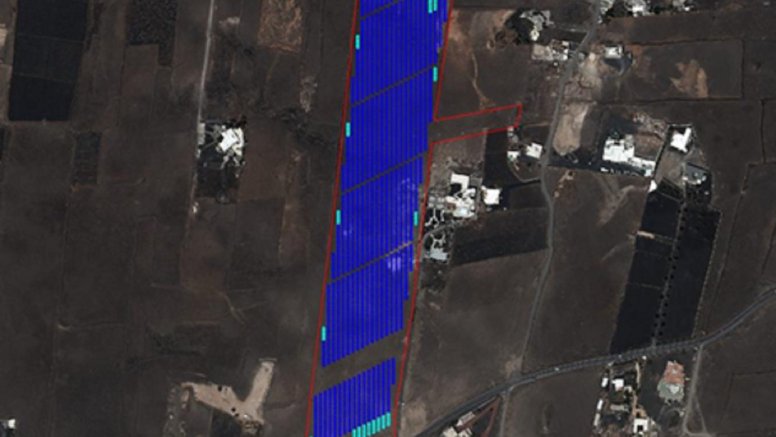
The Cabildo of Lanzarote and La Graciosa has reported unfavorably on the execution of the photovoltaic projects Tías I and Tías II, promoted by the company RS Iberia 23 S.L., after detecting "significant shortcomings" in their environmental assessment and risks to the biodiversity and natural values of the territory".
This technical pronouncement supports the position that the Institution had already announced publicly last October, when it expressed its rejection of the new plant planned in Tías and recalled that the implementation of renewable energies "must respond to an orderly plan, with maximum protection of rural land".
The two projects would add a power of 5.7 megawatts and occupy nearly nine hectares. The report warns that significant impacts on protected species cannot be ruled out and the precautionary principle is applied in the face of the possibility of irreversible damage.
The president of the Cabildo, Oswaldo Betancort, states that "the technical report supports a position that we had already announced clearly. The energy transition is necessary, but it cannot be done at the expense of our natural heritage or through indiscriminate occupation of rural land. Lanzarote has a roadmap and we are going to defend it".
The Canary Bustard, among the threatened species
The report alerts to the potential presence of up to 37 species of protected birds in the studied area. Furthermore, the Atlas of breeding birds in Lanzarote records ten species with probable or confirmed breeding presence in the area.
Among them, the Saharan wheatear, cataloged as vulnerable, and the Canary bustard, in danger of extinction, stand out. The document warns of possible impacts such as the destruction and fragmentation of habitats, the barrier effect for fauna, and the alteration of breeding areas.
The Minister of Environment, Samuel Martín, emphasizes that "this is not an opposition to renewable energies, but a demand that they be implemented with rigor, planning, and guarantees". Likewise, Martín points out that "the site is located within the Lanzarote Biosphere Reserve and the UNESCO World Geopark, and close to protected areas such as La Geria".
Renewables yes, but with planning and without mortgaging the territory
The Cabildo recalls that it has already submitted to the seven town councils its technical proposal for the Renewable Energy Acceleration Zones (ZAR), which reduces the proposed surface area from the initially contemplated 3,163 hectares to less than 200 hectares, approximately 0.25% of the island's territory. This planning prioritizes the roofs of public and private buildings, parking lots, existing infrastructure, and degraded land, minimizing the occupation of rural land.
“We have a planned alternative to advance in the energy transition without compromising our territory. The priority must be to take advantage of roofs, infrastructure, and already transformed spaces, not to extend facilities over rural land of agricultural and environmental value,” insists Oswaldo Betancort.
The Environment report concludes unfavorably on the execution of Tías I and Tías II, considering that irreversible damage to protected natural elements cannot be ruled out. The Cabildo thus maintains the criterion it has already announced on numerous occasions, arguing that the development of renewable energies must be compatible with the protection of the landscape, biodiversity, and the territorial model of Lanzarote and La Graciosa.
Add La Voz de Lanzarote as a preferred Google source.
Stay informed with the latest current news.