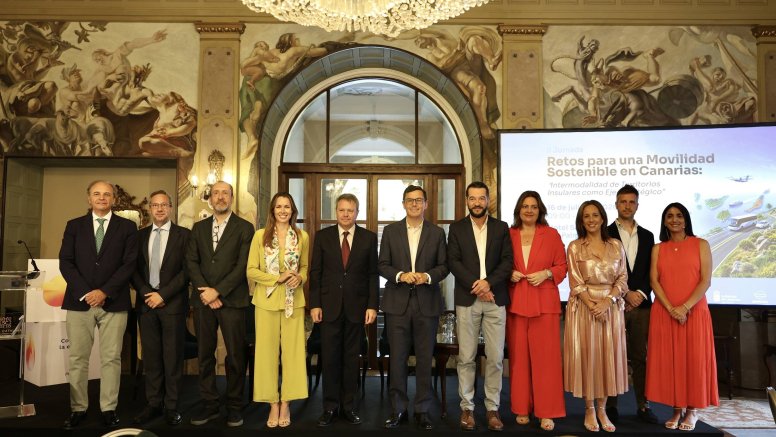
The Santa Catalina Hotel hosted last Thursday the II Conference Challenges for Sustainable Mobility in the Canary Islands: Intermodality of Island Territories as a Strategic Axis, a meeting that consolidated the space for dialogue between administrations and the private sector initiated in the first edition.
The institutional opening was carried out by Mr. Pablo Rodríguez, Minister of Public Works, Housing and Mobility of the Government of the Canary Islands, who inaugurated the conference and presented the keys to the Law on Sustainable Mobility of the Canary Islands. During his speech, the minister argued that "sustainable mobility must be approached from an integral vision that allows planning a connected system and not isolated actions". In this regard, he explained that the Canary Islands Executive "has promoted a strategy based on long-term planning during this legislature, with the development of the Strategy for Sustainable and Intelligent Mobility of the Canary Islands and the future Law on Sustainable Mobility".
Likewise, he insisted on the need to consolidate the free public transport due to the change in habits it has brought about and the opportunities it generates for accessing employment, training, and public services.
Rodríguez also highlighted the boost to the future Single Transport Ticket, support for the planning and development of railway projects in Gran Canaria and Tenerife, and the call for more than 15 million euros for island councils and city councils to execute infrastructures that favor intermodality and contribute to an increasingly efficient, connected, and sustainable mobility system. "Mobility is not just a matter of transport; it is equality of opportunity, territorial cohesion, and quality of life. Our goal is for roads, ports, airports, buses, and trains to be part of a single system that facilitates travel and guarantees a better connected and more sustainable Canary Islands," he stated.
Next, Mr. José Antonio Santano Clavero, Secretary of State for Transport and Sustainable Mobility of the Government of Spain, delivered the inaugural presentation “Commitment to the Canary Islands: moving towards more sustainable and connected mobility”.
During his speech, Santano expressed the Ministry's commitment to the Canary Islands and highlighted the Government's focus on the archipelago "within the strong impetus we are giving throughout the country to the transformation of the sector." The Secretary of State also recalled the Ministry's support for the mobility of residents and goods in the Canary Islands, amounting to 1.2 billion euros in 2025, and emphasized the archipelago's infrastructure, reviewing the investments planned for airports and ports, actions that exceed 2 billion euros in the coming years.
The round table "Intermodality in the Canary Islands: what can each sector contribute to this connectivity plan?", moderated by Ms. María Fernández, Director General of Transport and Mobility of the Government of the Canary Islands, brought together Mr. Ignacio Pérez-Carasa, Director of Institutional Relations and CSR of ALSA; Ms. Beatriz Calzada Ojeda, President of the Port Authority of Las Palmas; Mr. Luis López Chapí, Director of the Canary Islands Airports Group; and Mr. Manuel López Mendoza, Insular Director of Transport and Sustainable Mobility of the Cabildo of Gran Canaria.
The debate highlighted the idea that intermodality requires real coordination between transport modes and administrations: the participants agreed on the need to move towards integrated information, timetable, and ticketing systems that facilitate users combining buses, ferries, and airplanes in a single journey, as well as on the role of ports and airports as key nodes of that connectivity.
The program was completed with a presentation by Mr. Carlos Suárez Cubillo, Director of Mobility at Repsol, on multi-energy as a lever for the energy transition in transport.
At the closing, Ms. Rosa Martín (Nos Movemos Foundation) emphasized that "in a fragmented territory like the Canary Islands, intermodality is not a technical option, it is a strategic necessity. Eight islands cannot function as eight isolated transport systems: either we connect buses, ferries, and airplanes into a single travel experience, or we will continue talking about sustainable mobility without practicing it."
For her part, Ms. Vanesa Fontes (Fundación Líneas Romero) underlined the commitment of the private sector to this challenge: “the transport companies of the Canary Islands are not waiting to be told what to do; we are already investing in more efficient fleets and in better connecting our islands. What we ask is to move forward together, administrations and operators, because sustainable connectivity between islands will only be real if we build it together”.
Both agreed on the desire to give continuity to these conferences as a stable meeting space between the public and private sectors regarding the archipelago's mobility. The conference was attended by the Government of the Canary Islands and the collaboration of Repsol.