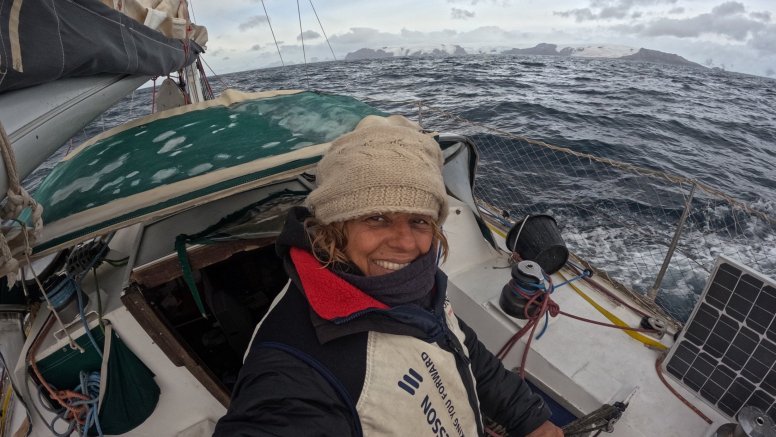
The Brazilian navigator based in Lanzarote for nine years, Izabel Pimentel, has just returned to the Canary Islands after a voyage of more than 12,700 nautical miles.
On September 27, Izabel arrived in El Hierro after completing her fourteenth solo Atlantic crossing. But this crossing was only part of a much larger adventure. The journey began on December 2, 2025, when she departed from Marina Rubicón, in Lanzarote, aboard her sailboat Don, a 34-foot Romanée, with a very particular goal: to turn 60 sailing at latitude 60. And she achieved it.
On February 11, her birthday, Izabel was in the middle of a storm in the Drake Passage, with winds of over 39 knots and waves over five meters high, a few miles from latitude 60. In the midst of that tempest, she was fulfilling the dream that had given rise to the journey: to celebrate her 60th birthday in the Drake, almost at latitude 60, heading for Antarctica.
During the voyage she faced strong storms, extreme temperatures, ice, fog, snow, breakdowns, and long solo days. She reached the waters of Antarctica and sailed among icebergs and penguins, before undertaking the long return journey to Brazil. From there she continued to Cape Verde and finally to Lanzarote.
Izabel is also the first Latin American woman to complete a solo circumnavigation and has sailed more than 100,000 nautical miles throughout her career. She participated in the Mini Transat in 2009, after crossing the North Atlantic in winter aboard a Mini 6.50, and has dedicated a large part of her life to sailing and to making projects a reality that, many times, seemed impossible.
Lanzarote has been her home for the last nine years and also the starting point of this latest adventure. She now returns to the island after having traveled thousands of miles and having fulfilled a dream that began long before she set sail.
Beginning of the round-the-world trip
Izabel Pimentel's relationship with the sea began many years ago, with windsurfing. It was there that it all started. "Then came the books and, with them, men who fed my imagination: Amyr Klink, Joshua Slocum, Bernard Moitessier, and Éric Tabarly. The dreams of high latitudes also arrived," she says. Little by little, a new project began to emerge: to sail around the world through the Southern Seas. Today, so many years later, the cold is so intense that it hurts the fingers. A sharp, almost unbearable pain, just to be able to take a reef.
Her story was never a rapid ascent. It was built slowly, with determination, resilience, and perseverance. She was born into a humble family, in Aquidauana, in Mato Grosso do Sul, Brazil, far from the sea. She studied, worked, and in 2009, she secured a spot to participate in the Mini Transat. In 2027, Las Palmas de Gran Canaria will host this regatta. She crossed the North Atlantic in winter, sailing her small boat, the Petit Bateau, and a few months later she was at the starting line of the Mini Transat. Before the Mini, she had already completed three Atlantic crossings in these small 6.50-meter boats. In total, there were 13 solo Atlantic crossings, in addition to others sailing as part of a team as part of her work.
"The round-the-world trip came in 2012, when I bought a Romanée, a 34-foot aluminum sailboat, under a French flag. Two years later, in 2014, I completed my solo circumnavigation of the Southern Seas, passing by the three great capes. At the end of 2015, life changed course again. I met my husband —a Frenchman of Greek origin— and Lanzarote became my home. I worked as a skipper and also produced and presented a show for a streaming platform, “Sueños Posibles”. Life found a calmer rhythm, but the sea never stopped calling me," she points out.
So, in 2025, an unexpected opportunity arose: to work as a skipper and take a classic Russian sailboat to Saint Petersburg. It would be a non-stop journey across the North Sea, with three people on board. It was a German boat, built for World War II, returning to its home port amidst a new period of tensions. After the war, it sailed under the Russian flag, traveled the world, participated in competitions, and even sank off Fuerteventura. The rest of this story is told in the documentary “Between Two Wars,” on my YouTube channel. "It was at that moment that I understood: it was time, once again, to turn a dream into a possible reality," he points out.
"I finished my job in Russia and began a new phase: preparing my sailboat, the Don. The same boat with which I had circumnavigated the world through the South Seas. A Romanée, designed by naval architect Philippe Harlé. It would turn 60 in February, and I decided to celebrate that birthday in a symbolic way: sailing to latitude 60. Today, reaching Antarctica requires complex procedures. My intention, however, was not to undertake a formal expedition. I was going to take advantage of the Drake Passage and simply get there. To encounter the icebergs, the seals, and the penguins. To be in that place that, for so many years, had only existed in my dreams," he highlights.
"I prepared the boat with the essentials: heating, a wind generator, solar panels, Starlink, appropriate sea clothing, and sufficient provisions of water and food. I set sail from Lanzarote on a sunny and windy day. Augusto, the manager of the Marina Rubicón shipyard, gave me a plotter and some cables, and I set off. I left behind my husband, my cats, and the island I call home. The crossing began with heavy seas, but without incident. Many birds accompanied the boat, and I sailed along a 'road' I already knew. Even so, there was something different in the air. A mixture of freedom, anxiety, and joy," he continues.
His first stop was in Brazil, in Florianópolis. There I received support from Schaefer Yachts, the largest shipyard in Latin America, in addition to equipment from Nautos and the wind vane from South Atlantic Self Steering Gears. From there, the temperatures began to drop. "I set off again with a forecast of atmospheric depression. To the south, in the area of Cape Santa Marta, I encountered intense traffic of fishing boats and also merchant ships. Despite everything, I managed to rest. The experience had already taught me not to be afraid of large ships," he comments.
Food and the rest of the journey
The food was simple: canned goods and freeze-dried meals. Two days later, strong, contrary winds arrived. Force 9. Waves of more than three meters. It lasted less than 24 hours, but it marked the beginning of a new stage. Further south, below the Río de la Plata, the concentration of fishing boats increased. Some were more than 300 miles from the coast, in an area where the depth reached approximately 100 meters. The AIS showed intense traffic, but I kept my course closer to the coast, always at a distance.
"Between calms and storms, I continued along the Argentine coast. Near the channel between Isla de los Estados and Tierra del Fuego, the wind exceeded 40 knots. I crossed the channel during the night and, already near the Drake Passage, the current showed its full strength. The initial idea was to go further west, towards Cape Horn. On the map it seemed simple. At sea, it was another story. The current was violent and I had the feeling of being dragged towards Isla de los Estados. With an engine of barely 25 horsepower, I couldn't count on it to resolve that situation," he recounts.
Little by little he gained ground to the south. And then the dreaded Drake crossing began. In 2014 he had already crossed the Drake from east to west. This time he would take another route. And he discovered that it was much more difficult. He gained some miles and reached the longitude of Cape Horn, but the northeast wind arrived with violence. The forecast of strong waves forced him to continue further east. The idea of entering Antarctica from the west had to be abandoned.
"The Drake is unpredictable. Violent winds followed by sudden calms. The famous '0 or 800'. Waves that violently heeled the boat. To keep my head on straight, I read: history books, novels, and travelogues. At sea, maintenance never ends. There's always something to adjust, something to repair. On the Argentine coast, I encountered dense fog. In the Drake, in addition to the fog, snow arrived. Even the sea spray froze," he recalls.
The Drake crossing began on February 8, a few days before his birthday. The barometer dropped sharply. On the 10th, the wind increased. And on the 11th, his birthday, he was in the middle of a storm, with over 39 knots of wind and waves over five meters high, a few miles from latitude 60. At that moment, in the midst of the sea's fury, he realized he was fulfilling the dream that had brought him there: celebrating his 60th birthday in the Drake, sailing almost at latitude 60. This time, he was truly at the end of the world.
The Drake is a chaos of currents, opposing wind systems, and crossed seas. A true maritime disorder. On the 14th, the wind dropped for a few hours. And that's not always good news when the current remains strong. He took the opportunity to make repairs. At night, the wind became favorable again, and he was able to advance. He reached the latitude of King George Island.
"At dawn, I saw the white of Antarctica. Icebergs. Screaming penguins. And that almost deafening silence that only exists in places where humans are still small compared to nature. I headed towards the bay of the Brazilian base, but the wind at the entrance was violent. I tried to advance a few miles, but the rocks, the current, and the force of the wind forced me to give up. Then another problem appeared: the engine wouldn't start. The battery was dead," he says.
"Without an engine, surrounded by ice and strong currents, I kept my distance from the coast. And, despite everything, I was happy. I celebrated my 60th birthday in the Drake. I sailed among icebergs. And I felt powerful. At that moment, I understood something that perhaps I had known for a long time: 'achievable dreams can truly come true'," he continues.
On the 16th, further east, he approached an area of large icebergs. He thought about the place where A23a, one of the world's largest icebergs, with almost 4,000 km², was born. It was there that the Don broke the ice again. And it was also there that he truly felt the danger of being close to an iceberg. An iceberg is not just what we see. Its submerged part can hit a ship. It can rotate, it can fragment suddenly, causing waves and water movements capable of affecting a vessel. And the small ice blocks around, often almost invisible, can also threaten the hull. In such cold water, the slightest incident can become a critical situation.
Once again, the wind dropped. Near Elephant Island, surrounded by ice floes, he waited. When the wind returned, he began the journey back. On the 22nd, a new calm. He remembered a book about acceptance. How many times do we fight against what we simply cannot change? There, in what is perhaps the most hostile place on the planet, he prepared a coffee and uttered a single word aloud: "acceptance."
"That day, five albatrosses landed around the boat. They stayed with me for hours. I gave them tuna, which they tried to catch with their huge beaks. I would never have experienced that moment without that calm. The wind returned, contrary, and the long journey back began. It took more than a month between the Drake and Florianópolis, without sun, between calms and winds of over 35 knots," he narrates.
He stopped again in Florianópolis and then continued towards Rio de Janeiro and Salvador. On a day of large waves and strong wind, he departed from Salvador for my fourteenth Atlantic crossing. It was another 12 days of calms—impressive, endless—. But he arrived safely at the island of Mindelo, in Cape Verde, almost a month later.
From Cape Verde to Lanzarote, there was still one last difficult stage: sailing against the wind. It was a tough beat. But on September 27th, he was able to shout once more: "Land ahoy!" And in front of it was the beautiful island of El Hierro. "I arrived lighter, a few kilos down, but carrying with me the certainty of having lived something extraordinary," he concludes.
Add La Voz de Lanzarote as a preferred Google source.
Stay informed with the latest current news.