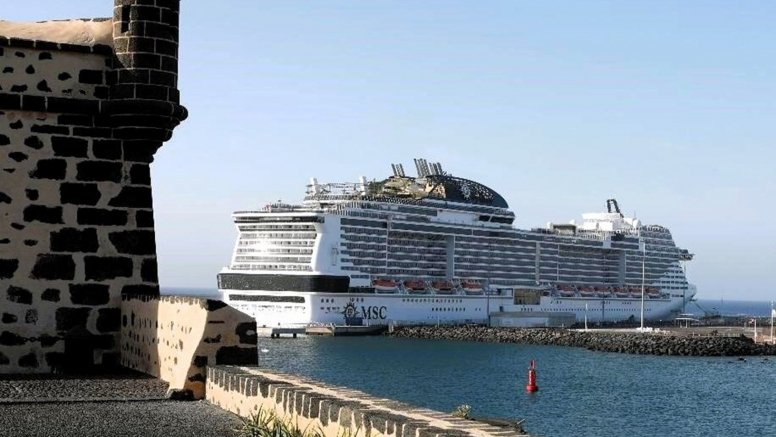
Ecologistas en Acción has penalized with a black flag for tourist overcrowding and pollution the tourist cruises of the Port of Los Mármoles and La Marina in Arrecife.
In one of its most publicized campaigns, the collective has denounced the "poor institutional management" of these cruises and has warned that they generate "an enormous impact" on "a limited and fragile territory."
The collective has indicated that Lanzarote is the second island "in terms of cruise volume," bearing "an especially high impact in its capital, Arrecife." To which it has added that the forecasts for this year are that the island will receive "a volume of cruise passengers ten times greater than its population."
One of the most polluting forms of tourism
In the case of the province of Las Palmas, Lanzarote has been penalized for poor management. The environmental group has pointed out that tourist cruises represent in the Canary Islands a "disequilibrium" between the economic benefits and the social and environmental costs they generate. Thus, they have warned that Lanzarote will go from 150,000 cruise passengers in 2021 to 700,000 in 2026.
The environmental group has warned that cruises constitute "one of the most polluting forms of tourism." Even when docked in port, ships keep their auxiliary engines active, in addition to underwater noise pollution, discharges that harm marine biodiversity, as well as the impact on air quality and the habitability of cities.
In this regard, it has held the Port Authority of Las Palmas, the Cabildo of Lanzarote, and the Government of the Canary Islands responsible for promoting a policy "based" on the "unlimited increase" of cruises.
Saturation of Timanfaya and lack of taxis
The frequency of these visitors, Ecologistas en Acción has indicated, affects the Timanfaya National Park, with "thousands of visits that generate kilometer-long queues of vehicles on the roads."
Furthermore, the incidence in Arrecife focuses on the lack of taxis for residents, overcrowding in commercial streets, demand for restrooms in cafes, as well as the non-compensation of extended commercial hours by cruise passengers and the low volume of sales.
Regarding the boom in cruises and their growth forecasts, Ecologistas en Acción states that "luxury segments and immersive experiences in previously less saturated areas are growing." Furthermore, these types of vessels, especially large cruise ships, consume between 150 and 250 tons of fuel daily.
For example, it points out that 47 cruise ships operating in Europe can emit "more sulfur oxides than 260 million cars". While stating that the transition to biofuels "does not solve the problem".
Four black flags in the Canary Islands
The report Black Flags 2026 covers more than 8,000 kilometers of Spanish coasts and points out 48 environmental disasters or threats. Per province or autonomous city, two black flags are awarded, one for pollution and the other for poor environmental management. In the Canary Islands, four points have been highlighted.
The other provincial flag has been awarded for "chronic spills and acute episodes of pollution" generated by industrial aquaculture on the coast of Telde, in Gran Canaria, where several beach closures due to marine pollution have been recorded. In the Canary Islands, it has also penalized with another black flag the beach of Las Teresitas, in Tenerife, as well as the alleged "illegal project" of the luxury macro-tourist development Cuna del Alma for the third consecutive year.