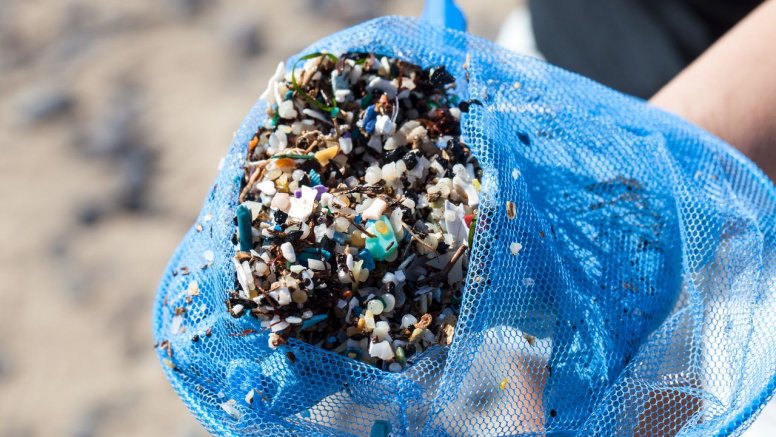
The plastic pellet spill from the containers lost by the ship Toconao on December 8, 40 nautical miles off the Portuguese coast and about 20 kilometers from the border with Galicia, represents a damage to marine ecosystems. This has been highlighted by the research group of Ecophysiology of Marine Organisms (EOMAR) of the Institute ECOAQUA of the University of Las Palmas de Gran Canaria.
In the event that remains of the pellet spill reach the Canary Islands, this arrival would occur approximately after one year. This is an assessment made by experts from the Physical Oceanography and Applied Geophysics group (OFYGA), also attached to the ECOAQUA institute, who have based their approach on statistics of dragging this type of waste in the sea currents that lead from the point of the spill to the islands.
“The Canary Islands, due to their condition as oceanic islands, are exposed to the arrival of all types of marine litter, unfortunately on a regular basis. Pellets are no exception, and it is not uncommon to find this type of plastic waste in the sand of the beaches or deposited among the rocks. It is likely that some of the pellets from the Galicia spill will end up reaching the coasts of the Canary Islands, but by then it will do so as one more element of that marine litter to which we are sadly getting used to”, says Miguel Borja Aguiar, researcher at OFYGA.
That is why, according to the Institute for Research in Sustainable Aquaculture and Marine Ecosystems (ECOAQUA), now that the first samples are beginning to arrive on the Galician and Asturian coasts, a month after the incident occurred, it is essential to have all the information about these pellets: what type of plastic they are made of, whether they contain additives, and whether their technical data sheet includes any type of specification in this regard.
In addition, it is important to remove them quickly from the coast, as they arrive, thus preventing them from mixing with sand and algae, which would make their collection much more difficult.
“Pellets represent a very serious environmental problem, as they can remain in the environment for a long time, between 50 and 70 years, until they gradually degrade into smaller particles. The danger for marine organisms is, on the one hand, the physical damage that their ingestion can cause, and on the other, the damage caused by the chemical contaminants they carry associated”, says Alicia Herrera Ulibarri, biologist and doctor in Oceanography, who belongs to the EOMAR research group.
Presence of pellets in the Canary Archipelago
With regard to the Canary Islands, the EOMAR group of the ECOAQUA institute has already detected the presence of pellets on the islands' beaches for years. “We can highlight, as an example, a microplastic sampling carried out in October 2015 on Famara Beach, located in the municipality of Teguise, in Lanzarote, where it was found that more than 40% of the sample was made up of pellets”, says Alicia Herrera.
Pellets or granules are raw material for the manufacture of plastic objects and, in general, have a spherical or lentil shape of approximately 5 millimeters in diameter, and are presented in white or transparent, although there may be various colors, they point out in EOMAR.
They can be made with different plastic polymers, mainly with polyethylene (PE) or polypropylene (PP), which are the plastics most frequently used by the industry; and they reach the sea or the beaches through containers that fall into the water, as has happened now, or through residual losses in the industries, which causes them to reach the rivers and ravines, and through these, to the coasts.
“In other studies carried out on pellets collected on three eastern Canary Islands: Gran Canaria, Lanzarote and La Graciosa, selected for their different degrees of anthropogenic pressure, which is the influence of tourism or proximity to urban environments, we found more than 80 types of associated contaminants, including pesticides, flame retardants and UV filters”, says the researcher, who is hired as an excellence researcher by the Viera y Clavijo program of the ULPGC, for competitive scientists with an outstanding career.
On the other hand, in experiments carried out with fish fed with feed and 10% microplastics and pellets, which the ECOAQUA institute group collected from the beaches and which had associated chemical contaminants, it has been found that these chemical contaminants passed to the liver of the fish.
In this sense, due to the high danger of the spill and the arrival of these pellets on the Spanish coasts, EOMAR praises the work that institutions such as Good Karma Project have been doing for years, through their complaint and disclosure.
Add La Voz de Lanzarote as a preferred Google source.
Stay informed with the latest current news.