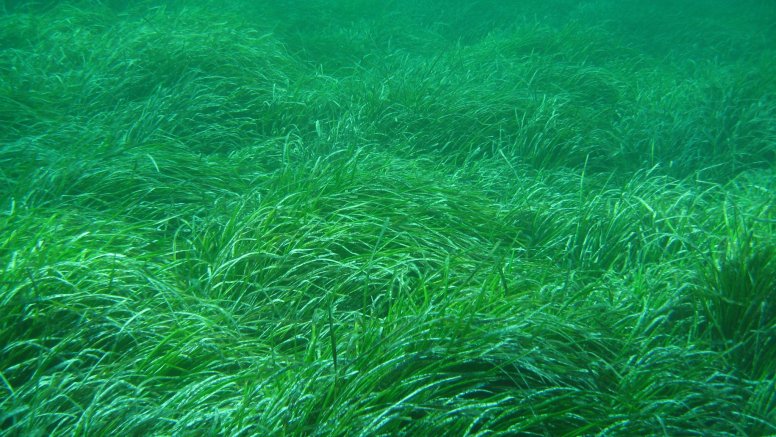
An international study has warned of the need to protect seagrass meadows, known in the Canary Islands as sebadales, and to reduce local pressures on one of the "most valuable and vulnerable ecosystems in the world". The research is led by professionals from the Biodiversity and Conservation (BIOCON) group of the ECOAQUA University Institute, at the University of Las Palmas de Gran Canaria (ULPGC)
Scientists assure that the gap between their recognition and their protection remains "immense". These seagrass meadows are formed by flowering plants adapted to living in the sea, including species such as *Cymodocea nodosa*, known in the archipelago as seba.
A refuge for fishing species and a carbon store
These sebadales are of vital importance to society as they provide refuge and breeding grounds for fishing species, filter sediments and pollutants, buffer waves, and store carbon. Therefore, their loss considerably affects biodiversity, coastal protection, water quality, and coastal economic activities.
The research, titled *Scientists warning on safeguarding seagrass meadows* and published in the scientific journal *Biological Conservation*, argues that stopping the loss of these habitats in the next decade is possible, but requires turning biodiversity and blue carbon commitments into effective conservation measures.
“Our central message is operational: it is possible to stop the loss of seagrass in the next decade, but only if conservation and political efforts focus first on protecting existing sebadales and addressing the main local drivers of decline, rather than relying primarily on climate mitigation potential,” asserts BIOCON researcher Rodrigo Riera, lead author of the study.
Therefore, the work, in which nine specialists from institutions in Spain, Australia, Brazil, Canada, South Africa, and Italy have participated and is based on three decades of 'Scientists' Warnings', presents an action-focused warning.
“We argue that the future of sebadales depends less on documenting declines and more on prioritizing the protection and conservation of existing meadows, which continue to be threatened mainly by local stressors,” says Riera.
Causes of loss and climate change
The scientific team points out that, in most biogeographic regions, the main causes of short-term loss are local and can be addressed through management. These include damage from anchors and mooring systems, dredging, deterioration of water quality, certain interactions with fishing and aquaculture, and modifications of coastal dynamics.
Climate change exacerbates these threats and can be decisive in the thermal distribution limits of species. However, the authors warn that "climate mitigation alone is not enough: it is also necessary to reduce the direct pressures that weaken meadows and limit their ability to withstand extreme events."
One of the central proposals consists of ceasing to evaluate each threat in isolation. A meadow exposed to pollution, physical damage, and heatwaves may respond differently than predicted when studying each factor separately. Therefore, they estimate that marine planning and environmental impact assessments must consider cumulative stressors, the magnitude, coincidence, and interaction of existing pressures before authorizing new activities. To this end, they affirm, tools exist and should be applied routinely.
Conserve first, restore with guarantees
The study argues that restoration is a complement, not a substitute for protection. Before investing in planting or transplanting, the causes of deterioration must be identified and reduced. The historical presence of a meadow or the ease of access to a site do not guarantee that an intervention will thrive if the conditions that caused its disappearance persist.
The review collects experiences showing that natural recovery is possible and replicable when local pressures decrease. Improved wastewater treatment and water quality have favored recolonization in various coastal systems of the Northwest Atlantic such as Virginia, Boston, and Florida, demonstrating that the warning can be effective. This evidence supports the need to act on the origin of the problem, in addition to developing restoration techniques.
Seven priorities for moving from knowledge to action
In this study, Riera explains, “we synthesize evidence across bio-regions to identify common degradation patterns, propose a practical framework that organizes threats according to their physical, chemical, biological, and climatic origins, explicitly considering cumulative effects, and establish a priority research and policy agenda.”
The proposed agenda brings together seven lines: standardize global mapping; improve species classification and knowledge of their ecological traits; quantify their resilience and recovery capacity and the role of associated microorganisms; expand restoration with biotechnological, genetic, and microbial science support; manage cumulative pressures; strengthen equitable governance capable of translating blue carbon and biodiversity commitments into effective protection and restoration actions; and promote communication, citizen science, and education.
Mapping occupies a fundamental place because there are still large unexplored areas and high uncertainty about the global extent of these habitats. The article proposes combining high-resolution remote sensing, drones, environmental DNA, and marine animal tracking to locate little-known meadows and protect them before they degrade.
In this regard, the researchers assert that standardized global mapping at a policy-relevant resolution “is the most important enabling task and must be the anchor for blue carbon and biodiversity accounting.”
The authors also call for the incorporation of local communities and the recognition of their ecological knowledge. Lasting conservation requires combining science, legal protection, and social participation, with actions that reduce threats on the ground and allow for the maintenance of the benefits these ecosystems provide to society.
In addition to Riera, the study included the participation of Fernando Tuya, director of the BIOCON group of ECOAQUA, as well as researchers from the following institutions: Mediterranean Institute for Advanced Studies (IMEDEA) (Spain); School of Biological Sciences and Oceans Institute, University of Western Australia, Centre for Marine Ecosystems Research and School of Science and Centre for People, Place and Planet, both from Edith Cowan University (Australia); Institute of Oceanography, Universidade Federal do Rio Grande (Brazil); Pacific Biological Station, Fisheries and Oceans (Canada); Department of Botany and Zoology, Stellenbosch University (South Africa); Stazione Zoologica Anton Dohrn and National Biodiversity Future Center (NBFC) (Italy).
Add La Voz de Lanzarote as a preferred Google source.
Stay informed with the latest current news.