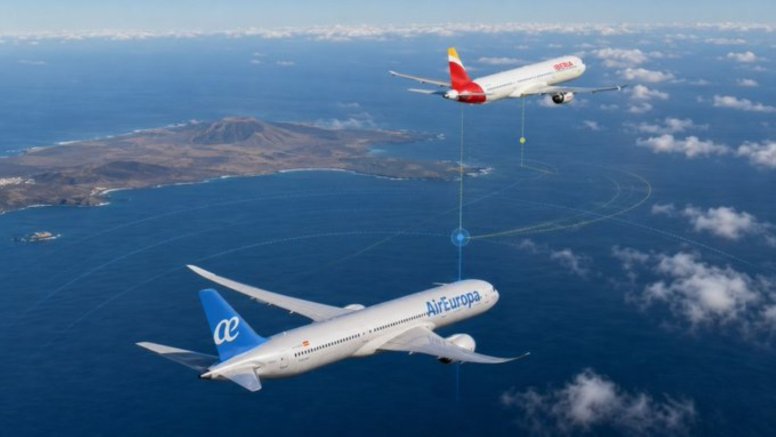
The Independent Professional Union of Air Traffic Controllers (SPICA) revealed this Friday, July 17, an incident registered on July 10 in the oceanic airspace of the Canary Islands, in which an Iberia Airbus A321 and an Air Europa Boeing 787-9 were involved, which, according to the union, were flying along the same airway, at the same flight level and in opposite directions.
According to the information released by SPICA, the event occurred at 01:23 UTC on airway N857, within the FIR/UIR of the Canary Islands managed by ENAIRE. The Iberia Airbus A321, registration EC-OLE, operating flight IBE0140, received an alert from the TCAS anti-collision system to descend, while the Air Europa Boeing 787-9, registration EC-NBM and callsign AEA05, received a coordinated order to ascend.
The union explains that the Iberia plane descended 500 feet and the Air Europa plane ascended 400 feet until the system indicated that the conflict had ended. According to SPICA, both aircraft subsequently continued their flights normally and no injuries or personal damage were reported.
In its statement, SPICA maintains that this incident "once again focuses on operational safety in oceanic sectors," where, it states, surveillance and communication coverage presents greater limitations than in continental airspace. Likewise, it defends the need to equip these sectors with adequate technical and human resources and to analyze each incident from a just culture perspective.
The union also takes advantage of this event to reiterate its criticism over the disappearance of the Commission for the Study and Analysis of Air Traffic Incident Notifications (CEANITA), considering that its suppression left the analysis of this type of incident without a collegiate body. In this regard, it calls for the recovery of a collective analysis system with the participation of professionals from the sector.
Finally, SPICA recalls that it is up to the Civil Aviation Accident and Incident Investigation Commission (CIAIAC) to determine the causes of the event, registered under reference IN-017/2026, and, if applicable, to issue the corresponding safety recommendations.
Add La Voz de Lanzarote as a preferred Google source.
Stay informed with the latest current news.