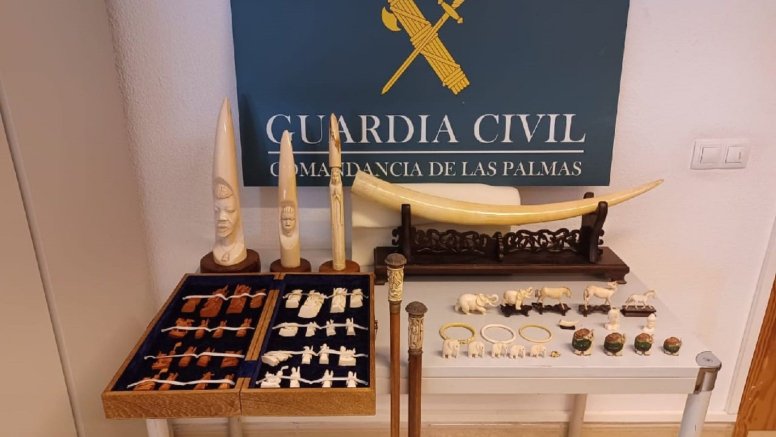
The Guardia Civil of Las Palmas has seized a collection of ivory pieces whose legal provenance could not be proven, after a private individual alerted the Nature Protection Service (Seprona) to the fortuitous discovery of these objects in a dwelling.
The events took place at the beginning of this month, when the owner of the property, where rehabilitation works were planned to begin, found several pieces that could be subject to regulations for the protection of endangered species.
In the absence of documentation proving their legal provenance, he decided to contact the Guardia Civil to report the find and facilitate the agents' intervention. From the outset, the owner showed "an attitude of full collaboration, voluntarily handing over the objects and facilitating Seprona's actions," the armed institute highlighted.
Ivory tusks, figures, and two wooden canes
The seized collection consists of four ivory tusks of different sizes, three of them with engravings of different motifs, numerous figures carved from this material, and two wooden canes with carved ivory handles.
The seizure of these pieces highlights the importance of checking the provenance of certain objects that, despite being part of old collections or having been in private homes for years, may be subject to legal restrictions related to the protection of endangered species.
In this regard, the Convention on International Trade in Endangered Species of Wild Fauna and Flora (CITES), along with European Union regulations, establishes measures to regulate the international trade of these species and products derived from them, with the aim of preventing their exploitation and contributing to the conservation of biodiversity.
The possession, display, or marketing of certain specimens without the required documentation or authorizations may lead to administrative actions and, depending on the circumstances, to possible criminal liability.
The applicable measures are determined by the nature of the objects, their origin, and the conditions under which they were acquired, conserved, or marketed, and may include their seizure and the processing of the corresponding sanctioning procedures.
Faced with situations like this, the Guardia Civil recalls the importance of communicating to Seprona the finding of ivory pieces, taxidermied animals or other specimens that may be subject to legal protection, especially when located in family homes, inheritances or old properties.
Citizen collaboration is fundamental to prevent the illegal trafficking of protected species and contribute to the conservation of biodiversity. The communication of these types of findings allows agents to assess each case and ensure that action is taken in accordance with current environmental regulations.
Add La Voz de Lanzarote as a preferred Google source.
Stay informed with the latest current news.