The historic agricultural town of Tiagua, of aboriginal origin and located in the municipality of Teguise, is turning its gaze back to its roots these days for the festivities in honor of its patron saint, Our Lady of Perpetual Help
The history of this endearing Lanzaroteño town dates back to very ancient times. Its original settlement was located in the Fiquinineo area, close to important archaeological sites such as the Cueva del Majo and El Bebedero. However, the adversities of nature, including sandstorms and the volcanic eruption of 1585, forced its ancient inhabitants to move to the place where the town of Tiagua currently stands.
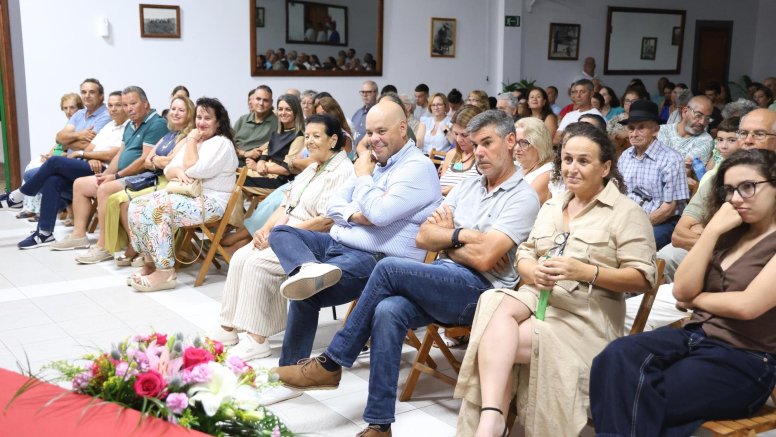
And precisely of history, memory, efforts, and experiences was imbued the night of last Thursday, when at 8:00 PM, the Tiagua Socio-Cultural Center El Molino hosted the traditional opening speech of the festivities. With the social hall completely full, neighbors and visitors gathered to share a very special evening, marked by emotion and by the prominence of several sons of the town who have managed to turn effort and perseverance into a way of life.
This year, the opening speech featured entrepreneurial residents of Tiagua, men linked to different professions and business activities who, with their daily work, have also contributed to the economic and social development of the town.
Among them were Esteban Martín, dedicated for years to carpentry, a profession he practices in his own workshop; Aníbal and Germán Díaz Barrios, owners of a car rental company; José María and Óscar Cabrera, at the head of their transport and excavation company; and Casimiro Rivera Bonilla, also dedicated to the transport sector.
They are all sons of Tiagua. Some continued the legacy and the path started by their predecessors, while others decided to start their own businesses and build their own companies step by step. A path that, as they themselves recounted during the opening speech, has been full of hours of work, sacrifice, worries, and also satisfactions.
Each of the speakers shared their own story with the public, recalling how those first beginnings were and how, over the years, they have managed to keep the activity alive despite the difficulties and the uncertainty that, on many occasions, accompanies the current labor and business landscape.
There was also room to talk about the future. Some expressed the concern and uncertainty they feel about the possibility that their children will not continue at the head of the family businesses. The new generations have embarked on their own paths, have other training and personal projects, and, as often happens, their lives may take different paths than those chosen by their parents.
But if there was something that especially aroused emotion among those present, it was the memories of childhood and youth.
The simplicity of the festivals of yesteryear
The heralds spoke of those simple and humble festivals of yesteryear, very different in many aspects from those celebrated today. There were no big events or extensive festive programs, but, as they themselves agreed, with very few things they were tremendously happy.
A simple scavenger hunt, a sack race, or a village festival held in one of the neighbors' threshing floors were enough to fill the streets and hearts of those children and young people from Tiagua with joy.
And, of course, there was a day that was awaited with very special excitement: the feast of Our Lady of Perpetual Help.
Then came the time to wear new clothes, to wear new clothes to attend the solemn religious service and the subsequent procession. Afterwards, the celebration continued in the homes, around the family table, enjoying that special meal prepared for the big day of the festivities. And as a final touch, homemade dessert, handcrafted with all the love by the mothers, could not be missing, whose flavors remain alive today in the memory of those who were fortunate enough to enjoy those times.
Simple experiences, but loaded with enormous sentimental value. Memories of a time when perhaps there were fewer comforts and fewer possibilities, but in which, as the heralds agreed time and again, people lived with a happiness that remains intact in memory.
The audience followed each of the speeches with great attention and closeness, and the heralds received the warm and well-deserved applause from the neighbors and visitors.
In this endearing evening, the accompaniment of various authorities and community representatives was also present. The protagonists were supported by the neighbor, the parish priest Don Rafael Tejera Parrilla, as well as the mayor of the Teguise City Council, Olivia Duque, and the councilor for Festivals and Culture, Andoni Machín.
Without a doubt, it was a very special and endearing night. A night in which the words of the heralds managed to awaken numerous memories among the attendees, transporting them, for a few moments, to their own childhood and youth.
Because, upon hearing those stories, many neighbors could also recognize a part of their own lives: the festivals of yesteryear, the games in the streets, the family gatherings, the excitement of wearing a new garment, or the happiness of enjoying simple things.
Tiagua thus inaugurated its patron saint festivals with a different, close, and profoundly human proclamation. A tribute to the entrepreneurial spirit of several of its children, but also a tribute to the collective memory of a town that does not forget its roots.
A night to remember that progress is important, that times change, and that new generations have the right to choose their own paths, but also to understand that there are memories, values, and experiences that are forever part of a town's identity.
And, above all, a night that left in the air a reflection shared by all: perhaps we had fewer things, but, without a doubt, we were very happy.
Add La Voz de Lanzarote as a preferred Google source.
Stay informed with the latest current news.