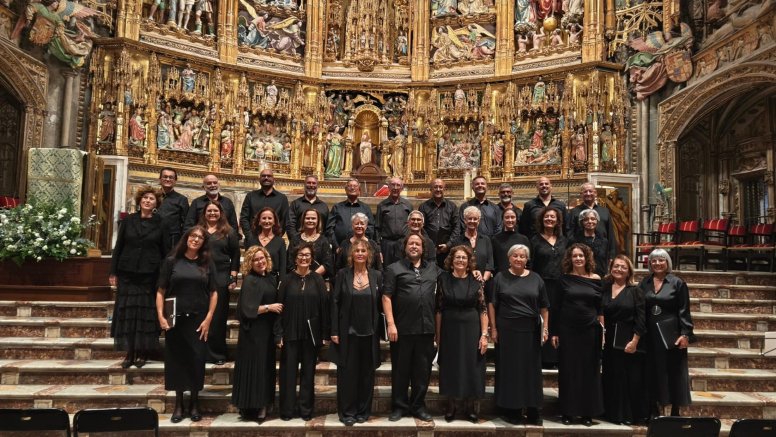
The San Ginés Polyphonic Choir, founded in Arrecife in 1973 by Professor Don Braulio de León Navarro, made a cultural trip through Castilian lands from the 9th to the 12th of the present month with the purpose of bringing its music to two cities of extraordinary historical, artistic, and spiritual relevance: Ávila and Toledo.
An experience in which sacred music, monumental heritage, and the emotion of singing in historically charged settings went hand in hand, leaving indelible memories for its members.
Ávila, the first stop on a journey with a musical soul
The first stage of the tour was to Ávila, a city universally linked to the figure of Saint Teresa of Jesus and the birthplace of one of the great masters of Spanish Renaissance polyphony: Tomás Luis de Victoria, a composer whose work is a regular part of the San Ginés Choir's repertoire.
On Saturday the 10th, the Arrecife group participated in the celebration of the Eucharist in the Basilica of the Holy Martyrs Vincent, Sabina, and Cristeta, one of the most emblematic churches in the city. The musical performance, of a distinctly sacred nature, reached its climax at the end of the celebration, when the voices of the San Ginés Choir raised the Ave Maria by Tomás Luis de Victoria from the main altar, a particularly significant performance as it took place in the land that saw the birth of the distinguished composer.
At the beginning of the Holy Mass, the parish priest announced the Choir's participation, expressing his gratitude for the presence of the Canarian group. Their cordial welcome continued at the end of the celebration, when, with commendable generosity, they offered to accompany the choristers on a tour of the church, explaining its history and the main elements of its artistic and religious richness.
One of the most notable moments of this visit was access to the crypt, where the Virgen de la Soterraña is venerated, one of Ávila's most deeply rooted Marian devotions. The visit allowed the members of the Choir to connect with the history and religious traditions of a city where spirituality is an inseparable part of its identity.
The Carmelite footprint was also present during the stay. Ávila, closely linked to Saint Teresa of Jesus, offered visitors the opportunity to get closer to one of the places connected to her figure. There, spontaneously, a few bars of "Nada te turbe" emerged, the well-known composition inspired by the saint's words. It was a simple moment, born from the emotion of the time, in which music became a form of homage and encounter with one of the most universal figures of Spanish spirituality.
Toledo, the grandeur of the Primate Cathedral
On Sunday the 11th, the expedition moved to Toledo, a monumental city that preserves the footprint of centuries of history in its streets, squares, and buildings. One of the most anticipated moments of the trip awaited them there; the participation of the Coral Polifónica San Ginés in the 6:30 PM Eucharist in the Holy Primate Cathedral of Saint Mary, also known as Dives Toletana, a Latin expression that evokes the richness and magnificence of this extraordinary temple.
The Coral's presence in the Cathedral took on a special meaning. Although daily celebrations usually take place in a chapel of the temple, on this occasion the Eucharist was celebrated at the main altar, accompanied by the songs of the Arrecifeña group from the cathedral choir.
Singing in a venue of such historical and artistic relevance was an experience of particular emotion for all the members. The solemnity of the space, the spiritual depth of the celebration, and the extraordinary resonance of choral music contributed to creating an atmosphere in which the voices integrated harmoniously into the liturgy, offering attendees a sample of the work and musical sensitivity that distinguish this group from Lanzarote.
The performance also had a commemorative significance. Throughout this year, various events have been held to mark the eighth centenary of the laying of the first stone of the Cathedral of Toledo, an event that took place in 1226, during the reign of Ferdinand III the Saint. With their musical participation, the Coral Polifónica San Ginés wished to modestly join this anniversary, contributing their voice to a celebration that links eight centuries of history, art, and religious tradition.
Just as had happened in Ávila, the priest who presided over the Eucharist expressed his gratitude for the Choir's performance, both at the beginning and at the end of the celebration. These were words that the choristers received with satisfaction, aware that their work had contributed to solemnizing the ceremony and sharing the beauty of sacred music with the faithful.
And, as has become customary on the group's cultural trips, the moment also came to immortalize the experience with a group photograph from the main altar. Before saying goodbye to that exceptional venue, the Choir once again paid homage to Tomás Luis de Victoria with the performance of his "Ave María". The voices resonated once more under the vaults of the Primate Cathedral, while the audience present responded with a warm applause, bringing an emotional musical conclusion to the day.
Music as a language of encounter
The repertoire chosen for this occasion was dedicated fundamentally to sacred music, in keeping with the nature of the liturgical celebrations and the uniqueness of the spaces in which the Choir participated.
The organ music was performed by colleague and professor Javier Díaz, whose performance accompanied the interpretations and contributed to the musical development of the celebrations. The direction was under the responsibility of professor Elías Roldán, at the head of a group that, with its work and dedication, continues to keep alive the choral tradition born in Arrecife more than half a century ago.
Because a trip of this nature is not measured solely by the kilometers traveled or the grandeur of the monuments visited. It is also measured by the shared emotions, by the welcome received, by the learning provided by contact with other cultural realities, and by the satisfaction of realizing that music continues to be a universal language capable of uniting sensibilities, awakening feelings, and building bridges between peoples.
From Ávila, under the spiritual memory of Saint Teresa of Jesus and the musical legacy of Tomás Luis de Victoria, to Toledo, with the solemnity of its Primate Cathedral and the commemoration of its eight centuries of history, the Coral Polifónica San Ginés has experienced a day in which culture, faith, and music have walked hand in hand.
A memory that will remain in the mind
With the return home, the Coral leaves behind the Castilian lands, but brings with it something that does not fit in suitcases; the emotion of having sung on two exceptional stages, the gratitude towards those who received them with such cordiality, and the pride of having represented Arrecife and Lanzarote through music.
Since its founding in 1973 by Don Braulio de León Navarro, the Coral Polifónica San Ginés has kept alive a musical vocation that is part of the cultural heritage of our city. Each performance, each meeting, and each trip contributes to enriching that trajectory, while also projecting the work of a group that finds its reason for being in choral singing beyond our islands.
Ávila and Toledo will undoubtedly remain in the memory of all participants. And among the images they will keep from these days, there will hardly be a lack of those voices that, from two temples steeped in history, made Tomás Luis de Victoria's "Ave María" resonate, uniting the Castilian musical tradition with the spirit of a Coral born next to the Atlantic.
Because there are trips that end when the journey back begins, but there are experiences that continue to resonate long after. This has been one of them for the Coral Polifónica San Ginés.
Add La Voz de Lanzarote as a preferred Google source.
Stay informed with the latest current news.