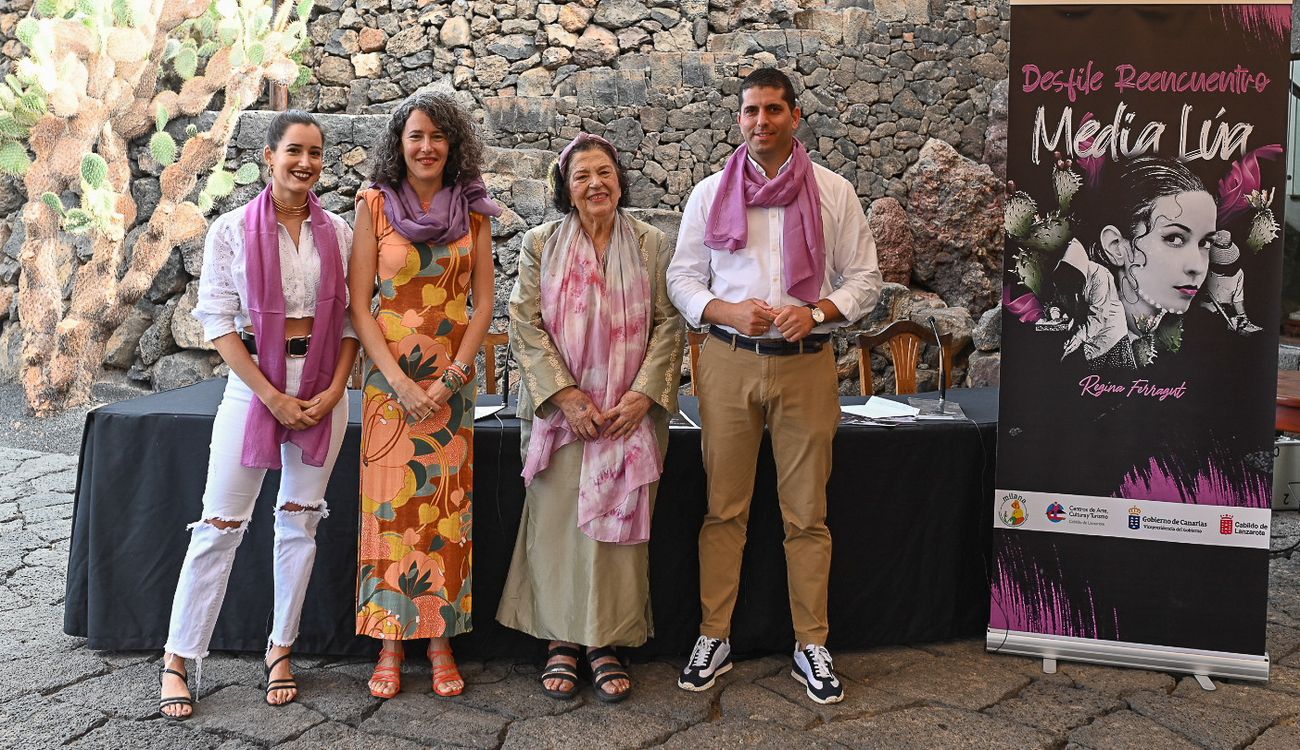
The Cactus Garden will become the fashion catwalk this coming July 30, to host the Reencuentro Media Lúa fashion show, an event organized by the Milana Association that will present designs by the creator Regina Ferragut dyed with cochineal.
The Minister of Industry of the Cabildo of Lanzarote, Ariagona González, the CEO of the Tourist Centers, Benjamín Perdomo, the president of the Milana Association, Sebastiana Perera, and the designer herself, were in charge of announcing the details of an event that will begin at 6:30 p.m. this Saturday.
With Reencuentro, Media Lúa, the Milana Association aims to motivate the use and application of cochineal in textiles and crafts to promote employment proposals that help boost the economy and contribute to recovering a "unique" landscape of the island.
Specifically, the design of the clothing that will be worn by models of different ages from the town of Mala corresponds to Regina Ferragut, a former student of CEIP las Mercedes and a graduate in Design and Fashion from the Rey Juan Carlos University.
The passes will be organized into three groups: the first, of garments for ages between 3 and 12 years; the second, of men's and women's garments in pastel tones made with organic fabrics such as linen, and the third, with more subtle and delicate feminine and masculine designs due to the fabrics used. In addition, there will also be music, dancing and many surprises.
A reunion supported by the Tourist Centers
González highlighted the benefits of a parade "that recovers such an important and unique landscape of the island", while the Minister of Industry considered that "there is no more appropriate space than the Cactus Garden to host an event that is beauty, countryside, agriculture, innovation, inclusion and good taste, and that offers new uses that dye our traditions with modernity".
For his part, Benjamín Perdomo has explained the "unquestionable" support of the Tourist Centers for an initiative that aims to rescue a fundamental part of the island's history.
"The extraordinary allocation of one million euros that we have made available to the cultural fabric of the island is allowing us to launch a series of initiatives as enriching as this fashion show, which rescues and values a fundamental industry for the socio-economic development of Lanzarote in the 19th century," he says.
During the presentation, Sebastiana Perera reviewed the work carried out by the Association she chairs to "rescue cochineal as a structuring, dynamizing and enriching element of the Guatiza and Mala area", and thanked the Cabildo of Lanzarote, the Director of Institutional Relations of the Vice-Presidency of the Government of the Canary Islands, Carmen Nieves Gaspar, and the Tourist Centers with its advisor at the head, Benjamín Perdomo" for their collaboration.
Regina Ferragut explained, for her part, that the parade is, precisely, "the reunion with the colleagues, friends and families of the CEIP Las Mercedes who participated in the project Rescue of cochineal cultivation. Socio-economic study of the town of Mala between 2003 and 2004". The young designer explained that "the designs are intended to represent the phases of the moon", and stressed "that the garments are inclusive because they are created for unconventional bodies".
It should be noted that since 2005, the Milana Association has decided to commit to undertaking actions to value cochineal with the aim of improving the quality of life of families in Lanzarote, raising awareness of the importance of cochineal and prickly pear, and providing the possibilities that its recovery has to revive the island's primary sector and revalue the work of farmers in the region of Mala and Guatiza.
Add La Voz de Lanzarote as a preferred Google source.
Stay informed with the latest current news.