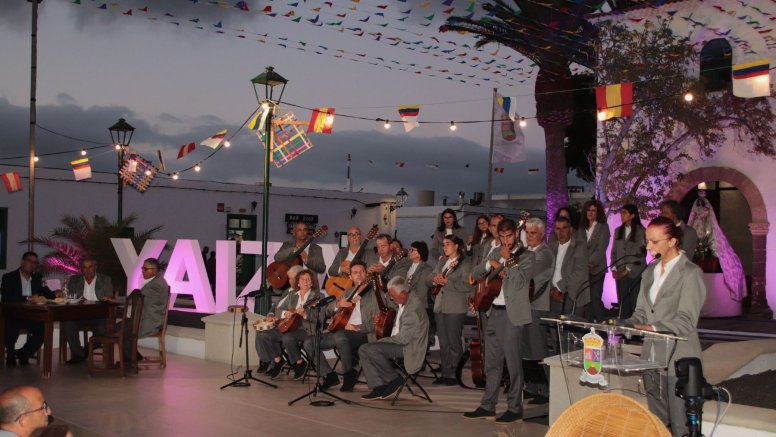
Yaiza's Rancho de Pascuas opened the patron saint festivities of the Virgen de Los Remedios to enjoyment, narrating, playing, and singing its history of friendship, tradition, and commitment to its Yaiza land. The group is part of and a witness to the contemporary musical history of southern Lanzarote and custodian of one of the most beautiful and heartfelt popular traditions of the Canary Islands, which it has also managed to cultivate and disseminate for 55 years.
"We keep alive the purest and simplest Christmas spirit of Lanzarote's popular culture," pointed out the Rancho de Pascuas, through the voice of its narrator Teresa Gutiérrez, during the interpretation of the proclamation held this Friday in Plaza de Los Remedios.
Twenty-five members write the current chronicle of the Rancho, two of them survivors of its birth in '71, 'Los Pedros', Pedro Santana and 'Perico' Cabrera, but the group's history is told in many voices and hands with indelible memories in the church of Los Remedios and public gathering places of Yaiza: "The town has continued to hear the same essence, here the voices of our elders sounded, here the young people learned, here generations grew up, and here, memories remain that time never wanted to erase."
The mayor of Yaiza, Óscar Noda, maintained that "the group symbolizes the arrival of Christmas, but the Rancho symbolizes much more, the Rancho embodies the union and community strength of our town; the Rancho, with its music and songs, as if it were a traditional poetic genre, symbolizes the joy of feeling ourselves, all of us, members of the great Yaiza family."
The proclamation of Yaiza was filled with emotion. The memory of its first stage, of what they call "The first Rancho," from '71 to the Christmas of '75. In response to questions from the communicator Leandro Martín, 'Los Pedros' recounted the first steps of the group encouraged by the parish priest Antonio Parrilla. The priest met with two neighbors from Mácher, Víctor Viñas and Celestino Saavedra, who had their girlfriends in Yaiza, and that's why they frequented the town.
To them and to Pepe Cedrés, who was indeed a musician, the priest proposed creating the Rancho de Pascuas. At only 16 and 15 years old, Pedro Santana and ‘Perico’ Cabrera joined the genesis of the group that immediately began to rehearse. “I remember that the priest, while we were playing the contradanza, would make us walk around the cistern of his house so we wouldn’t lose the rhythm”. The repertoire consisted of three songs: La contradanza, Venid Pastorcillos, and El anuncia, but anecdotes, tons.
Anecdotes everywhere
Laughter erupted in the square when the memory of a member who couldn’t find the right note and kept making mistakes surfaced: “He always played one extra guitar chord”, or that memorable performance on Christmas in Arrecife in ’72 which earned the Rancho an income of 3,000 pesetas, invited by the mayor Rogelio Tenorio. They had a very substantial feast at a restaurant in Playa Honda, but it was so much “money” that it was enough for another barbecue.
The second Rancho
In this atmosphere of joy and camaraderie, a moment of sadness filtered into the life of the Rancho, causing voices to fall silent and instruments to be put away. The death of one of its members, Jaime Cedrés Feo, who died in a tragic accident at only 23 years of age. The young man was the son of Pepe Cedrés, one of the founders and pillars of the Rancho, so the desire to continue went to hell. “It was very hard for everyone”.
The pain took its toll on the Rancho, however, “in the midst of that long silence, this same church of Los Remedios, which missed them so much, raised its voice in the night to make them a plea”, noted the narrator. ’79 is the year of El Rancho’s resurgence, the group returned with new voices and new instruments, “and feeling in our souls the same faith as always for our tradition”. El Rancho performed the song Venid Pastorcillos during the proclamation, evoking that episode that gave them back their lives: “It was an invitation to heal wounds and return to the place where it all began”.
From this second stage of the Rancho, three names stood out on the proclamation stage, musicians who are still part of the group, Benito Rodríguez, Magdalena Cáceres, and Miguel Ángel Tavío, three key people who propelled the new life of the Rancho.
They started meeting in '76, supported by the figure of Antonio José ‘El Canario’, as a professor of toque: “He was the one who taught us little by little to play instruments and so the group grew until the Christmas of 1979 arrived”. There were not enough plucked instruments and they had to make do. The solution, then, was to make the melody with the mouth, there was no other way.
Love also emerged in the Rancho de Pascuas of Yaiza of that time, and eternal love. Magdalena Cáceres started a relationship with Miguel Díaz, a couple's relationship that they maintain, both being members of the current Rancho. This second stage is also full of anecdotes.
Miguel Ángel Tavío recalled the drinks they had after performances or rehearsals. “The parish priest Manuel Merchán knew about it, and so that some companions wouldn't drink, he locked them in the sacristy, but one of them had a bottle in her bag and when the priest opened the door, they were as they were”.
And from the pranks of the Rancho de Pascuas of Yaiza, which Efrén Santana presides over today, not even the mayor of Yaiza, a former member of the group, was spared, who in the middle of the opening speech had to go out and play the water whistle at the surprise request of the speakers.
The first night of the Yaiza festivities was a journey to the past, “a journey to understand who we are”. The Rancho, in short, “is a school of life and its value lies not in its 55 years of history, but in the immense generosity of its people”. The Rancho thanked “those who today keep alive the soundtrack of our Christmases, and the youth who guarantee the future by tuning the strings and learning the old coplas”. A sentiment shared by the Yaiza City Council and the townspeople.
The Councilor for Celebrations of Yaiza, Daniel Medina, had words of gratitude for the Rancho de Pascuas for its trajectory and interest in proclaiming the festivities of the municipality's patron saint “with an exciting account that places us in events that are part of our history and our feeling as a people” and for the Festival Commission for its active participation in the preparation of the program: “Thank you for the hours, for the meetings, for the ideas, for paying attention to so many details and for working with the City Council to make these festivities possible, celebrations that are a little bit of all the towns in our municipality of Yaiza”.
The Administration also thanks the municipal workers, collectives, associations, security and emergency forces, collaborators, and all the people who make it possible for Yaiza to dress up for the festival again during these days.
Add La Voz de Lanzarote as a preferred Google source.
Stay informed with the latest current news.