After the summer break, the Timple House-Museum of Teguise reopened its doors to reconnect with the public and resume its concert programming. And it did so in a very special way; with an evening in which music became a bridge of union between two lands separated by the Atlantic, but deeply united by their roots, their histories, and their feelings.
Last Friday, at 8:00 PM, the concert hall of the House-Museum was completely full to welcome "Puente de Ritmos Isleños" (Bridge of Island Rhythms), a novel musical proposal that brought together excellent Canarian and Cuban performers on stage in an encounter where tradition, roots, and new sounds walked hand in hand.
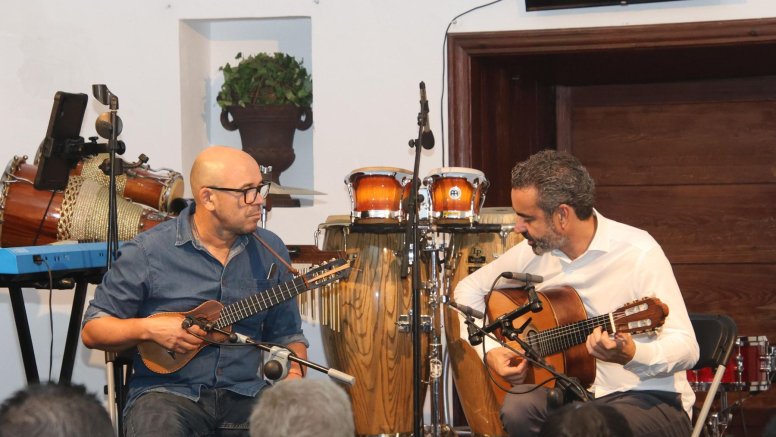
The first notes announced the beginning of a night that promised to be different. The concert, divided into two parts, began with the duo formed by Alexis Lemes and Javier Infante, two musicians who have been sharing stages, concerns, and the same way of understanding music for over a decade; from respect for Canarian tradition, but always with an open eye towards new sonic languages.
The artistic encounter between Alexis Lemes and Javier Infante was born from the desire to explore the possibilities of the timple and the guitar beyond traditional formats. The result is an acoustic, intimate, and personal proposal, in which the musical roots of the Canary Islands dialogue with jazz, contemporary music, and other influences.
Alexis Lemes' timple provided the characteristic sound and the roots of the islands, while Javier Infante's guitar expanded that universe towards more contemporary harmonic and melodic territories. Both instruments established a musical dialogue full of nuances, complicity, and sensitivity.
For this occasion, the duo selected a very novel repertoire that was enthusiastically received by the audience. Among the compositions performed were "Gente Humilde," "Canto del Mar," "Historia de un Amor," "Our Spanish Love Song," and "Tanganillo," among other pieces.
Each performance was followed with enormous attention and rewarded with warm applause. Once again, the interpretive quality of Alexis Lemes and Javier Infante managed to win the admiration and affection of those who filled the hall.
When Cuba and Lanzarote meet through music
With the arrival of the second part of "Bridges of Island Rhythms," the ties between the Pearl of the Caribbean, Cuba, and Lanzarote acquired special prominence.
The young singer Verónica Lucía appeared on stage, accompanied by a magnificent band made up of experienced musicians: Johan Baranis, on piano, Miguel Castañeira, on bass, and Carlos Almaguer, on percussion.
Before beginning her musical journey, Verónica Lucía wanted to share with the audience a story that, in one way or another, belongs to so many people who once had to leave their homeland to seek a better future in an unknown place. A story of goodbyes, of families left behind, of friends, memories, and feelings that remain on the other side of the ocean.
And that story had a particularly deep meaning for her
Her father is Cuban and came to Lanzarote with his parents. It was on this island that he met a young woman from Lanzarote, and from that love, Verónica Lucía was born. A young woman who has music in her blood and who has grown up surrounded by sounds, memories, and traditions from both shores of the Atlantic.
A musical heritage in which her paternal grandfather, don Carlos Almaguer, occupies a very special place. He arrived in Lanzarote and left an important mark on the island's cultural life. Here he started a music school, an association, and various projects, including the well-known percussion festivals. With his work, dedication, and closeness, he managed to win the affection and admiration of numerous Lanzaroteños.
After his death in 2019, his son Carlos Almaguer, Verónica Lucía's father, has followed in his father's footsteps in the world of music, keeping alive a family tradition that now also finds continuity in the young singer.
Verónica Lucía was received by the audience with a standing ovation. With confidence, naturalness, and great sensitivity, she presented a repertoire in which Cuba, the Canary Islands, nostalgia, and memories went hand in hand.
"Cuando Salí de Cuba," "Habanera Salada," "El Manisero," "Chica de Yaiza," "Mucho Corazón," and "Son de la Loma," among other songs, were played, in a performance that grew in intensity and emotion as the night progressed.
The evening also featured particularly endearing moments, such as the participation of her grandmother, Verónica Torres, and her aunt Lisi Almaguer, who joined this musical journey between generations and territories.
The young timple player Daniela Gutiérrez also joined them, contributing once again the sound of our most representative instrument and reinforcing that dialogue between the two cultures that gave meaning to the show.
Music as a bridge
There was a certain air of nostalgia that night. A nostalgia that was not sad, but profoundly human. The nostalgia of those who once had to leave, of those who left behind a family, a home, a land, and a part of their own history.
And precisely there lay the greatness of "Puentes de Ritmos Isleños" (Bridges of Island Rhythms), in demonstrating that music is capable of crossing oceans, generations, and borders.
Songs like "Pregón a Canarias" (Proclamation to the Canary Islands), a composition by Carlos Almaguer, Verónica Lucía's father, made it clear that the Canarian and Cuban cultures, although different, share deep bonds built over time. Two peoples who have known how to recognize each other in their music, in their rhythms, and in that very special way of feeling and living on the other side of the Atlantic.
The audience, completely captivated, followed each moment of the concert with attention and participation, responding to the artists with numerous ovations.
At the end of the evening, the Councilor for Culture and Festivals of the Teguise City Council, Andoni Machín, and the curator of the Casa-Museo del Timple, Benito Cabrera, congratulated all the participants for the extraordinary artistic quality of the concert and for having offered such a special night.
The Casa-Museo del Timple of Teguise thus raised the curtain on its programming once again with a resounding success. "Puentes de Ritmos Isleños" managed to bring together the rhythms, sounds, and feelings of the Canary Islands and Cuba on the same stage.
A night in which the timple, the guitar, the piano, the bass, the percussion, and, above all, the voices of several generations built an imaginary bridge between two shores.
A bridge built with music.
A bridge that, for a few hours, allowed us to remember those who remained on the other side of the Atlantic and to understand that, although oceans may separate lands, there are bonds that no distance can erase.
Because that night, at the Casa-Museo del Timple of Teguise, the Canary Islands and Cuba met again through music.
Add La Voz de Lanzarote as a preferred Google source.
Stay informed with the latest current news.