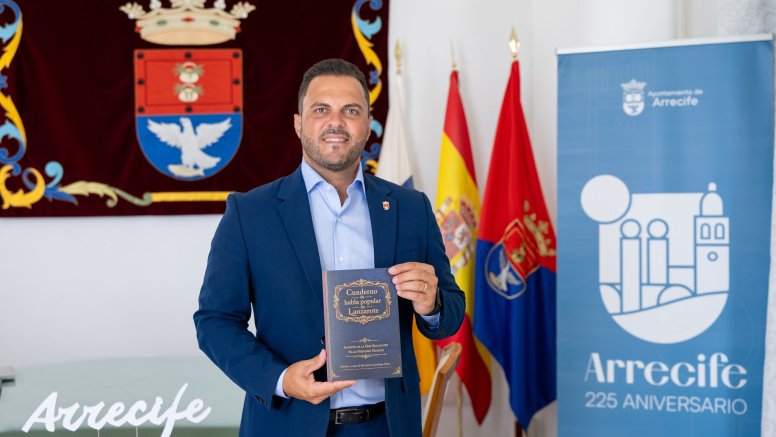
The Arrecife City Council has published, together with the executor and scholar of Agustín de la Hoz's work, Benchomo Guadalupe Oliva, the book Cuaderno de habla popular de Lanzarote, a work by the Lanzarotean writer Agustín de la Hoz, and his wife, the teacher Pilar Perdomo Fajardo.
This Tuesday, coinciding with the feast of San Ginés Obispo, patron saint of Arrecife, the mayor of the city Yonathan de León Machín, announced this news, which coincides with the celebration of Los Sangineles and the centenary of Agustín de la Hoz, a famous Lanzarotean writer to whom the City Council in the 1980s of the last century dedicated the House of Culture of the capital of Lanzarote.
Centenary of Agustín de la Hoz
Within the framework of the centenary of the birth of the Arrecife writer Agustín de la Hoz, and coinciding with the San Ginés festivities in August, the month of his birth and his passing, the book is published.
“The popular speech of Lanzarote. The writer adored the celebration of these festivals and remembered it with nostalgia: “On August 24th, the eve, the ringing of bells and rockets announced the start of the festivals, the buildings were decorated, the sailors with the money earned from fishing bought new suits. The band toured the main streets and neighborhoods of the town, starting from the Plaza de las Palmas, that is, in front of the hermitage itself, which was also adorned. On the 25th, the religious festival began with a solemn mass attended by all the island's authorities; in the afternoon, the patron saint's image was carried in procession, and at nightfall, the procession went along the pier again with great dances in the different societies of the city. The rest of the days were filled with games and contests. It is said that porpoises entered the islets of Arrecife and that the sailors caught them and offered a fifth to the saint, but then they stopped coming. The festivals were also celebrated on the onion pier, where, unlike the dances in the societies, children could enter, next to the music kiosk, which has since been moved. The stalls with their smell of marinated meat, fried porpoise meat was also served, which was a delicacy, but it is no longer seen, nor will it ever be seen again. The festivals were so important that even the houses were painted when the dates approached. In the old and now truncated market hall, wrestling matches were held, as well as boat races of corvina fishing boats in the marina. The prizes were: the first, the ability to moor inside the bar, and then a popular barbecue was held; the second prize consisted of a bottle of cognac, which many sailors preferred to the first. The population was so eager for these festivals that in 1965 of the 20th century, it was declared of National Tourist Interest”.
This book, disseminated and made known by Yonathan de León, with the title El habla popular de Lanzarote, is an unpublished work that was jointly initiated in 1969 by the writer and his wife, the teacher Pilar Perdomo; as a project for the conservation of "the endemic forms of expression of Lanzarote"; a project that never materialized for publication. Said work consisted of a series of notebooks with handwritten notes on topics and words, many pending comparison, drafts, etc., and which has finally taken definitive shape to be published by the Arrecife City Council through its Municipal Archive, with the impetus of the mayor's office coinciding with the anniversary when Arrecife commemorated the 225th anniversary of the founding of the municipality of Arrecife, during this term.
In this now-published booklet, terms and words from the popular Lanzarotean heritage can be found, not only from Arrecife, but from the towns of the island, linked to seafaring, but also from inland. As well as proverbs and expressions from yesteryear.
In the present year 2026, the centenary of the birth of the Lanzarotean writer and historian Agustín de la Hoz Betancort (Arrecife, 1926 – La Laguna, 1988), one of the most relevant figures in the cultural life of Lanzarote in the 20th century, will be celebrated.
Distribution among cultural centers of Lanzarote and all of the Canary Islands
He was born on August 31, 1926, in Arrecife—although different dates appear in some official documents—and died on August 11, 1988, in La Laguna, after a serious illness. With his disappearance, one of the most committed voices to the historical and cultural memory of the island was silenced.
Now, coinciding with this centenary of the writer from Arrecife, and on this day of San Ginés, the mayor Yonathan de León, makes known this publication of this booklet dedicated to the dissemination of the popular speech of Lanzarote.
For the mayor of the city, Yonathan de León, valuing the literary work of Agustín de la Hoz, contributing to its preservation and dissemination, is of great importance for De la Hoz's hometown, and we do so jointly with his executor and director of the Municipal Archive of Arrecife, Benchomo Guadalupe Oliva, one of the great researchers of Agustín de la Hoz's work.
The Arrecife City Council will distribute it among cultural centers in Lanzarote and all of the Canary Islands, libraries and schools in Lanzarote and La Graciosa, scholars of the Canary Islands, and at protocol events in the city of Arrecife. Furthermore, it will be available for consultation and public dissemination at the Municipal Archive of Arrecife.
Add La Voz de Lanzarote as a preferred Google source.
Stay informed with the latest current news.