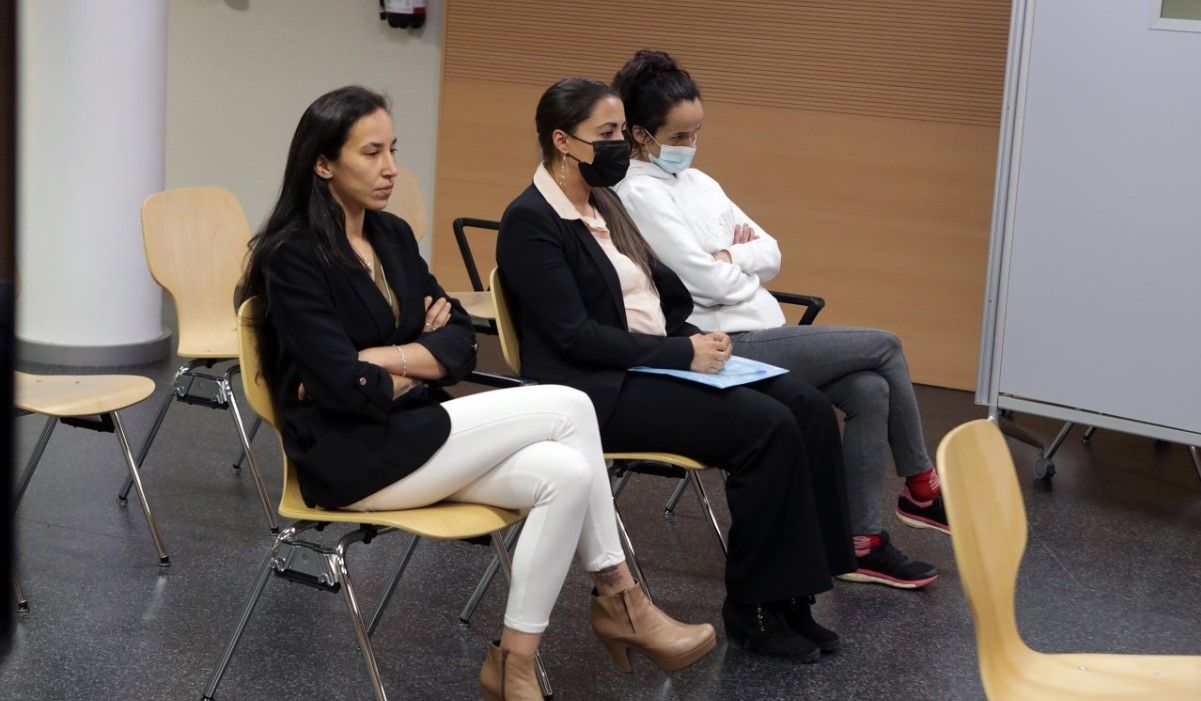
The Second Section of the Provincial Court has acquitted the three defendants accused of causing a fire in a house in Arrecife, who were tried on May 6 with a request for 13 years in prison. The ruling does consider it proven that there was an intentional fire, which cost the life of a dog and forced the evacuation of other residents of the building, but not the authorship of the events.
“We do not have any evidence that directly points to any of the defendants as the perpetrator of the fire, with only the mere suspicion of such authorship existing in all the witnesses, and even co-defendants,” the ruling concludes.
The Chamber refers to the testimony of one of the accused, Estela O.G., who blamed the other two for the fire.“They went to buy the can of gasoline. They were the ones who set fire to the house. I didn't leave my house,” she declared during the hearing, even acknowledging that after the event, both showed up at her home and left the gasoline can and one of their clothes there.
However, the ruling refers to the contradictions between the testimonies of the accused. “Neither of the two versions, both lacking evidentiary support, offers us greater credibility,” the Court points out, which describes the statements of Estela O.G. as “vague”, who during the trial was warned on several occasions that she would be expelled from the courtroom, due to her constant interruptions while other people testified.
In addition, it insists that there is no evidence of what was stated by some of the witnesses and by the complainants - almost all residents of Argana who live as squatters in different homes - who pointed to the accused and in particular to two of them. “They only expressed their suspicions, but without providing any objective data that minimally supported such assumptions,” the ruling maintains.
Questions that a key witness was not properly questioned
Regarding the “circumstantial evidence” to which the prosecutor referred when presenting her conclusions at the trial, the Court also considers it insufficient, and also questions that the Public Prosecutor's Office did not adequately support it at the hearing.
“The main indication is that the defendant Cheyene, on the same night of the events, bought three liters of gasoline at a gas station near the burned house,” the ruling recalls. However, it emphasizes that when an employee of the gas station testified as a witness, the prosecutor did not expressly ask him if he identified the accused.
This witness had recognized Cheyene's photo at the police station, but during the judicial investigation he was not called to testify, and the Court considers that at the trial, the interrogation was insufficient. “There has not been a reliable recognition in court of the defendant Cheyene by this witness, who also only referred in the plenary session to the fact that some boys (it seems that the complainants) went to the gas station and showed him some photographs, recognizing a girl.”
Regarding the recording from the gas station's security camera, which was also part of the summary of this case, the Court questions that its reproduction was not requested at the trial either. Thus, it merely points out that “it seems that” the video would exist, but it has not taken it into account, since the Prosecutor's Office referred to it during the hearing, but did not indicate it as evidence to view it.
The other indication that pointed to Cheyene is that she had the keys to the house, whose door was not forced. “This is just one more piece of information that by itself is absolutely insufficient to refute the presumption of innocence,” the Court adds. In addition, it emphasizes that the one who had a supposed motive to cause the fire was another of the accused, Débora Aroa, who was also pointed out by both the complainants and some witnesses.
According to what they stated, she blamed one of the victims for having stolen a computer from her, and the Prosecutor's Office maintained that that is why she agreed with two other friends to cause the fire as revenge. Among the accused, the complainants and several witnesses there had been relationships of friendship and even intimate relationships in the past, which in many cases ended in a conflictive manner.
“Not even a fully accredited indication”
“We do not even have a fully accredited indication,” insists the Court, which points out that it was also “not proven” that gasoline “was the possible accelerant used in the fire”, and insists that the references to the purchase by Cheyene “were not fully proven.”
“Not even if that had been the case, could we infer from that single fact that Cheyene, in agreement with the other two defendants, bought the gasoline so that Débora and Estela would set fire to the house, accessing it with the keys that the former also provided,” the ruling adds.
“The body of incriminating evidence that has been presented in the present proceedings, with respect to the authorship of the events that we consider proven, has been so poor that it necessarily leads us to conclude that in the present proceedings there is no evidence to refute the presumption of innocence that the accused enjoy, and consequently they must be acquitted,” it concludes.
Add La Voz de Lanzarote as a preferred Google source.
Stay informed with the latest current news.