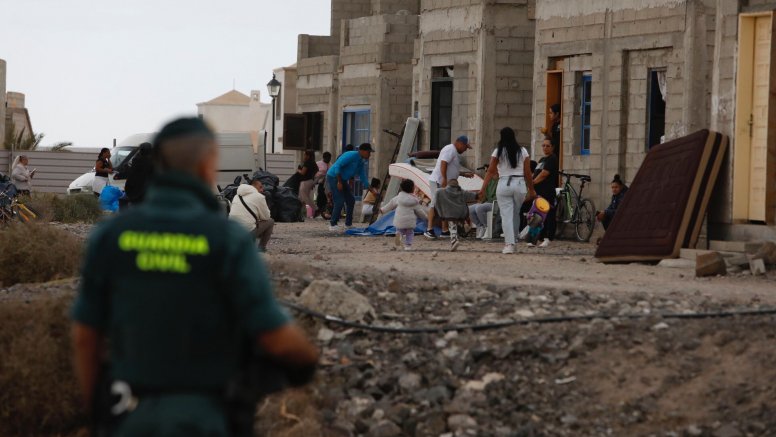
The First Section of the Provincial Court of Las Palmas has revoked the decision of the Investigating Court number 4 of Arrecife that evicted last January of 2024 in Playa Blanca a hundred people, including 24 minors, from some unfinished and abandoned houses in Cyca street. The Court has rendered this precautionary measure without effect.
Several of those affected, represented by the Fuenmayor Abogados law firm, filed an appeal against the ruling of October 19, 2023, which set the eviction of the families residing in Urban Plot T for October 31 of that same year. Finally, the eviction was carried out in mid-January after three attempts. Some families were left on the street without other medium-term housing alternatives, while others temporarily stayed in the homes of acquaintances.
This half-finished plot had 34 single-family homes built and another 33 pending and had been used by families without other alternatives to settle during the housing crisis that plagues the island.
In a judicial resolution of March 21, the Provincial Court states that it "does not share the origin of a precautionary measure" that did not identify the people who were going to suffer the eviction, despite the fact that the occupation of the property took place "relatively some time ago" and that there were even reports from the Yaiza City Council that confirmed this.
It also points out that the "real" precautionary measures are designed to ensure compensation that is added to the criminal process. These measures must be reasoned in the attribution of the punishable act "to a specific person", and be supported by "indications that evidence" their role in the crime that is imputed to them. The Court points out that "the measure should not be simply and plainly the anticipation of the penalty", as has happened in this case.
The aforementioned firm states that "it is an action that the Provincial Court itself describes as disproportionate, premature and lacking the necessary legal requirements for such an extreme measure".
Bought the property already occupied
This judicial resolution indicates that the property acquired the plot in December 2022, "knowing" that there was "an undetermined number of people" who had "illegally occupied several houses under construction". In addition, this occupation has been carried out for a "relevant time" because the occupants carried out accommodation works, such as installing aluminum, water or electricity.
The Court points out that "everything points" to the fact that the property went to the criminal route, instead of the civil one, to "actually obtain the material possession of a complex that is half finished". Thus, it adds that when it achieved the "eviction", "all the interest of the appellant" was exhausted and that what it was pursuing was to "instrumentalize the criminal route to achieve a civil eviction".
In this way, it indicates that "the criminal route and much less the adoption of this type of precautionary measures related to the eviction in the face of a minor crime of usurpation, cannot be instrumentalized for a purpose completely foreign to it". To which it adds that the use of a promotion of unfinished homes and their habitability conditions "is clearly administrative" and "not necessarily related to an alleged illegal occupation".
In addition, it highlights that although the precautionary measure "alludes to the danger to the integrity of the occupants themselves" for living in unfinished buildings, for the Court "it is paradoxical" that said measure is based on "a theoretical interest" of the occupants, "who oppose its adoption".
The Court highlights that "a complex of unfinished homes, with the works paralyzed for a time without any security measures being taken to prevent improper use, does not meet the minimum conditions of habitability", but in this case it is the owner and, failing that, the City Council itself that must take charge of the "damages that could be caused".
It adds that the report from the Technical Office of the Yaiza City Council in which the Public Prosecutor's Office relied to endorse the eviction as a "precautionary measure" stated that the small works carried out on the property "unfinished and without the necessary supervision of the administration", did not "formally meet the conditions of habitability" and, therefore, could not access supplies.
"Leaving us without housing is also violating the family", read one of the posters that the residents of this housing development on the day of the eviction.
Add La Voz de Lanzarote as a preferred Google source.
Stay informed with the latest current news.