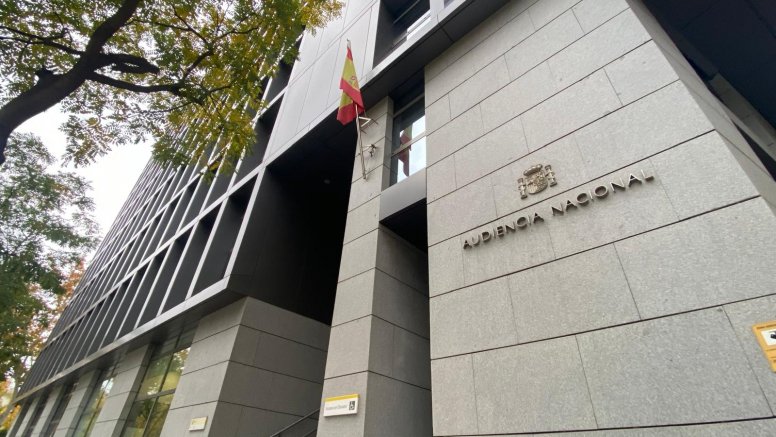
The former magistrate of the National High Court Baltasar Garzón has warned this Thursday against the "capture of justice," a process that is evolving towards its "industrialization" through artificial intelligence, which threatens democracy itself through the degradation of judicial, political, and media institutions.
Garzón, who gave the closing lecture of the II International Campus Ciudad de La Laguna, has linked this degradation of institutions with "the industrial fabrication of suspicion," which no longer requires an official to leak documents, a media outlet willing to publish them, and a narrative, but rather the conscious use of artificial intelligence and social networks to automate parallel trials.
This industrialization accelerates the spread of suspicion, lowers the cost of disinformation campaigns, and makes social condemnation "practically irreversible," because the objective is not the sentence, but a media and social space in which guilt is decided in advance and in which neither appeals nor the presumption of innocence are possible.
The magistrate has linked this "capture of justice" with public condemnations before the trial takes place and with "collaborators" supported by popular accusations with direct political interests who obtain penal and economic benefits without their statements being independently verified.
He placed the origin of many of these problems in the appointment system of the Judiciary, which, in his opinion, favors an "institutional colonization" incompatible with judicial independence.
One of the manifestations of this capture of justice is the disappearance of the presumption of innocence, the construction of closed narratives, and the inversion of the burden of proof, so that when the sentence is handed down, whatever it may be, the damage is already irreparable because social condemnation has been consolidated long before judicial condemnation.
He stated that the mechanism "is seen with laboratory clarity" in the case against former president José Luis Rodríguez Zapatero and warned that on other occasions the sole purpose is to indefinitely maintain someone's status as investigated, as in the case of Begoña Gómez, he pointed out.
For Baltasar Garzón, artificial intelligence has exponentially multiplied the risks of parallel trials to consolidate "an engineering of perception that transforms the repeated lie into an apparent truth, erodes trust in institutions, and facilitates the advance of authoritarian discourses."
The former judge has raised the need to regulate digital platforms and establish clear responsibilities for those who develop or use automated systems.
Garzón also referred to the recent sentence on former minister José Luis Ábalos, which highlights, on the positive side, that the judicial system is capable of prosecuting corruption in the highest institutions.
But he criticized that the statements of the collaborator who has directly participated in the criminal activity are not sufficiently corroborated independently and receives a "covert acquittal" accompanied by economic benefit.
The message sent is that "whoever designs a corrupt scheme can obtain significant benefits if they adequately calculate the timing and manner of collaboration," since in Spain there is no statute for collaborators with justice, a regulatory vacuum he attributed to a political decision maintained for decades.
Regarding popular accusation, Garzón acknowledged its historical importance, but warned that certain organizations and parties use it simultaneously with media pressure and the dissemination of collaborators' statements to construct narratives that condition the judicial process itself.
Garzón has argued that in the face of the capture of justice, active indignation is necessary, which involves demanding reforms.
In the case of collaborators, he has proposed that legal deadlines be established for revealing information, independent corroboration, transparency in agreements with the Public Prosecutor's Office, or confiscation of economic benefits.
He also defended limiting the popular accusation exercised by political parties and organizations in proceedings related to political corruption and reforming the appointment system in the General Council of the Judiciary.
Add La Voz de Lanzarote as a preferred Google source.
Stay informed with the latest current news.