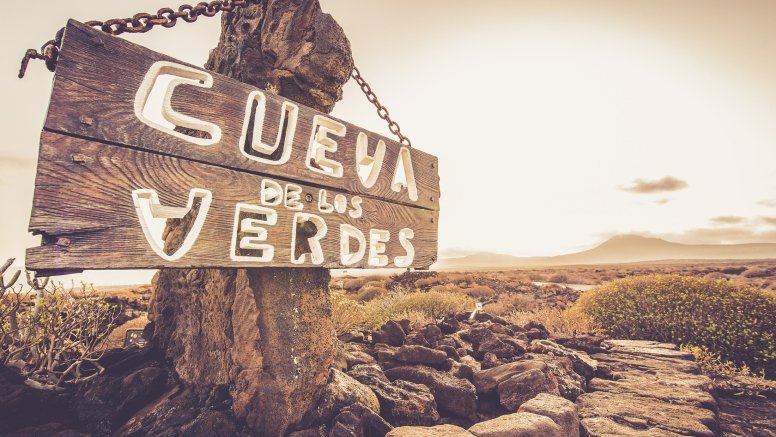
The travel magazine of National Geographic has focused on the north of Lanzarote with an extensive article that portrays Haría as "the village in the Canary Islands with a mysterious refuge against pirates under the lava".
The journalistic piece delves into the history and geology of the Cueva de los Verdes, defining this enclave as "Lanzarote's most hidden secret" and highlighting that this "spectacular volcanic tube that can be visited functioned as the perfect hiding place against privateer attacks".
The narrative places the origin of this legend in 1618, recalling how lookouts stationed on the heights warned with bonfires of the arrival of enemy incursions such as that of Jabán Arráez. Faced with danger, the neighbors abandoned the village heading for the coastal badlands, following a family of shepherds with the surname Verde, "where a rock mouth would swallow them to remain safe".
Before reaching the bowels of the earth, the report pauses at the charm of Haría and its Valley of the Thousand Palm Trees, a place of low, whitewashed houses that, as the text describes, creates "one of the most beautiful urban postcards of the Canary Islands".
The publication also explains the geological origin of this cavity, which "had been sculpted by fire more than 21,000 years ago, when La Corona erupted and a violent lava flow rushed towards the sea". That phenomenon originated a gallery of more than seven kilometers that includes the underwater section of the Túnel de la Atlántida and about twenty roof collapses known as jameos, among which its most famous neighbor stands out, the Jameos del Agua.
However, the report emphasizes that the visitor's current experience would not be understood without the intervention carried out in 1964 by the self-taught artist Jesús Soto.
The Cabildo commissioned him to condition one kilometer of galleries, a task he carried out with mastery "under the principle of 'leaving no trace', a philosophy of intervention that he defended alongside César Manrique".
Thanks to his lighting design, those who descend to a constant temperature of 18 degrees discover "the varied chromatic range —the black of the basalt, the dots or fine lines of calcium carbonate, the wide yellow veins of sulfur, or the red shine of iron oxidation— and the different textures of the volcanic walls".
Add La Voz de Lanzarote as a preferred Google source.
Stay informed with the latest current news.