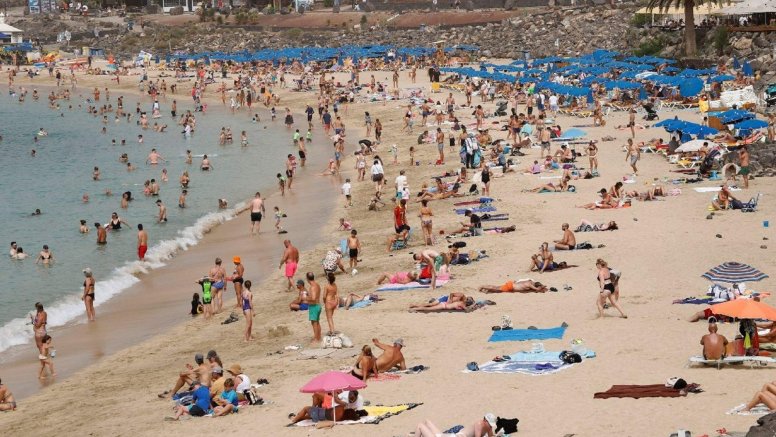
For decades, the British public's view of Lanzarote was conditioned by a word coined on UK television: 'Lanzagrotty'.
The term is a pun that ironically combines the island's name with the English adjective "grotty," which actually comes from grotesque, but is usually understood as tacky, common, or of poor quality.
In Ekonomus, we have undertaken a journey through the history of the invention through some journalistic articles that used it in the last five decades to talk about the island.
Its origin is attributed to the prestigious humorist, actor, and presenter Michael Palin, one of the Monty Python, the six British humorists who synthesized in a humorous key the way of thinking of the British for decades. Palin invented it in the late 1980s during his time as a travel presenter.
This is attested, among many others, by journalist Erica Crompton in her report "There's more to 'Lanzagrotty' than meets the eye", in which she contrasts the vision that the UK had in the 1980s of mass tourism, of sun and beach, with all-inclusive packages, neon lights, noisy bars, and "pints at ten in the morning".
Several chroniclers like Robin McKelvie have recorded that Palin ended up apologizing for the damage the invention caused to the island's reputation.
"I had heard people call it 'Lanzagrotty', but I was gobsmacked"
The impact of the term was so profound in popular culture that many travelers were surprised upon arrival by the great beauty of the island.
British businessman Eric Willson, in statements collected by journalist Matt Roper in The Mirror in the article "Businessman Eric Willson takes 69 holidays to Lanzarote in 20 years", recalled his first visit in November 1990:
"I had heard people call it 'Lanzagrotty', but I was gobsmacked. I looked at the volcanic park and thought I had landed on the Moon; it's incredible."
Despite the dazzling volcanic landscape that captivated visitors, the stigma of 'Lanzagrotty' became consolidated in the collective imagination of the United Kingdom as a synonym for cheap and unsophisticated tourism.
César Manrique's fight and his "James Bond-style bar"
The journalistic stigma did not yet reflect the attempts to make good tourist planning under the influence of César Manrique.
As the chronicler Lois Pryce recounted in The Guardian newspaper in her report "A Bond-style bar in Lanzarote? Get groovy at the Mirador del Río":
"César Manrique spent his life resisting the expansion of 'Lanzagrotty' —the eruption of cheap tourist complexes that ravaged the Canary Islands in the 1960s and 1970s— often confronting property developers in person."
Pryce refers to Manrique's work to prevent the island from succumbing to the urban planning model of concrete towers and billboards that affected other parts of the Spanish coast.
Thanks to the regulations imposed under his influence —low-rise houses, uniform white facade, and green or blue woodwork— the island retained a unique aesthetic identity.
Interventions such as the Mirador del Río, Jameos del Agua, or the Cactus Garden demonstrated that tourist development could be harmoniously integrated with the volcanic nature.
From reproach to rediscovery of the island
Over the years, the main travel supplements in the United Kingdom registered a radical shift in perception of the island.
The old cliché began to be used not to disqualify Lanzarote, but as a point of contrast to highlight its profound transformation towards design, ecological, and cultural tourism.
The Independent newspaper, in a comprehensive report signed by journalist Andrew Eames, categorically titled: "Grotty no more: How Lanzarote upgraded its appeal".
Eames pointed out that the island attracted a new profile of traveler eager to "break with the traditional diet of package tourism on an island derided as 'Lanzagrotty'", opting instead for "boutique rural villas, mountain biking, hiking, and sustainable tourism".
David Cameron's holidays
This change in perception was definitively boosted when several British public figures began to choose Lanzarote for their holidays.
And more than anyone, his prime minister. In 2014, David Cameron's trip to Playa Blanca generated intense media debate. On the HuffPost UK Life portal, journalist Sarah Ebner responded to criticism in an article titled "I Agree With David: Why the Camerons' Decision to Holiday in Lanzarote Is a Good One", stating:
"Despite its associations with 'Lanzagrotty', this Canary Island is perfect for families and offers plenty to do... And grotty it certainly is not."
In 2016, Paul Tierney explained in the London Evening Standard how the island had undergone a transformation under the headline "How Lanzarote went from 'Lanzagrotty' to hipster destination".
Tierney highlighted the proliferation of ecological villages, art galleries, and local gastronomy, concluding that "the sun certainly shines, but it certainly doesn't live up to its old nickname."
A constant temptation
However, many British journalists cannot resist the temptation to continue using the term nowadays to stir things up.
According to Gazette Life in "Lanzarote features in The Times", this newspaper included Lanzarote among the best winter destinations in 2023, but did not hesitate to point out: "That doesn't mean it's devoid of grotty parts — or should we say 'Lanzagrotty'?: see that eyesore that is the Arrecife Gran Hotel."
A few months later, in March 2023, the same publication explained in "More lies about Lanzarote" how The Times had published on its third page the headline "Brits too grotty for Lanzarote", misinterpreting statements by island authorities about the need to diversify the tourism market and focus on higher-spending tourism in the destination instead of mass tourism.
This controversy showed that, although Lanzarote has consolidated an international reputation linked to art, sustainability, and landscape, the word 'Lanzagrotty' continues to float in the British press archive, ready to reappear when you least expect it.
Add La Voz de Lanzarote as a preferred Google source.
Stay informed with the latest current news.