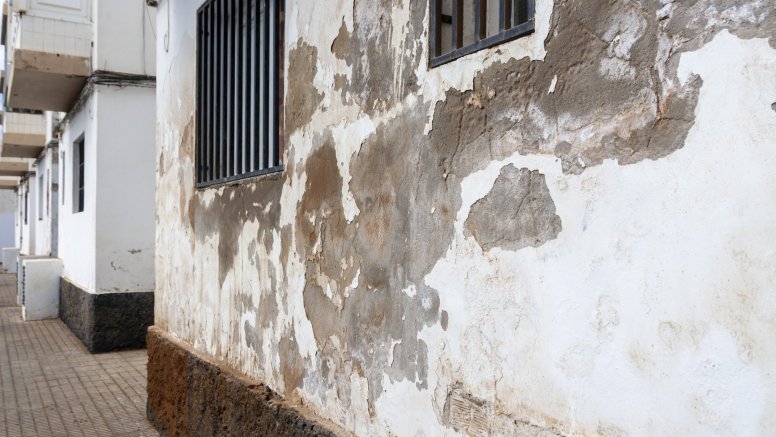
The Titerroy Neighborhood Association has urged the Arrecife City Council and the Government of the Canary Islands to establish a working group and to mediate "urgently" to comprehensively address the "structural and social" deficiencies of the capital city neighborhood. Along these lines, it has requested to be a participant in that working group.
In a statement, the Association has asked the institutions to carry out an immediate technical inspection of the six buildings that make up the hundred homes of Titerroy, known as the hundred homes of Juan Salazar. Along these lines, it has requested that they develop a comprehensive rehabilitation plan, financed with public money, and through housing aid programs.
The Titerroy Neighborhood Association has conveyed the "urgency and seriousness of the situation," which they have been denouncing in recent years. Therefore, they have insisted that this group of homes be included in the social housing rehabilitation and maintenance programs promoted by the Government of the Canary Islands.
In said document, also sent to La Voz, the Titerroy Neighborhood Association has indicated that "despite the numerous efforts made and the constant willingness to collaborate shown by this Association, neighborhood demands have not obtained an effective response or solutions that stop the progressive deterioration of the buildings."
To which he added that, "the current situation," according to the affected residents, "is critical and unsustainable." Juan Salazar's homes were built in the sixties and are located on Burgos, Logroño, Soria, Segovia, and Ávila streets. The residents have reported that "they present an evident risk of collapse, with cornices coming off, cracked ceilings, and severe dampness derived from the accumulation of water in the basements."
This association has pointed out that "no maintenance or painting has been done in more than 25 years" and that this "has accelerated the structural deterioration and generated serious consequences on the health and well-being of the residents," who are mostly elderly people with limited resources.
Thus, the residents have made "personal and economic efforts to maintain their homes in minimum habitable conditions, but the magnitude of the necessary works far exceeds their economic possibilities." "Faced with the lack of institutional support, many of them feel abandoned and helpless," he concluded.
Add La Voz de Lanzarote as a preferred Google source.
Stay informed with the latest current news.