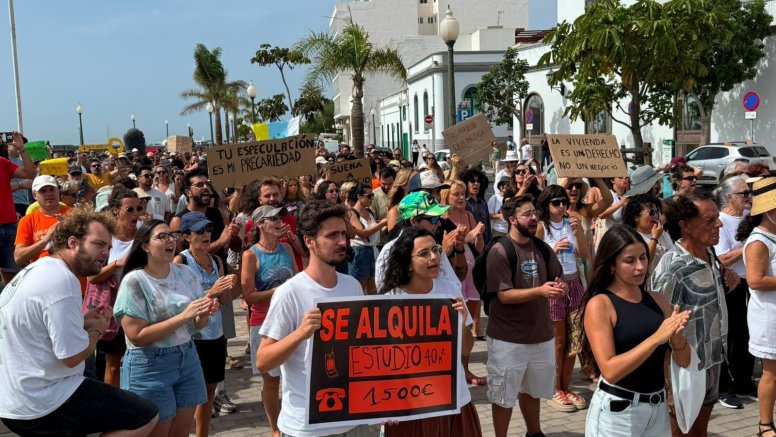
Right to Housing has denounced that the Canary Islands Housing Law, promoted by the Canary Islands Government, has excluded thousands of needy families. This collective in defense of the right to housing in the Canary Islands, together with the DESCA Observatory, has presented data on the impact of the protected housing policy of the Executive led by Fernando Clavijo (Coalición Canarias).
26.2% of Spanish households excluded and 52.3% of foreigners
The figures provided by Right to Housing indicate that 26.2% of Spanish households headed by people between 35 and 65 years of age would not meet the minimum income required to access the general regime of publicly promoted protected housing in the Canary Islands. If the index is analyzed in the foreign population, the percentage is even higher, reaching 52.3%.
"One in four Spaniards and two out of four middle-aged foreigners are excluded from the public housing system for being too poor while also unable to access the free market," lamented the collective. Thus, it added that "these limits mean the automatic exclusion of 68,144 tenant households in the Canary Islands, as they have net monthly incomes of less than 1,000 euros," according to the INE.
Both organizations have pointed out that this exclusion "particularly affects" women with minor children in their care, as 41.76% of single-mother households are at risk of poverty, almost double that of other households (21.59%).
A lawsuit before the TSJC
The presentation of this unprecedented data is in addition to the lawsuit filed last May before the Superior Court of Justice of the Canary Islands to declare Decree 23/2026, approved by the Canary Islands Executive, illegal for allegedly violating fundamental rights.
This lawsuit - which has recently been transferred to the Canary Islands Executive for a response - now includes "a technical report on the main impacts of the Canary Islands national priority in public housing matters."
Likewise, the text develops ten grounds for appeal and questions both the approval procedure of the Decree and its social consequences. Among them, the requirements of prolonged residence, the lack of sufficient analysis of its discriminatory impact, exclusions for economic reasons, and sanctions against people who have had to resort to occupying a dwelling due to the absence of housing alternatives stand out.
Migrants, women, and essential workers, the most affected groups
One of the most damaging measures is the requirement of having resided continuously for twelve years in the Canary Islands to be eligible for a publicly promoted protected dwelling, in addition to five years of continuous residence or work in the corresponding municipality.
This measure follows the line of the so-called "national priority" that right-wing and far-right parties are imposing in other regions such as Andalusia, Extremadura, Valencia, or Murcia.
According to data from the 2021 Population Census included in the lawsuit, 51.42% of the foreign population and 14% of the Spanish population would not meet the twelve-year registration requirement. In the case of the former, the situation is even worse, as migrants face significant obstacles in accessing the rental market due to real estate racism, and difficulties in being registered.
Likewise, this exclusion indirectly affects children, as INE statistics confirm the presence of children under 25 years of age in households of foreign origin. Therefore, by denying their parents access to public housing for not reaching the 12 years of registration, the decree also punishes children residing in the Canary Islands.
Less residential stability among unskilled workers
In the case of unskilled essential workers (food sector, hospitality, etc.), figures from the Canary Islands Institute of Statistics (ISTAC) included in the lawsuit show that they are those with the least residential stability: only 37.83% have lived 10 years or more in their current home, while 19.65% have lived less than 2 years, 18.69% between 2 and 5 years, and 23.84% between 5 and 10 years. Requiring 12 years of continuous residence to access the Registry of Applicants, or 5 years of registration in the corresponding municipality directly punishes the working classes with greater labor and residential mobility and a higher risk of poverty.
Finally, another reason for the challenge is the exclusion from the Registry of Applicants of those who have occupied a publicly promoted protected housing without a valid title, "without sufficiently considering their circumstances of need and vulnerability." "We recall that there are families who resort to occupation after suffering an eviction due to the lack of housing alternatives from Public Administrations," it has maintained.
For Right to Housing and the DESCA Observatory, these figures demonstrate the risk of indirect discrimination of an apparently neutral measure, but one that particularly harms the migrant population, essential workers, and people with greater residential precariousness.
"And we cannot accept that a family is excluded from public housing for being too poor," they have denounced. "Protected housing must serve precisely to guarantee the right to a home and promote material equality, especially for those who cannot access the market, and not become a privilege reserved for those who meet increasingly restrictive economic and administrative conditions."
Therefore, they have demanded that the Government of the Canary Islands fulfill its legal obligations and develop sufficient public housing, instead of "using racism and xenophobia to erect new barriers that also affect the native Canary population."
"There are no surplus people, there is a lack of public policy," it states
From Right to Housing and the DESCA Observatory, they have recalled that the migratory crisis is, in essence, "the eviction crisis of millions of people from their countries of origin due to the impacts of decades of neoliberal and imperialist policies."
In this regard, they have emphasized that the system is "not collapsed by demographic growth" (a +7.2% between 2013 and 2025, equivalent to a moderate +0.6% annually), but by "the absolute paralysis of public promotion" of housing. "In more than 10 years - between 2014 and 2025 - the public developer has only granted final qualification to 184 protected homes," the group highlighted. In the archipelago, the Canary Islands has not finished any social housing since 2022.
Furthermore, according to INE data from 2021 included in the lawsuit, the Canary Islands has 211,452 empty homes.
From Derecho al Techo and the DESCA Observatory, we have requested that the TSJC evaluate the Decree in accordance with the principles of equality, non-discrimination, and protection of social rights, taking into account the impact of its requirements on the most vulnerable groups.
More public housing and limiting speculation
We argue that the response to the housing crisis involves increasing the public housing stock, limiting speculation, mobilizing empty homes, guaranteeing housing alternatives, and establishing proportionate adjudication criteria compatible with fundamental rights.
"The housing emergency is not resolved by excluding more people; it is resolved by ensuring that those who cannot access housing in the market have an effective public response."
To conclude, it is argued that "housing is a right, not a privilege." "And public housing must be at the service of those who need it most, without discriminatory barriers or unjustified exclusions," it concluded.
Add La Voz de Lanzarote as a preferred Google source.
Stay informed with the latest current news.