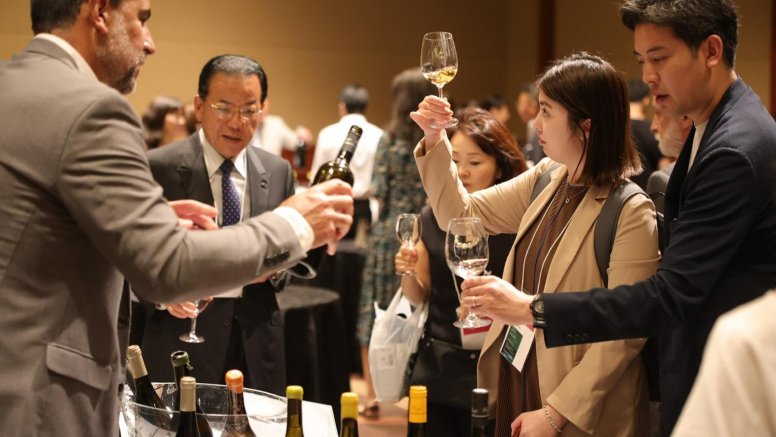
Representatives of the Government of the Canary Islands and the Canarian wine sector are participating this week in a trade mission in Japan aimed at strengthening trade relations with this Asian market, in the field of exports of wines with Protected Designation of Origin (PDO).
From the island of Lanzarote, a representation of Bodegas Bermejo has attended, as well as the secretary of the Regulatory Council of Wine of Lanzarote, Nereida Pérez. Several wines from Bodegas El Grifo are also present among the sample of Canarian wines.
Regarding the initiative, the Minister of Agriculture, Livestock, Fisheries and Food Sovereignty of the Canarian Executive, Narvay Quintero, pointed out that "after the announcement of the imposition of tariffs by the United States, a country to which we allocate almost a third of the total sales of Canarian wine abroad, we have been working with the producers of the islands in alternative markets to the American one".
Among them, "the Asian market stands out, and more specifically the Japanese market, to which a dozen Canarian wineries already sell their productions and another thirty have expressed their interest in exploring this destination, which has a consumer profile with high purchasing power".
"The Japanese market values differentiation, origin and authenticity, which represents an advantage for the native varieties and products of the Canary Islands with PDO, such as our signature wines with a unique personality," he added.
In this context, the main event for the promotion of Canarian wine production organized within the framework of this mission through Proexca and the Canarian Institute of Agri-Food Quality (ICCA) with the support of the public company Gestión del Medio Rural de Canarias (GMR Canarias) brought together more than 70 importers, distributors, specialized journalists and influencers from the Japanese country.
Presenting the uniqueness of Canarian wines
The working day included a seminar and a networking session which, in addition to these professionals and the representatives of the Canarian delegation composed of the Minister Narvay Quintero, the director of the Canarian Institute of Agri-Food Quality (ICCA); Luis Arráez Guadalupe; the director of Foreign Promotion of Proexca, Pedro Juan Monzón; technical staff from both entities and the public company GMR Canarias, and representatives of the Regulatory Councils of the Protected Designations of Origin (PDO) and Canarian wineries, was attended by the Minister Counselor of the Embassy of Spain, Miguel Gómez de Aranda y Villén.
This event was structured in two activities aimed at presenting the particularities of the wine sector of the Canary Islands, taking into account aspects such as climatology, topography, oenological biodiversity or the cultivation techniques used in the archipelago, as well as the opportunities present in the Japanese market for these elaborations, and the exposition of the most relevant characteristics of the Japanese wine market through the presentations of Yoshiko Akehi, journalist expert in Spanish wines and president of Akehi Co. Ltd, and Chisako Morimoto, teacher at the Academie du Vin, with extensive experience teaching about Spanish elaborations.
The meeting also allowed the representatives of the PDOs and of different Canarian wineries present to offer tastings of their productions and interact with the agents of the invited sector.
Media, companies and influencers
In addition to media such as the publication Japan Food Journal, influencers with profiles of great reach in social networks -KOZE Wine Beginner Advisor, Nichi Wine Lover, Yui Chiyoda, Haruna Takahash and Mami T Wine- also covered the event, who shared the experience with their followers on different platforms through the hashtags #CanaryWines, #VolcanicWines, #DiscoverCanaryWines and #CanariasWines.
The agenda of actions aimed at promoting the export of Canarian wines of differentiated quality includes different visits of commercial interest to different establishments to study the marketing channels of the wine sector in Tokyo, from the shops of the gourmet segment, including the Meijiya Kyobashi Store, to large surfaces such as the Shinjuku Takashimaya warehouses.
This program is completed with appointments with representatives of the wholesale exporting companies Aeon Shinonome, the Ginza Mitsukoshi Wine Section or Ginza Six wine shops, and the Seijo Ishii or Meidi-Ja supermarket chains.
The purpose of these actions is, in short, to know the characteristics of this market and the price segments of its different distribution channels, as well as to evaluate the presence and positioning of Spanish wines, and to obtain first-hand information to formulate future export and expansion strategies.
Japan, consumer country
Although wine is not traditional in Japan, it is the second most consumed alcoholic beverage after beer. However, local production is small, around 45 million liters in 2023, mostly from imported bulk wine. Only 14% is made entirely in the country.
According to data from the report of the Economic and Commercial Office of the Embassy of Spain in Tokyo, Japanese imports of wine had a total volume of 232,870,000 liters in 2023, whose value was about 1,653 million euros. Of this amount, 78.3% was "still wine" (those that do not have a relevant presence of carbon dioxide and whose alcoholic strength is achieved without adding wine alcohol), while sparkling wines made up 21.3% and fortified wines 3.1%.
Japan imported a total of 192 million liters of still wine in 2023, which means that imports cover 68% of the total wine consumption in the country.
That same year, Spanish wines ranked fourth in sales volume, with 18,451,000 liters that reached more than 46 million in value, after Chilean, French and Italian wines. Also, throughout 2023 the demand for organic wines grew in the Japanese market and in this segment the Spanish production was the second best-selling, only behind that of Chile.
As for the profile, consumers are mostly over 55 years old, although there is a growing consumption in women between 40 and 60 years of age and young people with an interest in healthy and organic products.
Add La Voz de Lanzarote as a preferred Google source.
Stay informed with the latest current news.