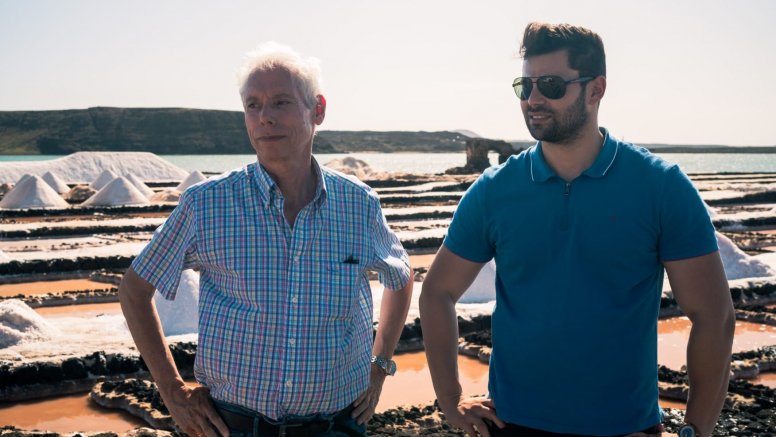
Putting salt on life has special meaning in Lanzarote, an island that once had 26 salt flats all over the island. Today Carlos Padrón Lleó and his son, Carlos Padrón Marrero, manage Salinas de Janubio, a family business that began in 1895, and that preserves and transmits the tradition of artisanal production, in addition to preserving a landscape declared a natural space.
In an interview with the radio program Más de Uno Gourmet, they explain that they are not only guardians of tradition, but that they are also constantly innovating, in collaboration with other companies, to achieve new services and products such as four types of beer with a touch of salt.
- Salt has traditionally been very important in Lanzarote, hasn't it?
Carlos Padrón Lleó: Sea salt has been closely linked to the history of Lanzarote, there were more than 26 salt flats throughout the island.
It is an artisanal, ecological product, without additives, it does not contain microplastics, or preservatives, and it is produced in an artisanal way.
- How did the Salinas de Janubio company start?
Carlos Padrón Lleó: The Salinas started in 1895, started by my grandfather's great-uncle. The Salinas were declared a natural space, but the landscape is also due to the intervention of man, adapting to the orography of the land and the lagoon.
Before the eruptions, there was the royal port of Janubio, a port of great importance through which goods of the time entered and left. The salt flats, not only those of Janubio, were developed thanks to the fishing and primary sector, of which we are part, which helped to create and maintain many jobs.
- As a member of the last family generation, how did you get infected with that feeling to continue with that legacy and give it a twist thanks to your university education?
Carlos Padrón Marrero: Since I was little I have been linked to the company and I spent a lot of time with my grandfather.
My father was able to allow me to study. I have always helped my father while I was studying, but I joined the company permanently in 2018 when I finished my studies.
My father and I talk a lot, we have good communication, so I pass on my ideas to him and we shape them to diversify in products and services. Also in the salt flats space to further improve the landscape and what we offer to the people who visit us.
- Also in your store you can find many other products such as nuts or beer...
Carlos Padrón Lleó: Yes, we have a good collaboration with kilometer 0 products from Lanzarote. In our store we sell gofio, wine, honey, bath salts...
We came up with the idea of creating beer with a touch of salt. We started with Janubio la Sal y la Mar beer, the next one will be Artemia and the last one will be Piedra. We hope to have these last two ready before the end of the year.
Carlos Padrón Marrero: The idea of all this is to give value to the product and the space. Companies are there to grow and improve, and above all to provide a good service and a good product.
We are very aware that we are dedicated to salt, but in the end salt is directly linked to food. So, in collaboration with other companies, we have launched products such as nuts with Casa Ricardo.
They are complementary products that add value to the product and add to the billing. Then there are the products, which I call social, such as beer, which is having a lot of success in collaboration with the Nao brewery.
- Returning to the landscape, you have one of the best sunsets in the world in the salt flats, and you also organize guided tours. How do they work?
Carlos Padrón Lleó: Yes, there are guided tours from Monday to Sunday, they are at 10:00, 12:00, 14:00 and 16:00. Our objective is to transmit the history of the Janubio salt flats.
The visit lasts around an hour and a half and you visit the mills, which have been rehabilitated. Not only is the process of salt formation and how it is produced told, but also the fact that it is a Special Protection Area for Birds, and a place where the brine shrimp lives, a microorganism capable of surviving in a hypersaline environment, there is also talk of folklore...
Carlos Padrón Marrero: It is a way of training the people who visit us because there is a lot of ignorance about the values of the product or about the differences between the different salts, the ways of extracting it... and, as my father says, we want people to leave happy and trained to distinguish the different types of salt as they do with the different types of wine.
Add La Voz de Lanzarote as a preferred Google source.
Stay informed with the latest current news.