Originally from the town of Haría, Ricardo Socas was always in contact with the countryside and his family always produced wine for the home. In 2007 he decided to open Malpaís, the first winery in the north in the 21st century, which has made a name for itself among the island's wineries and is winning national and international awards.
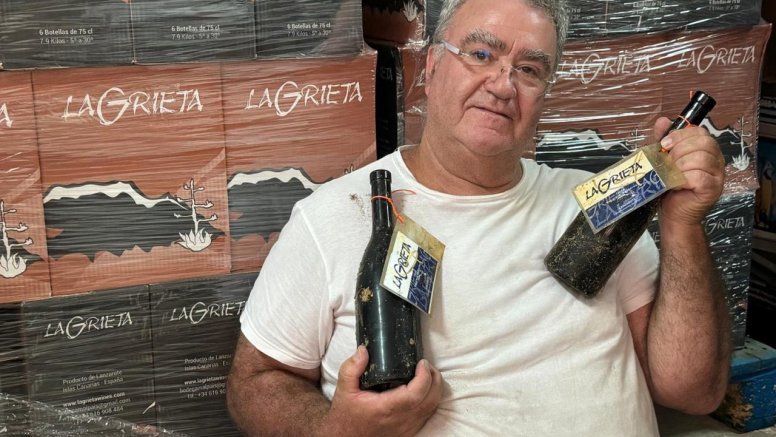
Malpaís produces white wine, red wine and 500 bottles of underwater wine. In an interview with the Radio Lanzarote-Onda Cero radio program, Más de Uno Gourmet, Socas explains how the Arctic waters can further improve a wine produced in Lanzarote.
- Is Malpaís the only winery in the north of Lanzarote?
When I started it was the only one, our facilities are in Punta Mujeres. Now, there is another one in the town of Haría, Valle de Malpaso, and another one in Guatiza.
In my time, nobody was betting on the wines from the north of the island, so we had to make an effort to show people that good wines are made in the north.
- Where does Ricardo Socas come from?
I was born in the town of Haría and I am the son of farmers. I know the countryside almost like the back of my hand. At home we had goats, pigs, sheep, rabbits, chickens, a donkey... we had everything.
My grandparents and my father made wine at home. It is very traditional in Lanzarote to have your little vines and make your own wine. It was a family gathering.
- When did you start making your own wine?
I started making wine for the restaurant I have in Arrieta, El Charcón, until I decided to take the plunge and start a winery in 2007. We produce between 18,000 and 20,000 liters per year.
Today we have almost three hectares of our own vineyard, 65% of the production is our own grapes from Máguez.
- What is the difference between the grapes from La Geria and the north?
They differ at the time of the harvest. In La Geria, the ripening is faster because being in a hole there is more temperature. If you make a coupage of both you make very good wines, which is precisely what characterizes us in our winery.
- Do you have a reference for restaurants and another for individuals?
For restaurants, we have La Grieta, and we have launched another very small line for Spar supermarkets, called Cenizas del Volcán, it is a dry white wine.
- And how do you produce the red wine?
The red wine is very rare. It is quite a ritual. Last year's vintage has 15 degrees, it is a wine, as I say, for conversation. It is a velvety, smooth and elegant wine. It is made up of a coupage of four grapes. It is mostly Listán Negro, 10% Syrah, 2% Cabernet Sauvignon and 1% Merlot. We grow the foreign varieties on our farm.
- How did you discover that putting a bottle under the sea could be beneficial?
I come from diving, from scuba diving, I competed for many years in underwater photography. Before I dedicated myself to underwater fishing, when I was young, at 13 years old. Today I am almost 61.
I decided to do a test in Punta Mujeres, in a small module that we put in. The wine evolved spectacularly. Then we did tests on the coast of Mala until we made it official. We contacted a team called Bodega Submarina de Canarias, from Carlos González Gil, in Tenerife.
There we have a small container, whose sides open and where we have the wines, which are in direct contact with the sea, at 18 meters deep, with 2.8 bars of pressure. The currents are quite interesting.
- Why in Tenerife?
It is in Tenerife because that is where the upwelling occurs in the Canary Islands. Upwelling occurs when the waters of the Arctic travel south. The cold waters travel to the bottom, become loaded with oxygen and there comes a time when they rise to the surface. They are very rich waters. This is how we make La Grieta Submarina, which we release at Christmas.
We put it in the water at the end of June and in two months everything is reserved. That's 500 bottles. We have been producing it for ten years and it always sells out.
Add La Voz de Lanzarote as a preferred Google source.
Stay informed with the latest current news.