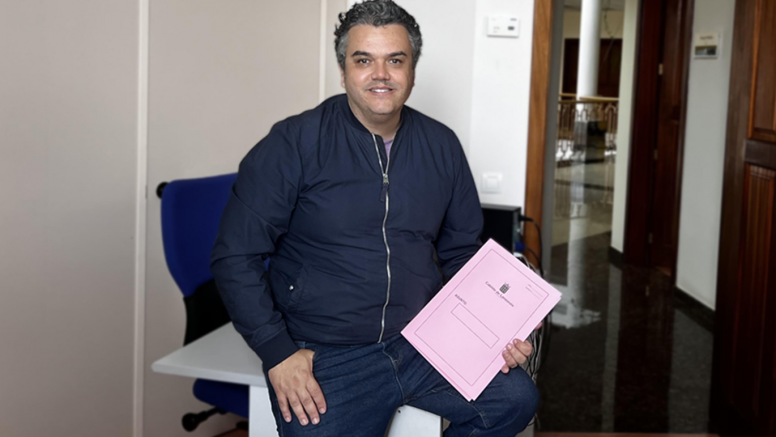
Armando Santana is a politician with extensive training in the hospitality sector. Last May, he assumed the third Vice Presidency of the Cabildo and the areas of Commerce and Consumption, Citizen Participation, Open Government, and Animal Welfare. Furthermore, he created a new specific area specialized in Hospitality, which he presented last September.
In an interview with the radio program Más de Uno Gourmet on Radio Lanzarote-Onda Cero, he analyzes the situation of the hospitality industry in Lanzarote, highlights the virtues of hospitality training for achieving better salaries, and outlines his plans to support the sector from the Cabildo.
-
How did the idea arise to give the hospitality sector greater representation in the Cabildo through its council?
60% of the wealth generated in Lanzarote is linked to the hospitality industry. We are talking about more than 25,000 people on this island who live off the sector.
That is why I have always thought that it should have a dignified and important place within the administrative structure, be it city councils, the Cabildo, or the Canary Islands Government itself, because we are talking about an essential industry.
The proposal to create a specific area was the first thing I told the President of the Cabildo when I joined the government, and he also saw it as a goldmine.
- It's a sector you have a lot of experience in, isn't that right?
I trained in the hospitality field, I did hotel management, then I have a master's degree from the Hague school and I specialized in hotel management and direction, and then as a result of my studies I dedicated myself to training
I was a professor at the hotel school in Teguise and then I provided training for hotel chains. I have also worked for gastronomic consultancies, in wine distribution, and I also had my own hospitality business.
- It honors him to assume political functions that he knows perfectly…
It's an advantage, although a politician doesn't have to know everything when they enter an administration. That's what the capacity, often intellectual, to let yourself be advised by people who know is for.
- Will there be synergies with Saborea Lanzarote?
Saborea Lanzarote is for external promotion, but we have to be very closely linked to carry out projects like the Hospitality Day that we celebrated in Marina Lanzarote for the first time on the island.
We recognized people who have made island history through their work, as well as the new hospitality sector, especially those who are starting businesses.
That event was beautiful because we did it through coordination with the employers' association, Saborea Lanzarote, and the new Department of Hospitality that I represent.
- What are your priorities?
I believe we have a very big problem on the island, and that is the lack of qualifications and professionals
I know people who haven't been able to open a hospitality business because they don't have staff, or who have had to close a hospitality business that was working
- How is it possible that the Lanzarote hotel school closed?
I suffered through that. At that time, everything was much more complicated; there was debate about whether management should be municipal through Teguise or through the Cabildo. That is one of the great thorns we've had with the profession and training on this island
When you travel a bit and go to Switzerland, France, or the Scandinavian countries, you realize that there a head chef has the same prestige, the same reputation as, for example, a doctor might have.
The kitchen has now truly gained significant prominence due to television programs, where it seems everyone wants to be a chef, but then there are other departments like the dining room, which I believe are totally neglected.
- How do we strengthen training?
Training is very complicated when there is full employment in the hospitality industry. People who are working don't want to be trained, and they can even afford to say: "Look, I'm leaving because tomorrow I'm starting at another restaurant that's offering me a better salary than you were giving me."
But we have to be there, motivating them and explaining that with better training and qualifications, they will have better salaries, they will get promoted, and above all, they will have many more opportunities
- What other issues do you want to prioritize?
We want to make efforts within the area's competencies on issues as in-demand as digitalization, which is very important, there are very interesting challenges starting now for establishments.
We are also talking about sustainability, about waste reduction as the hospitality industry's commitment to the environment.
I also believe that counseling can be a good communication channel between employers, the island's producers, and workers. With dialogue and consensus, we can achieve interesting things.
- It is fundamental to support our farmers and ranchers…
There are brave restaurateurs, I call them patriots, in the sense that they defend their land by betting on products from the island, or from the Canary Islands, each in their own land betting on zero kilometers. When the director of a restaurant or hotel decides to bet on local products, they are ensuring that a large part of tourist spending stays here.
Furthermore, when a tourist decides to have wine from Lanzarote, or try cheese from the island, they are not only satisfying a physiological need, but they are also enriching their experience with the island of Lanzarote. And the Cabildo of Lanzarote must be there to recognize and, above all, reward those who truly commit to the island's product.
- What are your most imminent projects in hospitality consulting?
We are preparing several agreements with training centers, including with the University of Las Palmas, to promote related studies linked to gastronomy.
Then, we will dedicate ourselves mainly to generating that table, which I believe is extremely necessary, where there will be many stakeholders, so that the decisions regarding the policies we will implement in relation to hospitality are truly guided by the people involved in the sector.
Add La Voz de Lanzarote as a preferred Google source.
Stay informed with the latest current news.