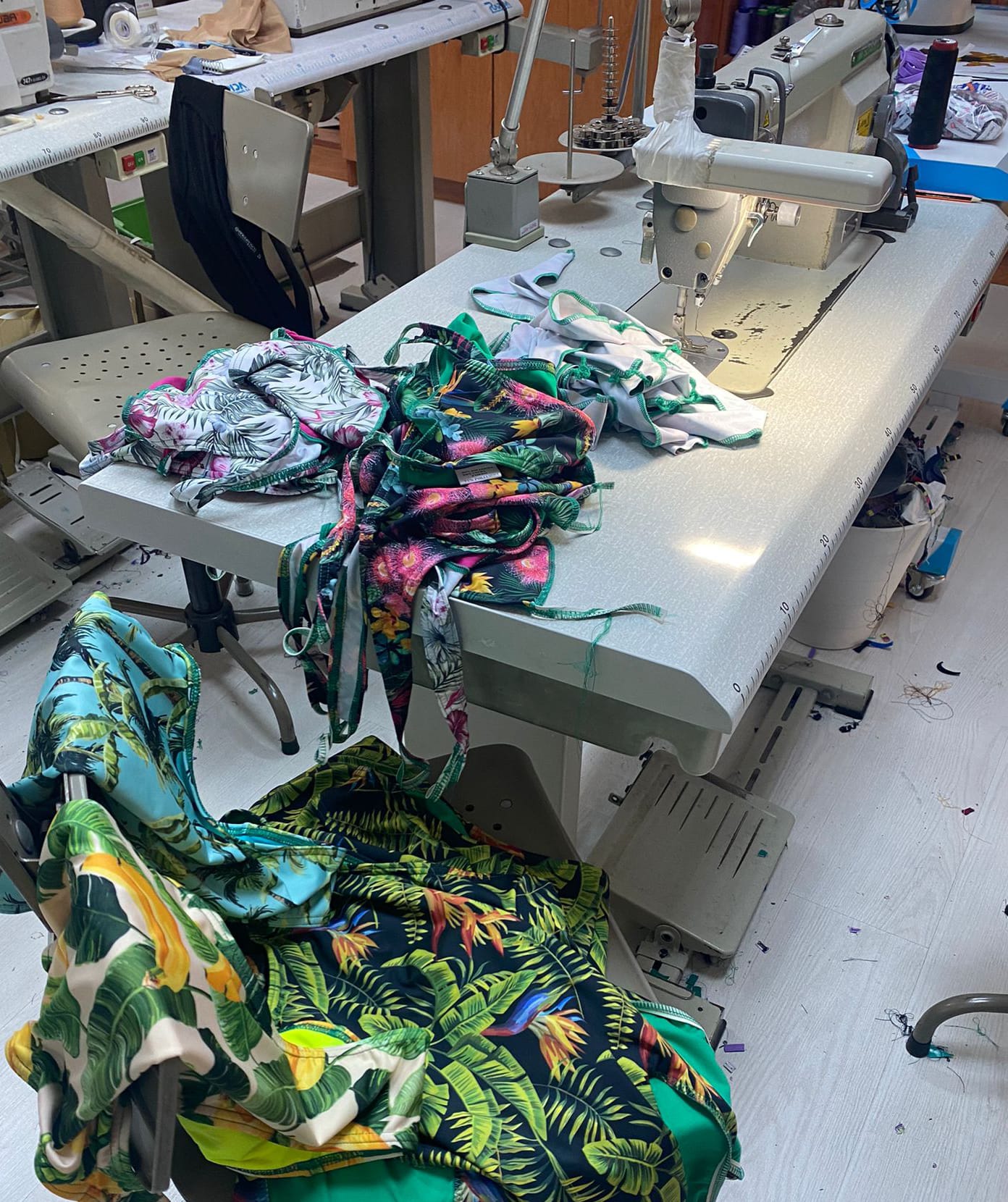
Do you know how many t-shirts you have? Are they made of ecological or recycled materials? When you buy, do you think about whether the manufacturing process has been fair?
These are some of the questions that Lanzarote entrepreneurs Visi and María, founders of the fashion brands Macaronesia and Alava Brand, ask themselves daily.
Both seek to bet on a more sustainable and fair type of sale called slow fashion, away from mass productions and seeking to give added value with the quality of their garments.
Slow fashion “slow fashion” versus fast fashion “fast fashion”
“Slow fashion is committed to a type of consumption focused on a thoughtful purchase, with more versatile quality designs that last over time, always from the point of view of sustainability and recycling”, explains María González, founder, together with Cristina Limousin, of Alava Brand, a small clothing brand from Lanzarote.
“It is fair trade, where fewer garments are produced, but of higher quality”, says Visi González, founder of the Lanzarote swimwear brand Macaronesia. “My brand is framed in this context because, in addition, we are in line with the environment, we do not use plastic packaging, we recycle materials and we even sublimate the merchandising with natural inks”.
For its part, fast fashion seeks to produce in mass for a mass audience through its numerous clothing collections, which follow the latest trends. In addition, garments tend to be manufactured quickly and at a very low cost, generating a great environmental impact.
Without going any further, a basic t-shirt of about 200 grams of cotton can require up to 2,000 liters of water for its preparation, according to calculations by the Water Footprint Network, so this type of production tends to leave an even more notable water footprint.
The insatiable obsession with buying, ¿incentivized by the textile giants?
However, the entrepreneurs place the consumer as an indispensable part of the puzzle that fights against the climatic impact of the sector.
“Consumers have a lot of power, if they start demanding and betting on slow fashion brands, things will change”, says María. “I'm not saying don't buy at Zara, because it's very difficult, but maybe it's not your only place to buy, in the end it's an internal process”.
“We have an awareness problem”, says Visi. “We are obsessed and used to buying a lot of clothes unnecessarily, you only have to see the stir that the arrival of Primark to Lanzarote has caused”.
However, it does not take away blame from the businesses themselves for “incentivizing that compulsive purchase with their new collections”.
“The new is what calls us and everything is placed strategically to attract the consumer's attention and buy”, he argues. “Slow fashion brands, like mine, tend to make more timeless garments, which do not necessarily go in line with the trends of that year”, that is, “they do not go out of style”.
Both businesswomen believe that the key is in the “education of the consumer”, so that they learn to “value more the labor and the origin of the product, because maybe you don't need to buy three t-shirts every three months”.
Higher costs and smaller sizes, the price to pay for higher quality
However, not everyone values or can access this type of slower and fairer fashion. In recent days, messages have been read on Twitter defending fast fashion with the premise that it has more accessible prices and a wide range of sizes, which goes beyond XL.
"If Shein closes, the truth is that I don't know where I'm going to dress, because nothing fits me in the rest of the stores", commented a user of the social network.
For its part, Visi's business confirms this reality and admits that, despite the use of fabrics during the production process, they tend to be very limited units, in number and sizes.
“I don't usually exceed six units per size in garments with plain colors, and when it comes to printed swimsuits, there are trikinis of which there is only one S and one M, very exclusive”, says the founder of Macaronesia.
In addition, she adds that the prices of companies like hers can limit some sectors of the population because not everyone can “afford to pay” what the garments cost. “In the end we all end up buying in the big textiles because they have cheaper prices”, she admits.
María agrees and insists that “the problem in Spain is that the consumer has the Inditex price very marked”. “Some friends tell me “I would pay 70 euros for that shirt (which costs 170)”, but if I lower it to that price, I lose money”, she adds.
“How do you fight or how do you make people understand that it is not that you are selling something at this price because you want to, it is because it is what it costs”, justifies the founder of Alava Brand. “We want to make people understand this, we do practically everything ourselves and the price is the price if we want to maintain the quality”.
The debate on social networks arose as a result of a hoax that pointed to the closure of Shein, after the approval of the “European Green Pact”, a measure that aims to gradually end the polluting model of fast fashion businesses such as this textile giant.
The problem of shipments in Lanzarote raises prices
It should be noted that for brands such as Macaronesia and Alava Brand, located in a small piece of land in the middle of the Atlantic, the road is complicated. Despite having a very small team, with modest productions that are more like handicrafts, both have been forced to carry out part of the process outside of Lanzarote.
“Macaronesia is a 100% Canarian brand, but I have not yet managed to have the production done entirely in Lanzarote”, confesses Visi. “For me it was already a milestone to be able to bring the sublimation process from Barcelona to the archipelago, because the process is very expensive, especially the shipments”.
For its part, part of the collection of María's business was produced in the Basque Country because the “expenses were much lower”.
“We start from the fact that many brands do not ship to the Canary Islands and much less to Lanzarote”, says the founder of Alava Brand. “It makes no sense because we are also Spain”.
In addition, she points out that the companies that do send do so with “very high costs and always arrive late”, not to mention the customs, which charged her “more than 200 euros” for the shipments of the last collection.
This means that shipments to Lanzarote become more expensive by up to “more than 50%” compared to the peninsula. “It's really impossible”, insists María. “The day will come when I will have to decide between being as sustainable and as coherent as possible or being a fast fashion”.
“One wants to have a good price, but in the end you realize that either you are a Shein or you have to manage it like this”, she adds.
However, with her latest collection and the help of Oswaldo Machín's workshop, they have made their dream come true: bringing all the production to the island.
“In the end, doing it in the Basque Country did not allow me to carry out certain control processes from Lanzarote, it was a mess”, explains María.
The future of fashion will be sustainable or it will not be
In short, both Visi and María agree that slow fashion will not be able to prevail against textile giants, but they do believe that the latter will improve their sustainable policies over the years.
“Large companies are realizing that they have to change, adapt to a more ecological model”, explains María. “Fast fashion is not going to disappear, so the ideal is that they have greater regulation and coexist more with businesses like ours”.
For its part, the European Union has already begun to take measures in this regard. Specifically, with its so-called “Green Pact” they intend to achieve "a greener sector" and, for this, they propose a transition route towards that sustainable model, that is, the textile giants are not going to disappear overnight, but will have a period of adaptation.
In that line, Visi insists that in order for businesses like hers to survive multinationals have to establish regulations. “If you regulate the big ones so that they comply with the rules, prices will rise and they will be equated with ours”, says the founder of Macaronesia and adds that small businesses should have “more discounts or tax breaks” to survive.
Add La Voz de Lanzarote as a preferred Google source.
Stay informed with the latest current news.