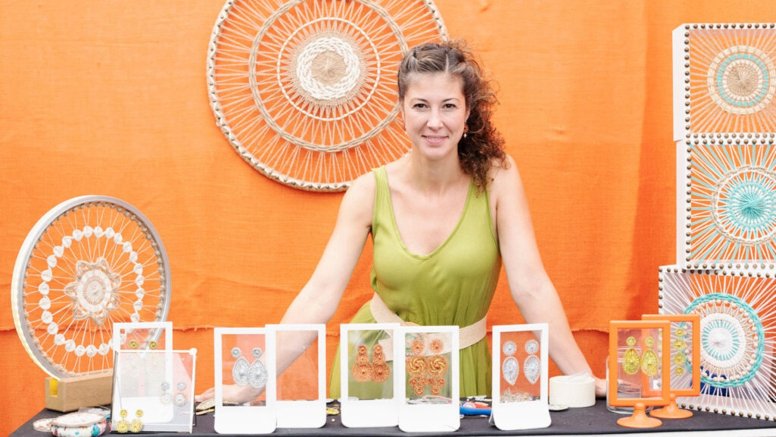
The rabbit breeder Estefanía González is today one of the great experts in rosetas of the island, both for her creations and for the workshops she teaches, in addition to many other traditions that she is recovering and spreading in the schools of the island.
However, when at 17 years old she decided to study Physical Education nothing seemed to indicate that this would be her path. She studied the degree in Gran Canaria and in Barcelona, where she realized “the importance that people gave to maintaining the singularities of the place.”
“I wanted to open a tourist-sports company in Lanzarote. My master's final project was to investigate what experiences the tourist has in Lanzarote and I realized that there were companies dedicated to windsurfing, kayaking, trekking, diving... but if someone wanted to make a mojo, a gofio, a roseta or an empleita, to have an authentic experience, there were not many options,” shares González.
Thus her company was born fifteen years ago: Experimenta lanzarote. She presented her project and got a space in El Monumento al Campesino. From there, she researched the different crafts such as ceramics, empleita and of course, the roseta. Estefanía learned above all with Carmen Darias, expert in traditional techniques.
“With the rosetas, the women of Lanzarote bartered”
The art of the rosetas was born in the Canary Islands at the end of the 19th century to decorate everyday household objects such as tablecloths, doilies or curtains especially in Lanzarote and Tenerife.
“In its beginnings there were different shops in Lanzarote that provided the thread to the women. It was like a small industry, some were dedicated to the making of the roseta, others were dedicated to hemming them, that is, to joining some rosetas with others to create the tablecloth.”
“With the rosetas there was barter, they were given in exchange for vouchers for oil, clothes or fabric,” shares González.
“The rosetas are not the same in the north as in the south”
“The base of the roseta itself has to be even, a multiple of four, and it has three basic techniques: warping the roseta, doing the darning and making the knots, but, like any craft, it is not an exact science, the technique has been passed from mothers to daughters, but maybe the mother gives it another little touch and the grandmother gave it another little touch.”
In fact, González shares that the traditional rosetas made in the north of Lanzarote are not exactly the same as those made in the south of the island or in San Bartolomé.
“Craftsmanship is not lost because our elders die, but because we do not adapt it to the contemporary world.”
“I researched the technique and the different adaptations in different parts of the island, I did a selection and now I teach my workshops in the way that students understand most easily. Handicraft is not lost because our elders die, but because we do not adapt it to the contemporary world.”
For González it was important that anyone could make a rosette, whether a child or a tourist who does not know the language.” The first thing I did was give it a larger diameter so that it would be easier visually, then when warping, the first round I do in one color, and the second, in another color.”
Knowing the traditions and adapting them to the current world
From there arose her contemporary large and colorful rosettes that today decorate all kinds of objects, but also houses and businesses that give an undeniable Lanzarotean flavor to the spaces.
González’s twist with the rosettes is also recognized in the opposite, her smaller pieces for many other uses such as the creation of earrings or belts.
Experimenta Lanzarote also brings to the island’s schools, in collaboration with the Cabildo, the educational project Rincón de la tradición. "The children call me the culture teacher. We had the opportunity to teach 1,287 children to create their own mojo, many had not even tried it, the idea is to give our little ones signs of identity.”
“So that they know what is ours, give it the value it has, and so that tomorrow, when they see me at the handicraft fair, they don’t haggle with me,” jokes González.
Add La Voz de Lanzarote as a preferred Google source.
Stay informed with the latest current news.