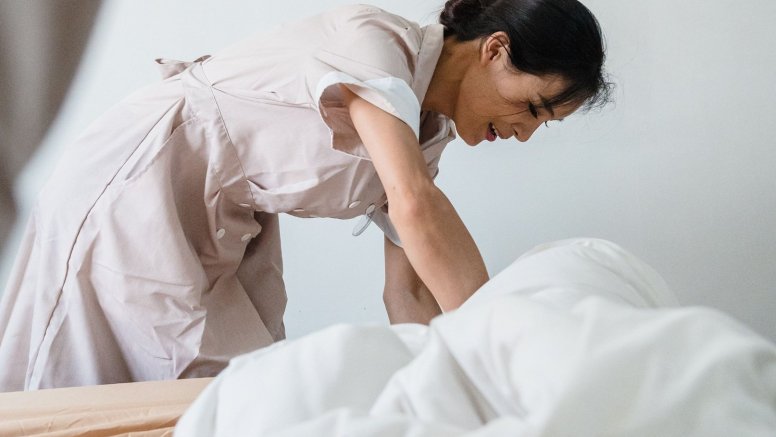
The Minister of Social Inclusion, Social Security and Migration, Elma Saiz, announced this Monday that the Government has approved the urgent processing of the modification of the list of occupational diseases to incorporate "an explicit reference to room attendants".
Saiz explained, before an assembly with room attendants organized by the UGT union in Palma, that the Council of Ministers approved last week to urgently update the catalog of occupational diseases and this Tuesday the proposal will be published with "a specific mention of the ailments and pathologies that room attendants have".
"Tomorrow the text will be submitted for public consultation so that we can have this modification as soon as possible, which will allow us to specify this incorporation and the pathologies considered," she added.
Saiz pointed out that this change implies that, when the processing is completed, those ailments that are "directly linked to their day-to-day activity and their work will be incorporated into the list of occupational diseases".
"We are talking about ailments that affect, among other areas, the shoulder, elbow, forearm, wrists - including carpal tunnel syndrome -, which are directly related to repetitive movements and sustained efforts, with the handling of loads specific to this activity," the minister detailed.
The recognition of these pathologies as occupational diseases will allow affected workers "to have the specific protection provided by an occupational contingency, and this has a direct consequence in terms of benefits and coverage by Social Security," according to the minister.
Furthermore, it will allow "to know the real dimension of these pathologies, have precise information and stop treating them as isolated situations."
Saiz stressed that "there are ailments that do not appear overnight, they are the result of years of effort, repeated movements and sustained physical demands."
"We cannot allow these injuries to be diluted under the consideration of a common illness, as if it were a simple cold, when they are directly related to the work you do," she emphasized.
Early retirement
She also referred to early retirement, the other major demand of the room attendant collective, some 150,000 workers throughout Spain and about 20,000 of them in the Balearic Islands, according to UGT.
Saiz recalled that in September a working group was created to analyze the new procedure for determining with objective criteria when the especially arduous conditions of an activity may justify the reducing coefficients for retirement, and announced that she has requested that they begin by analyzing the situation of the chambermaids.
"The first assignment I have given to this working group is to study precisely the work carried out by chambermaids, and the physical wear and tear of this profession will be analyzed," she indicated.
According to the minister, that of the chambermaids is "very hard work, exposed to risks derived from carrying out tasks that take a clear physical and mental toll."
The minister considered that "behind every impeccable room there is a female worker who has made a considerable effort and for too long has not received the recognition she deserves."
She emphasized that "one of the professionals who contributes most to the quality of the tourist experience is one of those who has had the least visibility" and praised the mobilization capacity of the group, which has led to the debate about their conditions being opened.
Add La Voz de Lanzarote as a preferred Google source.
Stay informed with the latest current news.