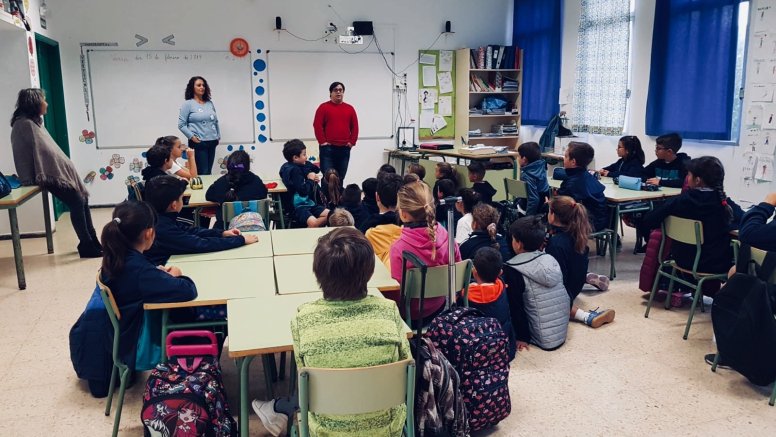
The back to school is just around the corner and will once again test the economy of Spanish households with an average back-to-school spending starting at 635 euros for public school, rising to 733 euros for private-subsidized schools, and reaching 1,849 euros for private schools.
According to the latest study by the Spanish Consumers Association, based on family surveys and price analysis in stores, costs vary significantly by autonomous community. The organization has called on schools to moderate their demands for books and materials, avoiding expenses on supplies that are then practically unused.
Canary Islands is in the upper-middle range of the national economic impact, being the sixth most expensive community as it requires a disbursement of 680 euros per student in public education. This figure places the islands above the state average in the public model, tying in spending with the Valencian Community and the Region of Murcia. For Canary Islands families opting for private-subsidized education, the average cost is 720 euros, while in private education it reaches 1,720 euros per student.
On the national map, the five communities with the most expensive public back to school are led by the Community of Madrid with 756 euros, followed by Catalonia with 735 euros and the Basque Country with 720 euros. Cantabria and Navarra complete this group of higher cost, both with an initial bill of 710 euros per student.
At the opposite end, the five autonomous communities where it is most economical to equip students for public school are the Principality of Asturias, which leads the table as the cheapest with 556 euros, followed by Galicia with 566 euros and Extremadura with 598 euros. Castilla-La Mancha with 605 euros and both Aragón and Castilla and León, tied at 610 euros, close this block of greater savings.
The rest of the autonomous communities show intermediate costs in public education. Andalusia registers a figure of 615 euros, while in La Rioja the spending reaches 620 euros. For its part, the Balearic Islands are slightly below the Canary Islands with an average of 673 euros.
To cushion this financial impact, the Spanish Association of Consumers recommends organizing purchases in advance and acquiring only what is necessary, avoiding impulses. It is essential to compare prices and qualities in different stores, as diversifying points of sale can generate significant savings on certain items.
Likewise, the entity advises to be well-informed about store return policies and to always keep purchase receipts for possible returns or claims, remembering that advertising is binding. If purchases are made online, users have 14 days to withdraw without penalty. In case of any irregularity, the official complaint form should be requested, also prioritizing the reuse of materials from previous courses as a tool for responsible consumption education.
Add La Voz de Lanzarote as a preferred Google source.
Stay informed with the latest current news.