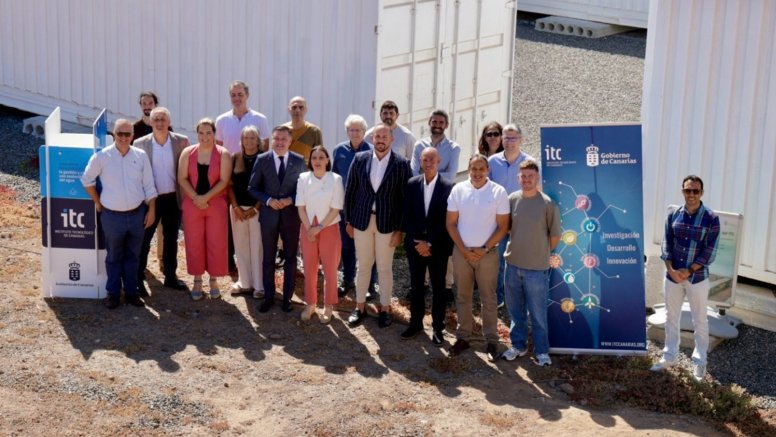
The Canary Islands Technological Institute (ITC) announced this Tuesday its new R&D&I Space located in the Gran Canaria Technology Park-Circular Economy Experimental Area, in Punta de Gáldar, a collaborative environment designed to accelerate the development of prototypes, pilots, and technological solutions with applications in key sectors for the sustainable development of the Archipelago, such as agriculture, the blue economy, or the digitized industry.
The event was attended by the Minister of Universities, Science, Innovation and Culture of the Government of the Canary Islands and president of the ITC, Migdalia Machín; the mayor of Gáldar, Teodoro Sosa; and the director of R&D&I of the ITC, Gonzalo Piernavieja.
Migdalia Machín recalled that the Government of the Canary Islands has supported the consolidation of the Gran Canaria Technology Park through the ACIISI, "because we believe that innovation must have spaces connected to the needs of the territory." The minister also highlighted that the presence of the ITC is key for this laboratory to "function as a tool to accelerate innovation through collaboration, bringing together technical teams, researchers, companies, and public entities around common projects."
The mayor of Gáldar, Teodoro Sosa, emphasized that the launch of this new R&D&I Space represents "one more step in the consolidation of La Punta Scientific and Technological Park as a benchmark in innovation, circular economy, and technological development in the Canary Islands."
He recalled that the transfer of the land by the City Council responded to a firm commitment to create a space at the service of the entire north of Gran Canaria, capable of generating opportunities for talent, research, and companies. In this sense, he stressed that "this park is no longer a project of the future, but a reality that continues to grow," thanks to the collaboration between administrations and the commitment of the administrations to diversify the economy and create qualified employment.
The R&D&I Space will allow the development of capabilities across the full spectrum of ITC's research and innovation areas, integrating specialized knowledge in scientific and technological computing, renewable energies, water technologies, biotechnology, circular economy, blue economy, and sustainability, among others. During the event, Migdalia Machín highlighted the value of this new environment as an open infrastructure for collaboration, designed to connect the capabilities of the Canary public technological institute with the needs of companies, administrations, universities, research centers, and innovative entities in the Archipelago.
The first initiatives deployed in this space have been driven by the ITC's Department of Scientific and Technological Computing. Its head, Juan Francisco Rodríguez, explained during the visit the technologies and capabilities currently active in the facilities, with solutions applied to process automation, advanced data management and processing, sensorization, the Internet of Things - IoT, artificial intelligence, robotics, modeling, and the development of intelligent monitoring and control systems. These tools allow for testing applications aimed at improving efficiency, reducing costs, strengthening operational safety, and facilitating decision-making in production and resource management environments.
Among the initiatives currently under development are the TEXTIL and INNOVABLUE projects, both co-financed by the Interreg MAC 2021-2027 program. TEXTIL works on solutions to move towards more sustainable and circular models in the textile sector, through image analysis and data processing technologies aimed at identifying, characterizing, and classifying fabrics, with potential application in material reuse, recycling, and valorization processes. INNOVABLUE, for its part, promotes the green and digital transformation of marinas and sports ports, through intelligent monitoring and management solutions based on IoT, data, and artificial intelligence, with the aim of improving the sustainability and efficiency of these environments.
Beyond these initial applications, the new R&D&I Space is projected as an open platform for developing solutions with impact in sectors that require greater technification, automation, and digitalization. Its configuration, with 120 square meters distributed in four modular containers, in addition to 180 square meters of outdoor space, allows for tests, demonstrators, and pilots to be carried out in conditions close to their real application, favoring the co-creation of solutions together with technology companies, research groups, and agents of the Canary innovation ecosystem.
The launch of this space is a demonstration of the strategic collaboration between agents of the Canary innovation ecosystem to promote new applied research projects, favor technological entrepreneurship, and generate opportunities linked to knowledge, innovation, and qualified employment. This alliance contributes to bringing scientific and technological capabilities closer to the Archipelago's productive fabric and to advancing towards a more competitive, diversified economic model connected with the real challenges of the Canary Islands.
Add La Voz de Lanzarote as a preferred Google source.
Stay informed with the latest current news.