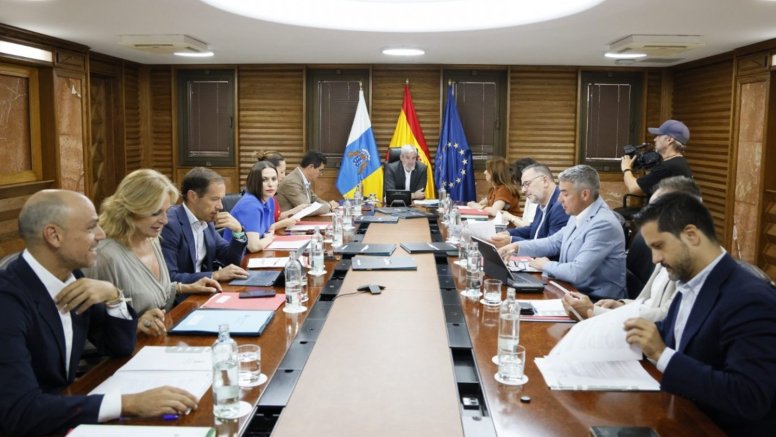
The Governing Council has approved this Tuesday, at the proposal of the Ministry of Finance and Relations with the European Union, headed by Matilde Asián, to set the limit of non-financial spending of the General Budgets of the Autonomous Community of the Canary Islands for the year 2027 at 12,912,662.81 euros.
This figure represents 769 million euros more than in the initial budget of 2026 and is the amount that the Government of the Canary Islands has to respond to the needs of the Canarians, mainly to cover the basic services of healthcare, dependency, education, and access to housing, to which the largest part of the budget is preferentially allocated.
With the communication of the non-financial spending limit, compliance is given to the Organic Law on Budgetary Stability and Financial Sustainability (LOEPSF), which obliges the autonomous communities to approve a maximum spending limit before August 1. From here, the Government of the Canary Islands begins the preparation of the budget for the next fiscal year, which must be submitted to Parliament before October 31 for subsequent processing.
This limit may vary depending on the amount of income foreseen for 2027 in terms of affected financing. Likewise, the limit may also undergo variations if there were changes in the fiscal rules established by the State.
Context of high uncertainty
On July 7, the Council of Ministers approved the proposal for budgetary stability and public debt objectives for all Public Administrations and each of their subsectors for the period 2027–2029 and the limit of non-financial spending of the State budget for the year 2027.
The proposal contemplated a deficit of -0.1% of GDP for the autonomous communities and a public debt for all administrations of 97.6% of GDP in 2027, falling to 95.3% in 2029. However, the Congress of Deputies rejected these objectives on two occasions, the last one on July 23.
Therefore, as the stability path has not been approved, the only reference framework available is the Medium-Term Fiscal and Structural Plan (PFEMP) of the Kingdom of Spain 2025-2028, validated by the European institutions, which establishes for all Public Administrations a deficit target of 1.8% of GDP in 2027.
However, said plan does not distribute the financing need capacity among the different subsectors of Public Administrations. Consequently, the preparation of the non-financial spending limit is carried out in a context of high uncertainty regarding the applicable national budgetary and fiscal framework.
On the other hand, it is the responsibility of the Ministry of Economy to calculate the medium-term reference rate of growth of the Spanish economy's GDP to be taken into account by each of the autonomous communities in the preparation of their respective budgets. The Report on the Situation of the Spanish Economy 2026 forecasts a reference rate of 4% in 2027, 3.8% in 2028, and 3.6% in 2029.
For the preparation of the CAC budget, the central scenario analyzed by the Vice-Ministry of Economy and Internationalization of the Government of the Canary Islands has been considered the most plausible, which sets the nominal GDP of the autonomous community at 2.9% for 2027. In this case, an increase in the real GDP of the Canary Islands in 2026 of 2% is forecast, equivalent to an increase in nominal terms of 3,344 million euros. For 2027, a moderation of growth is forecast to a rate of 1% to grow by 0.9% in 2028.
Spending Rule and Non-Financial Spending Limit
As the new European fiscal framework has not yet been transposed into Spanish law, the deadline for which was December 31, 2025, the Organic Law on Budgetary Stability and Financial Sustainability (LOEPSF) remains in force. This law states that the variation in computable spending by the central administration, the autonomous communities, and local corporations may not exceed the reference rate of growth of the Spanish economy's Gross Domestic Product in the medium term.
The 2026 Report on the Situation of the Spanish Economy, prepared by the Ministry of Economy, includes the medium-term nominal reference rate of growth of the Spanish economy's Gross Domestic Product for the period 2027-2029, and places it at 4.0% for 2027. Therefore, the difference between the revenue forecast of 8% and 4%, which the autonomous community may allocate to cover the needs of all Canary Islanders, is obvious.
The non-financial spending limit for 2027 is determined by the spending rule, leading to an estimated deficit or financing need of 65.74 million euros for 2027, representing -0.1% of GDP.
What about revenue?
Regarding revenue from the financing system, the Ministry of Finance indicated that it would increase by more than 8%, including advances and the 2025 settlement. In this context, we have considered a total of 8,881.83 million euros, pending the communication of specific figures.
On the Canary Islands Financing Block (BFC), the Canary Islands Tax Agency carries out a linear projection of revenue and recognized rights as of June 2026. To estimate the 2027 fiscal year, it applies the macroeconomic variables calculated by the Vice-Ministry of Economy and Internationalization in its central scenario.
In relation to European funds, the necessary certifications are contemplated to comply with the financial sheet of the operational program corresponding to the 2021-2027 period.
And regarding state financing affected, the amounts included in the 2026 budget remain constant. Furthermore, in the road agreement, the annual amounts foreseen in the latest addendum have been taken into account, which amounts to 215,000,000 euros for the 2027 fiscal year. Likewise, the annual amount corresponding to the new state housing plan 2026-2030 is included, which includes an amount of 45,050,000 euros for the year 2027.
Add La Voz de Lanzarote as a preferred Google source.
Stay informed with the latest current news.