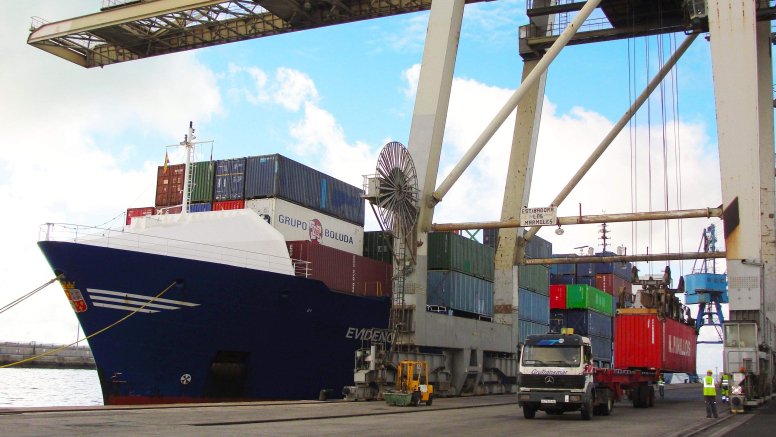
Despite the transaction lacking the formal authorization required by Spanish legislation, the Moroccan state-owned company Marsa Maroc already includes the acquisition of 45% of Boluda Maritime Terminals (BTM) in its balance sheets.
The commercial operation, agreed upon in December 2025 and valued at approximately 80 million euros, was frozen by the Spanish Government, which ordered an analysis by the Foreign Investment Board (Jinvex), a collegiate body involving strategic ministerial departments, the National Security Department, and the National Intelligence Center (CNI).
The Maghreb company, however, included the acquisition of 45% of BMT in its semi-annual financial report, effectively incorporating the Canary Islands and mainland terminals into its international network to boast a deployment of 35 terminals in 21 commercial ports.
Boluda manages a total of nine strategic logistics enclaves on the Spanish coast, including five key administrative concessions in the Canary Islands ports of Las Palmas, Santa Cruz de Tenerife, Arrecife, Puerto del Rosario, and Santa Cruz de La Palma, as well as four other facilities on the mainland.
Spain activated the reinforced control mechanism for non-EU capital investments in critical infrastructure to determine if Moroccan penetration compromises sovereign interests, in a sensitive diplomatic context following episodes such as the Ceuta border crisis or the Pegasus program espionage.
The resolution will set a precedent for the protection of Spanish port concessions against foreign capital and will define the geopolitical and commercial balance of power in the Atlantic corridor connecting Europe with West Africa.
For its part, the Moroccan press —through outlets such as H24Info, Barlamane, or Silicon Valley Maroc— has described Madrid's doubts as "absurd reasons" aimed at hindering the economic projection of the Alaouite kingdom.
In the face of the controversy, Boluda Corporación Marítima publicly defended the agreement, assuring that the Spanish shipping company will continue to "lead the management of the business, ensuring the continuity and stability of operations as well as decision-making."
In its official corporate communication, the group chaired by Vicente Boluda maintained that Marsa Maroc "will contribute its experience to promote new business opportunities" in the maritime corridor between Spain and Morocco, cataloging the alliance as "a significant step forward in its expansion process" on both shores of the Strait.
However, institutional reticence has erupted with particular intensity in the Archipelago. The president of the Cabildo of Gran Canaria, Antonio Morales, has led the criticism due to the risk that the state-owned company from the neighboring country gains access to port decision-making bodies. "Have we lost our minds, perhaps? It cannot be that the Moroccan public company Marsa Maroc —our most important direct competitor— buys 45% of Boluda and sits on the Board of Directors of the Port Authority of Las Palmas or Tenerife in this way," warned the island leader through his blog.
Canarian concern is intensified by the development of the Dajla megaport, planned on the coast of Western Sahara just 420 kilometers from Gran Canaria with an estimated investment of 910 million euros and scheduled to open in 2029.
Add La Voz de Lanzarote as a preferred Google source.
Stay informed with the latest current news.