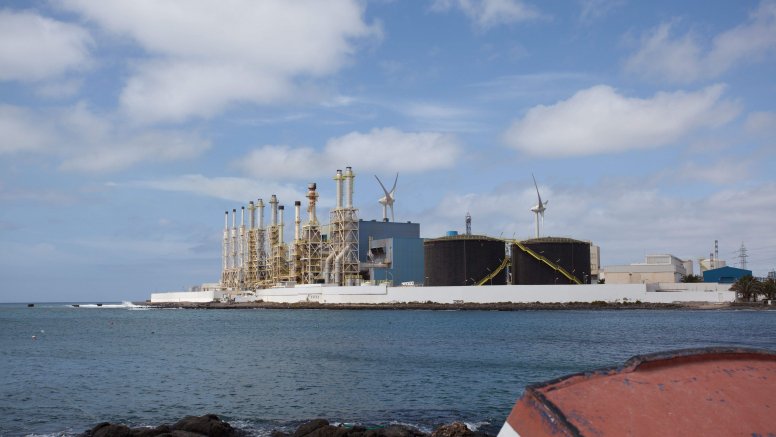
Lanzarote's electrical system is undergoing a structural divergence between what it consumes and what it is capable of generating in its own territory.
According to data from the Canary Islands Institute of Statistics (ISTAC), provided by the Lanzarote Data Center, the internal electricity demand on the island reached 898,190 megawatt-hours (MWh) in 2025, the highest figure in the entire historical series started in 1991. However, this consumption peak coincided with the largest deficit in self-production recorded to date.
During the past full fiscal year, gross production generated on Lanzarote soil stood at 740,889 MWh, representing a decrease of 0.8% compared to the previous year and leaving a negative gap of 157,301 MWh between energy demanded and locally produced.
In percentage terms, island infrastructures only covered 82.5% of electrical needs, compared to rates above 100% that were common less than a decade ago.
Renewable Stagnation and Thermal Dependence
To this loss of self-sufficiency is added the slow progress of the energy transition on the island. According to ISTAC's own records broken down by sources, barely 8.95% of the electricity produced in Lanzarote comes from renewable energies (7.73% from wind power and 1.22% from solar photovoltaic). This percentage places the island—along with La Palma, at 8.77%—at the bottom of the entire archipelago in terms of renewable share, far from the regional average of the Canary Islands (which exceeds 22% of electricity generation).
Historical evolution shows that, although clean production grew strongly during the last decade—doubling between 2011 and 2019 after the commissioning of new wind farms and solar plants, reaching around 9%-10% of generation—its relative weight in the island mix has been stagnant for several years below the 10% threshold. More than 91% of the electricity leaving Lanzarote facilities continues to depend on the burning of petroleum products in the thermal units of the Punta Grande power plant.
ISTAC's statistical series clearly reflects the change in cycle experienced by the island system. After reaching its historical peak of total generation in 2009, with 906,818 MWh, the island maintained a balance close to self-sufficiency until 2017, the year in which local production (890,844 MWh) still exceeded internal consumption (869,162 MWh) by more than 21,600 MWh, achieving 102.5% coverage.
From 2018 onwards, both curves began to diverge. While electricity demand recovered quickly after the halt caused by the pandemic in 2020 and 2021 —chaining four consecutive years of increase until breaking the previous record of 2017 in 2025—, generation in Lanzarote remained anchored in a range between 740,000 and 756,000 MWh annually, 17% below its production capacity recorded fifteen years ago.
The key role of the link with Fuerteventura
This mismatch makes the submarine cable connecting Lanzarote with Fuerteventura a critical piece for guaranteeing daily supply. As part of the same interconnected electrical system, the deficit of 157,301 MWh accumulated by Lanzarote in 2025 had to be compensated through net import flows from the neighboring island, multiplying by more than four the gap that existed before the health crisis (in 2019 the negative balance was 36,556 MWh).
Records available up to October 2026 confirm that pressure on the grid continues at maximum levels. Between January and October of this year, accumulated demand amounts to 768,478 MWh, 1% above the same period in 2025, with a monthly peak in August of 85,769 MWh, the highest monthly record in more than two decades. Although local generation showed signs of reactivation between August and October —raising the accumulated coverage rate for the first ten months to 83.6%—, the island maintains a deficit balance of 125,648 MWh so far this year.
Add La Voz de Lanzarote as a preferred Google source.
Stay informed with the latest current news.